
Database performance can make or break an application as data volume scales. When a database executes a query without an index, it performs a sequential scan—reading every single page on disk to locate matching rows. On tables with millions of records, this results in unacceptably high latency, high CPU usage, and I/O bottlenecks.Understanding Database Indexing.
Understanding database indexing: B-Trees, Hash Indexes, and GiST explained provides backend engineers and database administrators with the knowledge required to optimize database access patterns. Indexes are specialized data structures that maintain a sorted or mapped reference to table rows. Selecting the right index strategy dramatically speeds up read operations while minimizing storage and write overhead.
Key Takeaways
- Indexing Trades Read Speed for Write Overhead: Indexes significantly accelerate
SELECTqueries, but everyINSERT,UPDATE, orDELETErequires updating the index, incurring a minor performance cost. - B-Trees Are the Universal Default: B-Tree indexes excel at exact matches, range queries (
<,>,BETWEEN), pattern matching (LIKE 'prefix%'), and sorting operations (ORDER BY). - Hash Indexes for Point Lookups: Hash indexes specialize exclusively in exact equality comparisons (
=) with minimal memory overhead, but offer no support for range queries or sorting. - GiST Handles Complex Data Types: Generalized Search Trees (GiST) power queries on multidimensional, spatial (PostGIS), geometric, and overlapping range data structures that B-Trees cannot process.
- Strategic Indexing Beats Over-Indexing: Indexing every column bloats disk storage and degrades write throughput. Choose indexes based on query execution plans analyzed via
EXPLAIN ANALYZE.
What Is Database Indexing and How Does It Work?Understanding Database Indexing
A database index works like an index at the back of a textbook. Instead of reading every page to find a topic, you look up a key term in the index, grab the page number, and turn directly to the target content.
At the physical storage layer, database records reside on disk pages (blocks). An index creates a lightweight search structure mapping indexed column values directly to a Tuple ID (TID) or Row ID (RID). When a query runs, the database engine traverses the index, retrieves the exact row pointers, and fetches only the required disk blocks.
SQL
-- Standard unindexed table query triggers a full table scan
SELECT * FROM users WHERE email = 'dev@example.com';

-- Creating an index on the email column
CREATE INDEX idx_users_email ON users(email);
Deep Dive: Comparing B-Trees, Hash Indexes, and GiST
Different query patterns require different data structures. Below is an overview of the three most important indexing models.
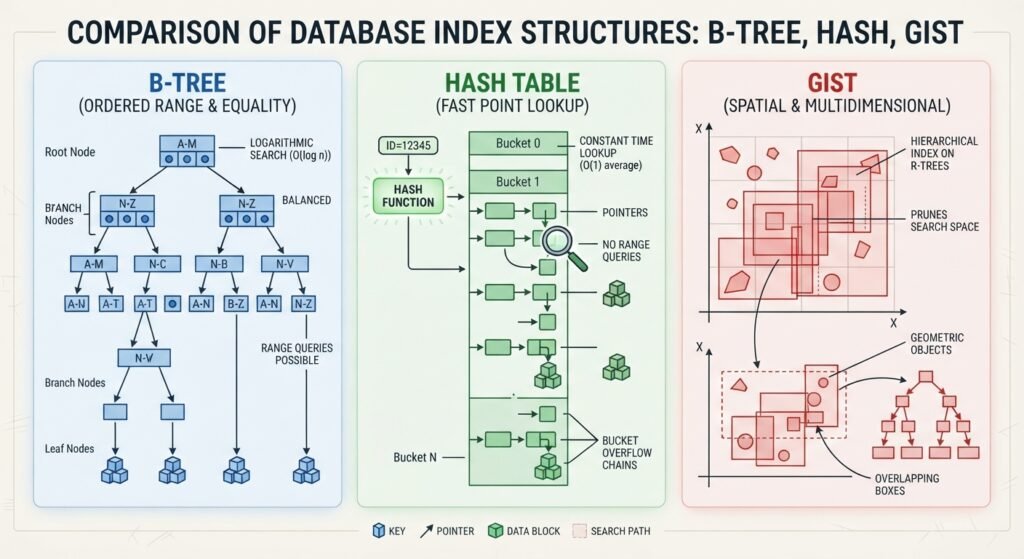
| Feature / Trait | B-Tree Index | Hash Index | GiST Index |
|---|---|---|---|
| Default Index Type | Yes (in PostgreSQL, MySQL, SQL Server) | No | No |
| Supported Operators | =, <, >, <=, >=, BETWEEN, IN, LIKE 'prefix%' | = (Equality only) | && (overlap), @> (contains), <@ (contained by), <-> (nearest neighbor) |
| Data Types | Scalar types (Integers, Strings, Timestamps, UUIDs) | Key-value pairs, hashable scalar keys | Geometries, Polygons, Ranges, Text Search, Vectors |
| Ordering / Sorting | Supports ORDER BY natively | Does not support sorting | Supports spatial nearest-neighbor ordering |
| Search Time Complexity | O(logN) | O(1) average case | O(logN) average case |
1. B-Tree Indexes: The Swiss Army Knife
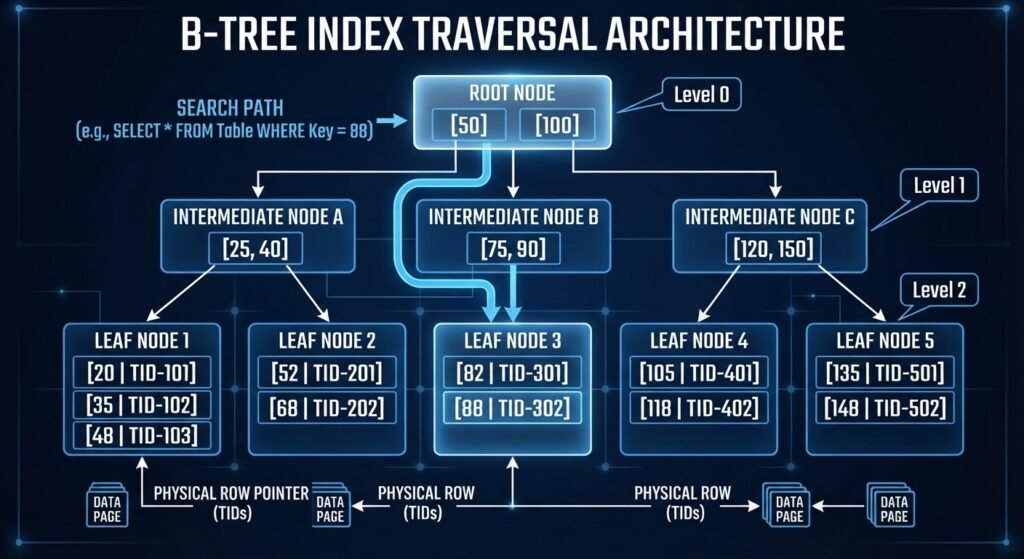
A B-Tree (Balanced Tree) is a self-balancing search tree structure that keeps sorted data and allows searches, sequential access, insertions, and deletions in logarithmic time.
How B-Trees Function
In a B-Tree, every leaf node sits at the exact same depth from the root. Leaf nodes are linked sequentially in a doubly-linked list, allowing the query engine to traverse ranges without returning to the root node.
When to Use B-Trees
- Exact value searches (
WHERE user_id = 42). - Range filtering (
WHERE created_at BETWEEN '2026-01-01' AND '2026-06-01'). - Sorting query results (
ORDER BY score DESC). - Prefix string matching (
WHERE username LIKE 'alex%').
SQL
-- Creating a composite B-Tree index for filtering and sorting
CREATE INDEX idx_orders_customer_date ON orders (customer_id, order_date DESC);
2. Hash Indexes: Ultra-Fast Equality Lookups
A Hash Index uses a cryptographic or non-cryptographic hash function to map an arbitrary column value into a 32-bit or 64-bit integer bucket address.
How Hash Indexes Function
When a query executes an equality search (WHERE key = 'value'), the database passes the search key through the hash algorithm to locate the matching bucket index directly, achieving O(1) constant-time lookup performance.
Limitations of Hash Indexes
- No Range Support: Because hash outputs are pseudo-random, adjacent input values do not land in adjacent buckets. Operations like
>,<, orBETWEENcannot utilize a hash index. - No Sorting: Hash buckets hold no inherent order, making
ORDER BYclauses ineligible for hash acceleration.
SQL
-- Creating an explicit Hash index in PostgreSQL
CREATE INDEX idx_sessions_token ON sessions USING HASH (session_token);
3. GiST Indexes: Generalized Search Trees for Complex Data
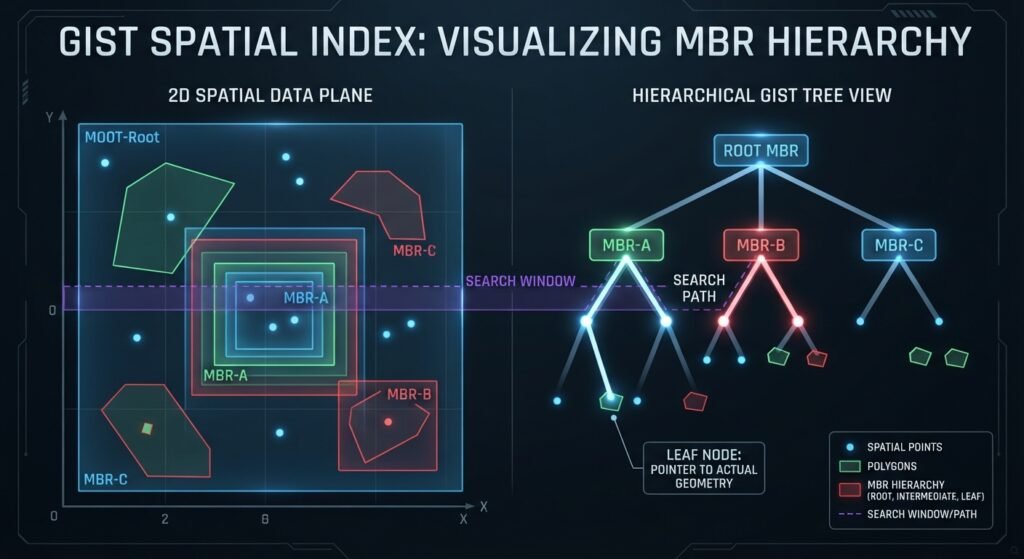
GiST (Generalized Search Tree) is an extensible, lossy tree-structured index framework. Rather than acting as a single fixed index type, GiST provides a template that allows developers to define custom lossy indexing rules for non-scalar data types learn Understanding Database Indexing
How GiST Functions
GiST uses a hierarchical tree where each internal node represents a bounding region (e.g., a Minimum Bounding Box for spatial points or an inclusive range interval).
Because GiST can produce false-positive matches at the index level, PostgreSQL automatically performs a secondary check on the actual table rows to discard non-matching candidates.
Primary Use Cases for GiST
- Spatial & GIS Queries: Searching locations within a polygon or finding points within X distance using PostGIS (
<->operator). - Overlapping Ranges: Querying date ranges or booking schedules to detect overlaps (
&&operator). - Full-Text Search: Querying document vectors for phrase matches and similarity.
SQL
-- Creating a GiST index on spatial geographic points
CREATE INDEX idx_locations_geo ON locations USING GIST (coordinates);

-- Querying nearest neighbors using the KNN operator
SELECT name FROM locations ORDER BY coordinates <-> POINT(-73.935242, 40.730610) LIMIT 5;
Best Practices for Designing a Database Indexing Strategy
- Index Foreign Keys: Always place indexes on foreign key columns to eliminate table scan locks during
JOINoperations and cascading deletes. - Utilize Partial Indexes: Reduce index size by indexing only the active subset of a table:SQL
CREATE INDEX idx_active_subscriptions ON subscriptions (user_id) WHERE status = 'active'; - Avoid Over-Indexing: Every additional index slows down
INSERTandUPDATEthroughput. Audit and drop unused indexes regularly using system statistics views.
Conclusion
Understanding database indexing: B-Trees, Hash Indexes, and GiST explained allows software engineers to build database schemas that scale gracefully under heavy query loads. Use B-Trees as your primary default for scalar range and sorting operations, select Hash Indexes when you need dedicated constant-time equality lookups, and deploy GiST when handling spatial data, geometric shapes, or overlapping intervals.
Frequently Asked Questions (FAQs)
What is the default index type in most relational databases?
In almost all major relational databases—including PostgreSQL, MySQL (InnoDB), and SQL Server—the B-Tree (or B+ Tree) is the default index type created when executing CREATE INDEX without specifying a type.
Why are B-Trees preferred over Hash indexes for general database queries?
B-Trees support range searches (<, >, BETWEEN), pattern matching (LIKE 'prefix%'), and ORDER BY sorting. Hash indexes only support exact equality matches (=), rendering them unsuitable for most common database queries.
What makes GiST indexes different from standard B-Tree indexes?
While B-Trees require strict one-dimensional sort ordering, GiST indexes handle multi-dimensional, spatial, and composite data (such as geometric shapes, PostGIS points, and range intervals) by using hierarchical bounding regions.
Understanding Database Indexing
1 thought on “Understanding Database Indexing: B-Trees, Hash Indexes, and GiST Explained”