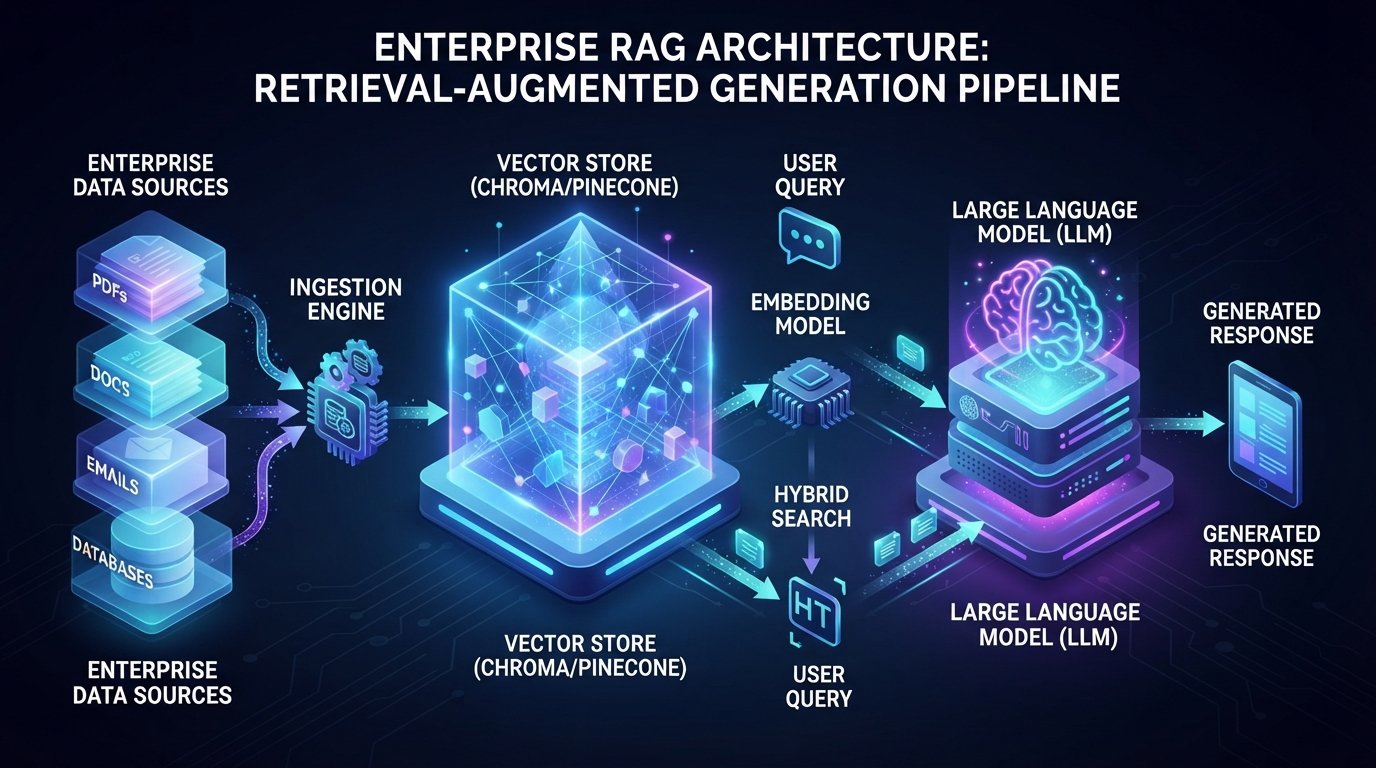
Large Language Models (LLMs) excel at reasoning and natural language understanding, but they suffer from two major limitations in enterprise settings: static knowledge cutoffs and a tendency to hallucinate non-existent facts. Training or fine-tuning proprietary models on enterprise data is often prohibitively expensive, slow, and risky regarding data privacy.
How to build an enterprise Retrieval-Augmented Generation (RAG) pipeline with vector databases is the industry-standard blueprint for grounding AI applications in verified enterprise domain knowledge. By combining real-time document indexing, high-density vector search, and contextual prompt augmentation, enterprises can deploy secure, accurate, and context-aware AI assistants without modifying underlying model weights.learn how to Build an Enterprise Retrieval-Augmented Generation .
Key Takeaways(Build an Enterprise Retrieval-Augmented Generation )
- Grounding Eliminates Hallucinations: RAG injects authoritative, real-time enterprise documents directly into the LLM’s context window, ensuring verifiable, fact-based responses.
- Vector Databases Power Semantic Search: Vector databases (e.g., Pinecone, Qdrant, Milvus, pgvector) index high-dimensional embeddings to perform sub-second similarity searches over millions of unstructured documents.
- Hybrid Search Is Essential: Enterprise RAG systems must combine dense vector search (semantic intent) with sparse lexical search (BM25 for exact keyword matching, serial numbers, and codes) for optimal retrieval accuracy.
- Advanced RAG Patterns: Production systems go beyond basic chunk-and-embed pipelines—employing query rewriting, parent-document retrieval, reranking models, and contextual compression.
- Security & Governance First: Role-Based Access Control (RBAC), document-level permissions, and data loss prevention (DLP) must be enforced at the retrieval layer before context hits the LLM.
What Is an Enterprise RAG Pipeline?
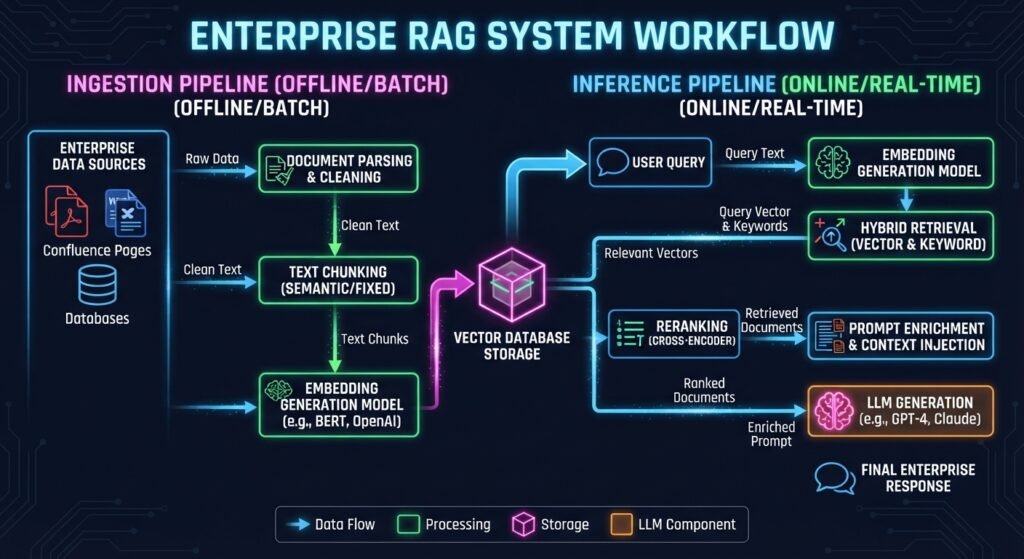
An enterprise Retrieval-Augmented Generation pipeline is a dual-phase system comprising an Ingestion Pipeline (offline data preparation) and an Inference Pipeline (real-time query execution).
Build an Enterprise Retrieval-Augmented Generation
Unlike consumer RAG applications, enterprise RAG must handle complex document formats (PDFs with tables, PowerPoint decks, Notion pages), enforce strict security access rules, support incremental index updates, and maintain strict SLAs for query latency.
Core Components of an Enterprise RAG Architecture
1. Document Parsing & Chunking Engine
Raw enterprise files must be parsed and split into manageable text segments (“chunks”).
- Fixed-Size Chunking: Simple character or token counts (e.g., 512 tokens with 10% overlap). Fast, but can slice sentences across logical boundaries.
- Semantic & Hierarchy Chunking: Splits documents based on logical structure (headers, paragraphs, tables) or sentence-transformer boundaries, preserving complete thoughts and context.
2. Embedding Generation Model
An embedding model converts text chunks into numerical vectors (e.g., 1536-dimensional vectors) where semantically similar concepts sit close together in vector space. Popular enterprise choices include OpenAI text-embedding-3, Cohere Embed v3, and open-source models like BGE-Large.
3. Vector Database (Vector Store)
Vector databases specialize in storing, indexing, and querying high-dimensional vectors at scale using Approximate Nearest Neighbor (ANN) algorithms like HNSW (Hierarchical Navigable Small World) or IVF (Inverted File Index).
| Vector Database | Type | Key Strengths |
| Pinecone | Fully Managed SaaS | Low maintenance, auto-scaling, built-in metadata filtering. |
| Qdrant | Open-Source / Cloud | Rust-native speed, rich payload filtering, hybrid search native. |
| Milvus | Distributed Open-Source | Highly scalable for multi-billion vector enterprise datasets. |
| pgvector (PostgreSQL) | Database Extension | Integrates vector search directly into existing relational Postgres infrastructure. |
Step-by-Step: Building the Enterprise Ingestion & Retrieval Pipeline
Step 1: Data Ingestion and Metadata Enrichment
When loading documents, enrich every vector payload with strict security and source metadata:
Python
# Conceptual payload structure for an enterprise vector record
vector_record = {
    "id": "doc_89432_chunk_04",
    "values": [0.012, -0.045, 0.089, ...],  # High-dimensional embedding vector
    "metadata": {
        "document_id": "doc_89432",
        "title": "2026_Q2_Financial_Policy.pdf",
        "tenant_id": "enterprise_corp_a",
        "allowed_roles": ["finance_admin", "executive"],
        "source_url": "https://internal.sharepoint.com/policies/89432",
        "created_at": "2026-03-15"
    }
}
Step 2: Implementing Hybrid Search with Metadata Filtering
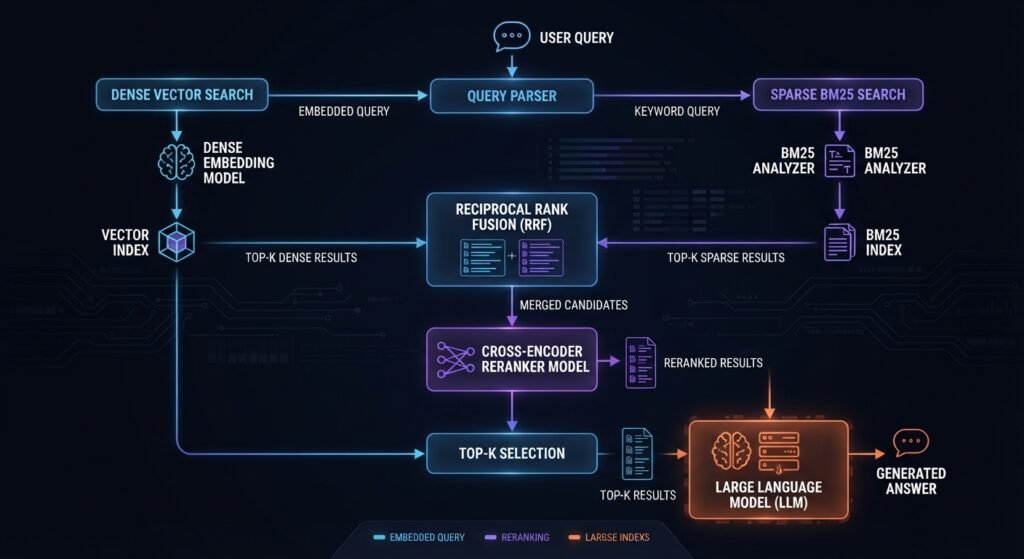
Dense vector search captures semantic meaning (“financial forecasts”) but can miss exact codes, names, or alphanumeric SKUs (“ERR-404-B”). Hybrid search merges dense vectors with sparse lexical search (BM25):
$$\text{Hybrid Score} = \alpha \cdot \text{Dense Similarity} + (1 – \alpha) \cdot \text{Sparse BM25 Score}$$
Metadata filters must run pre-retrieval to discard chunks the user lacks authorization to view:
Python
# Querying vector database with pre-filtering for RBAC
query_response = vector_store.query(
    vector=user_query_embedding,
    top_k=20,
    filter={
        "tenant_id": {"$eq": "enterprise_corp_a"},
        "allowed_roles": {"$in": user_session.roles}
    }
)
Step 3: Reranking Candidate Chunks
Vector databases use fast spatial distance metrics (Cosine Similarity, Dot Product) to retrieve top candidates (e.g., Top 20-50). However, passing 50 chunks to an LLM increases cost, latency, and noise.
Applying a Cross-Encoder Reranker (e.g., Cohere Rerank, BGE-Reranker) evaluates the query and document chunks together to output a precise relevance score, trimming candidate sets down to the Top 3-5 most pertinent context blocks.
Advanced Enterprise RAG Optimization Techniques
1. Parent-Document Retrieval
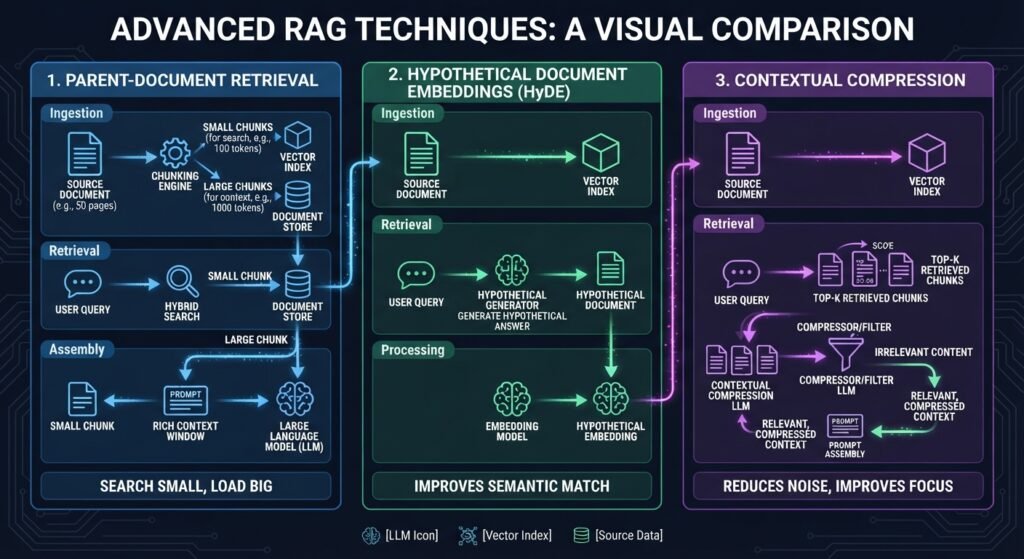
Small text chunks (128-256 tokens) generate superior, precise embedding vectors during search. However, LLMs require broader context to generate coherent answers. Parent-document retrieval indexes small child chunks for vector search, but retrieves the larger parent block (1024+ tokens) to supply as context to the LLM.
2. Hypothetical Document Embeddings (HyDE)
Instead of embedding a user’s raw question, HyDE instructs an LLM to generate a hypothetical answer first. The system then embeds that hypothetical answer and searches the vector store for matching actual enterprise documents, improving vector alignment.
[External Link: Insert high-authority external URL about Official Vector Database Benchmarks with anchor text “industry vector database performance benchmarks”]
Enterprise Security, Compliance, and Monitoring
- Access Control (RBAC/ABAC): Integrate vector retrieval directly with enterprise Identity Providers (Okta, Azure AD). Never return context vectors for documents a user cannot access in source systems.
- Citation and Source Auditing: Always force the LLM system prompt to cite source document IDs and URLs inline for human verification.
- Observability and Evaluation: Use evaluation frameworks like Ragas or TruLens to continuously monitor three core RAG metrics:
- Faithfulness: Is the response derived solely from the retrieved context?
- Answer Relevance: Does the response address the original user query?
- Context Precision: Did the retriever fetch clean, non-noisy document chunks?
Conclusion
Mastering how to build an enterprise Retrieval-Augmented Generation (RAG) pipeline with vector databases gives organizations a decisive competitive edge. By combining robust document ingestion, hybrid search with metadata security filters, cross-encoder reranking, and continuous evaluation, enterprises can unlock the transformative power of Large Language Models while maintaining strict governance, zero hallucinations, and high system reliability.
Frequently Asked Questions (FAQs)
What is the difference between fine-tuning an LLM and building a RAG pipeline?
Fine-tuning updates model weights to adapt its style, tone, or domain terminology, but it is expensive and cannot easily forget stale data. RAG keeps the model weights frozen and supplies up-to-the-second internal knowledge dynamically in the context window.
Why is hybrid search necessary in an enterprise RAG pipeline?
Pure vector search relies on semantic similarity and can miss exact string matches like product part numbers, policy codes, or names. Hybrid search combines dense vector search with sparse keyword search (BM25) to cover both semantic intent and exact phrase matching.
Which vector database is best when building an enterprise RAG pipeline?
The best vector store depends on your stack: Pinecone offers hands-off SaaS simplicity; Qdrant and Milvus provide high-throughput open-source control and custom hosting; while pgvector allows teams already using PostgreSQL to maintain a single unified database system.Build an Enterprise Retrieval-Augmented Generation
1 thought on “How to Build an Enterprise Retrieval-Augmented Generation (RAG) Pipeline with Vector Databases Explained”