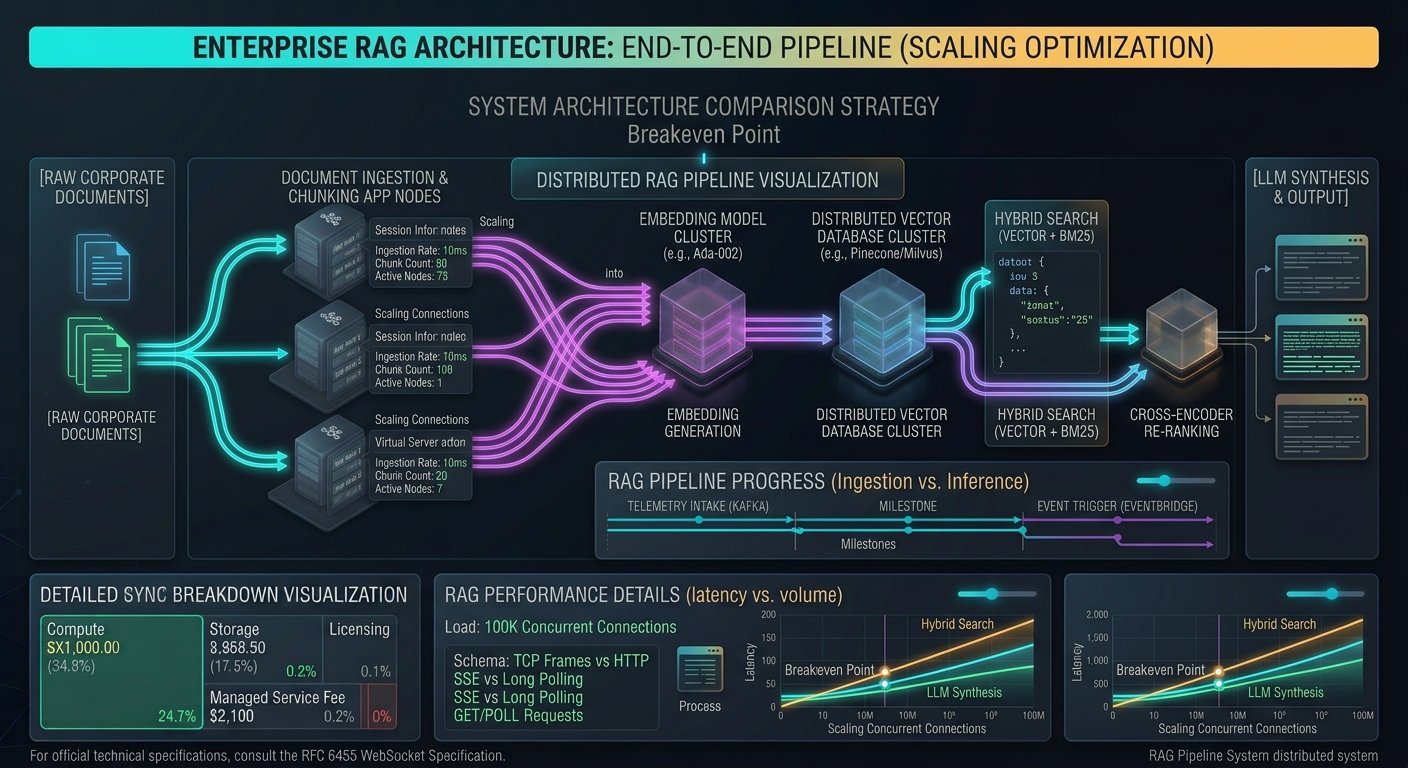
Enterprise Retrieval-Augmented Generation Pipelines building a proof-of-concept Retrieval-Augmented Generation (RAG) chatbot over a small folder of PDFs is straightforward. However, scaling that prototype into a production-grade enterprise system handling terabytes of messy internal documentation, strict security compliance, and low-latency response requirements is an entirely different challenge. Enterprise users demand accuracy, deterministic grounding, and zero data leakage.
Mastering how to build an enterprise Retrieval-Augmented Generation (RAG) pipeline with vector databasesrequires moving beyond default settings. It demands an intentional architecture spanning smart document ingestion,hierarchical chunking, vector embedding consistency, hybrid search execution, and cross-encoder re-ranking.
This comprehensive guide breaks down the technical blueprint, architectural trade-offs, and step-by-step strategies required to deploy a production-ready enterprise RAG system.
Key Takeaways
- Smart Chunking over Fixed Sizing: Naive character-based splitting shreds semantic context. Enterprise pipelines require semantic or hierarchical chunking to keep tables, headings, and related paragraphs intact.
- The Power of Hybrid Search: Vector search excels at conceptual similarity but fails at exact keyword or part-number lookups. Combining dense vector retrieval with sparse BM25 keyword search via Reciprocal Rank Fusion (RRF) is essential.
- Precision Cross-Encoder Re-Ranking: Bi-encoders score broad semantic matches quickly, but high-precision cross-encoders must re-score top candidate chunks before injecting them into the LLM context window.Performalytic
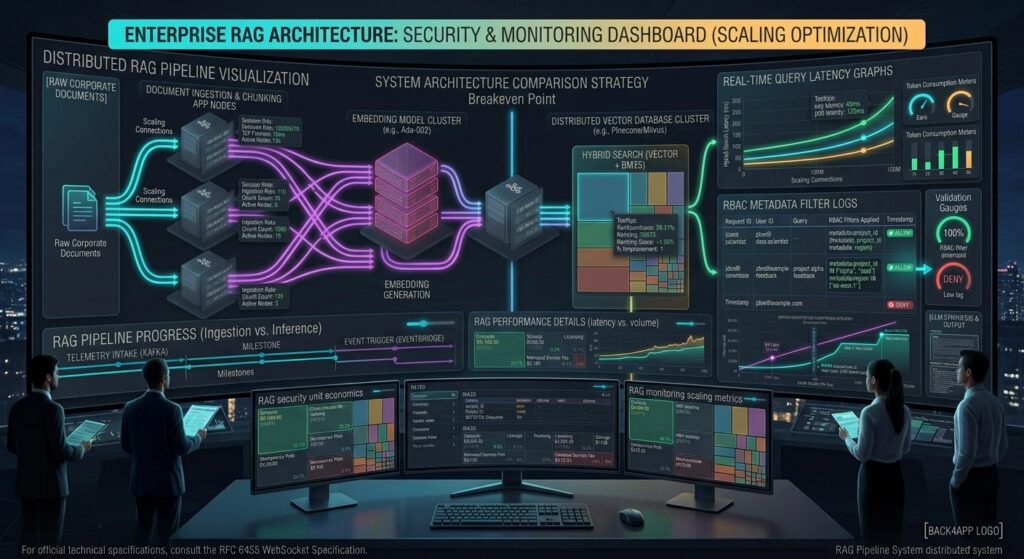
- Enterprise Security and Governance: Production systems must enforce strict role-based access control (RBAC) at the vector database retrieval layer to prevent unauthorized document exposure.
Deconstructing the Enterprise RAG Architecture
A production RAG pipeline operates across two distinct lifecycle phases: the Ingestion Pipeline (offline processing of source data) and the Retrieval & Generation Pipeline (online execution of user queries).
┌────────────────────────────────────────────────────────────────────────┐
│                   ENTERPRISE RAG LIFECYCLE ARCHITECTURE                │
├───────────────────────────────┬────────────────────────────────────────┤
│ INGESTION PIPELINE (Offline)  │ RETRIEVAL & GENERATION (Online)        │
├───────────────────────────────┼────────────────────────────────────────┤
│ 1. Document Extraction (PDF,  │ 1. User Query Embedding Generation     │
│    HTML, Confluence, DBs)     │                                        │
│ 2. Semantic & Hierarchical    │ 2. Hybrid Search (Dense + BM25 Sparse) │
│    Chunking Strategy          │                                        │
│ 3. Embedding Generation via   │ 3. Cross-Encoder Re-Ranking for Top Hits│
│    Enterprise Models          │                                        │
│ 4. Vector DB Upsert with      │ 4. Context Augmentation & LLM Synthesis│
│    Metadata Enrichment        │                                        │
└───────────────────────────────┴────────────────────────────────────────┘
When building scalable infrastructure, every layer must be optimized for throughput, data freshness, and retrieval precision.
Document Ingestion and Smart Chunking
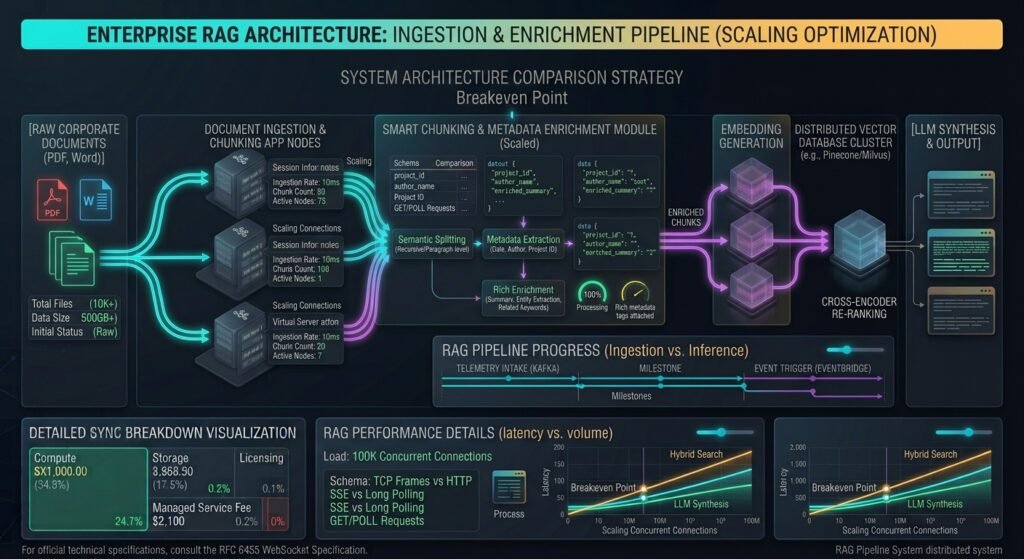
One of the most frequent failure points in enterprise RAG is naive document chunking. Splitting a 500-page financial ledger or technical manual by a fixed character count (e.g., every 500 tokens) inevitably cuts sentences in half,separates tables from headers, and destroys context.
- Semantic Chunking: Break documents based on natural semantic boundaries (such as sentence breaks, paragraph shifts, or markdown heading tags) rather than rigid character lengths.Medium
- Metadata Enrichment: Attach contextual metadata—such as document title, author, department, creation date,and security clearance level—directly to every vector chunk. This metadata is critical for downstream filtering and access control.
Vector Embeddings and High-Performance Indexing
Once chunks are finalized, they are passed through an embedding model (such as OpenAI’s text-embedding-3 series or top-tier open-source models) to convert text into high-dimensional vectors. These vectors are stored in a specialized vector database or vector-capable data store configured with high-performance indexing algorithms like HNSW (Hierarchical Navigable Small World).
Choosing the Right Vector Storage Strategy
When designing the data layer, architects generally choose between dedicated vector databases (such as Pinecone,Milvus, Qdrant) or relational database extensions (such as PostgreSQL with pgvector).
┌─────────────────────────────────────────────────────────────────────────────────┐
│                     VECTOR STORAGE STRATEGY COMPARISON                          │
├──────────────┬──────────────────┬──────────────────┬────────────────────────────┤
│ STORAGE TYPE │ EXAMPLES         │ STRENGTHS        │ BEST USE CASE              │
├──────────────┼──────────────────┼──────────────────┼────────────────────────────┤
│ Dedicated    │ Pinecone, Milvus,│ Massive scale,   │ High-velocity, petabyte-   │
│ Vector DB    │ Qdrant           │ specialized ANN  │ scale vector search farms  │
│              │                  │ tuning           │                            │
├──────────────┼──────────────────┼──────────────────┼────────────────────────────┤
│ Relational   │ PostgreSQL +     │ Single source of │ Enterprise apps requiring  │
│ Extension    │ pgvector         │ truth, ACID      │ co-located metadata &      │
│              │                  │ compliance, SQL  │ relational joins           │
├──────────────┼──────────────────┼──────────────────┼────────────────────────────┤
│ Integrated   │ Alibaba Hologres │ Unified OLAP &   │ Low-cost, simplified stacks│
│ OLAP         │ / Cloud DBs      │ vector engine    │ avoiding multi-DB sync     │
└──────────────┴──────────────────┴──────────────────┴────────────────────────────┘
For many enterprise applications, keeping vectors co-located with relational metadata inside PostgreSQL using pgvector eliminates synchronization issues between decoupled systems. When properly tuned with HNSW indexes and adequate RAM configuration, pgvector easily scales to tens of millions of vectors with sub-20ms query latencies.
Advanced Retrieval Mechanics: Hybrid Search and Re-Ranking
Relying solely on pure vector similarity search often causes retrieval failures in enterprise environments. Users frequently search using a mixture of conceptual queries (“How do I fix memory leak errors?”) and exact keyword identifiers (“Error code ERR-9942-X”).
Alibaba Cloud
Combining Dense Vector Search with Sparse BM25
- Dense Retrieval: Captures semantic meaning and conceptual relationships in high-dimensional vector space.
- Sparse Retrieval: Traditional keyword matching (BM25) ensures exact terms, product codes, and proper nouns are never missed.
- Reciprocal Rank Fusion (RRF): Merges the results of dense and sparse retrieval algorithms into a single unified list, balancing semantic intent with exact keyword precision.
Cross-Encoder Re-Ranking for Precision
Initial retrieval algorithms quickly filter down thousands of candidate chunks to the top 20 or 50 results. However, to achieve maximum accuracy, a secondary Cross-Encoder Re-Ranker model evaluates the user query and each candidate chunk simultaneously through a deep attention mechanism. The re-ranker re-scores the chunks, ensuring only the top 3 to 5 most relevant context blocks are injected into the LLM prompt.
For official technical frameworks on optimizing generative AI retrieval quality and prompt safety, consult the OpenAI Developer Guides and Best Practices.
Optimizing Latency, Scale, and Production Security
Scaling a RAG pipeline from a staging environment to production requires addressing strict latency, cost, and security parameters.
┌────────────────────────────────────────────────────────────────────────┐
│               PRODUCTION RAG LATENCY & BOTTLENECK PROFILE              │
├───────────────────────────────┬────────────────────────────────────────┤
│ PIPELINE STAGE                │ TYPICAL LATENCY & BOTTLENECK           │
├───────────────────────────────┼────────────────────────────────────────┤
│ Query Embedding Generation    │ 30ms – 80ms (Network I/O to model API) │
├───────────────────────────────┼────────────────────────────────────────┤
│ Vector Search (ANN Index)     │ 10ms – 50ms (Index type & RAM pressure)│
├───────────────────────────────┼────────────────────────────────────────┤
│ Cross-Encoder Re-Ranking      │ 100ms – 300ms (Compute-heavy attention)│
├───────────────────────────────┼────────────────────────────────────────┤
│ LLM Synthesis & Generation    │ 500ms – 3000ms (Token generation speed)│
└───────────────────────────────┴────────────────────────────────────────┘
Implementing Access Controls and Data Governance
Enterprise users must only retrieve documents they are explicitly authorized to view. Production vector databases support metadata filtering, allowing the retrieval query to evaluate user security clearance tokens dynamically:
SQL
-- Example secure vector search with metadata access filtering in PostgreSQL/pgvector
SELECT chunk_id, content, 1 - (embedding <=> query_vector) AS similarity
FROM document_chunks
WHERE clearance_level <= :user_clearance_tier
  AND department = ANY(:user_departments)
ORDER BY embedding <=> query_vector
LIMIT 5;
Conclusion
Learning how to build an enterprise Retrieval-Augmented Generation (RAG) pipeline with vector databases is essential for delivering reliable, secure, and accurate generative AI applications. Moving past naive prototypes requires implementing smart semantic chunking, robust hybrid search combining dense vectors with BM25 keyword matching,high-precision cross-encoder re-ranking, and strict metadata-driven access controls. By structuring your pipeline for scale, security, and continuous evaluation, your organization can harness private knowledge bases safely and effectively.
Frequently Asked Questions (FAQs)
What is the best vector database for enterprise RAG pipelines?
The “best” vector database depends on your stack complexity. Dedicated vector databases like Pinecone, Milvus, and Qdrant offer specialized scaling features for massive workloads. However, many modern enterprises choose relational extensions like PostgreSQL with pgvector to keep metadata and vectors unified within a single ACID-compliant database.
Why is hybrid search critical in enterprise RAG systems?
Vector search excels at conceptual similarity (“find documents about company culture”), but frequently fails at exact keyword matches (“find product SKU-9921-B”). Hybrid search combines dense vector retrieval with sparse BM25 keyword search, ensuring both semantic intent and exact identifier lookup succeed.
Alibaba Cloud
How do you prevent unauthorized data access in a RAG pipeline?
Enterprise security requires enforcing Role-Based Access Control (RBAC) directly at the vector retrieval layer. By attaching security clearance and department metadata tags to every vector chunk, your database queries can filter out restricted documents before they ever reach the LLM context window.
IBM
1 thought on “How to Build an Enterprise Retrieval-Augmented Generation Pipeline with Vector Databases”