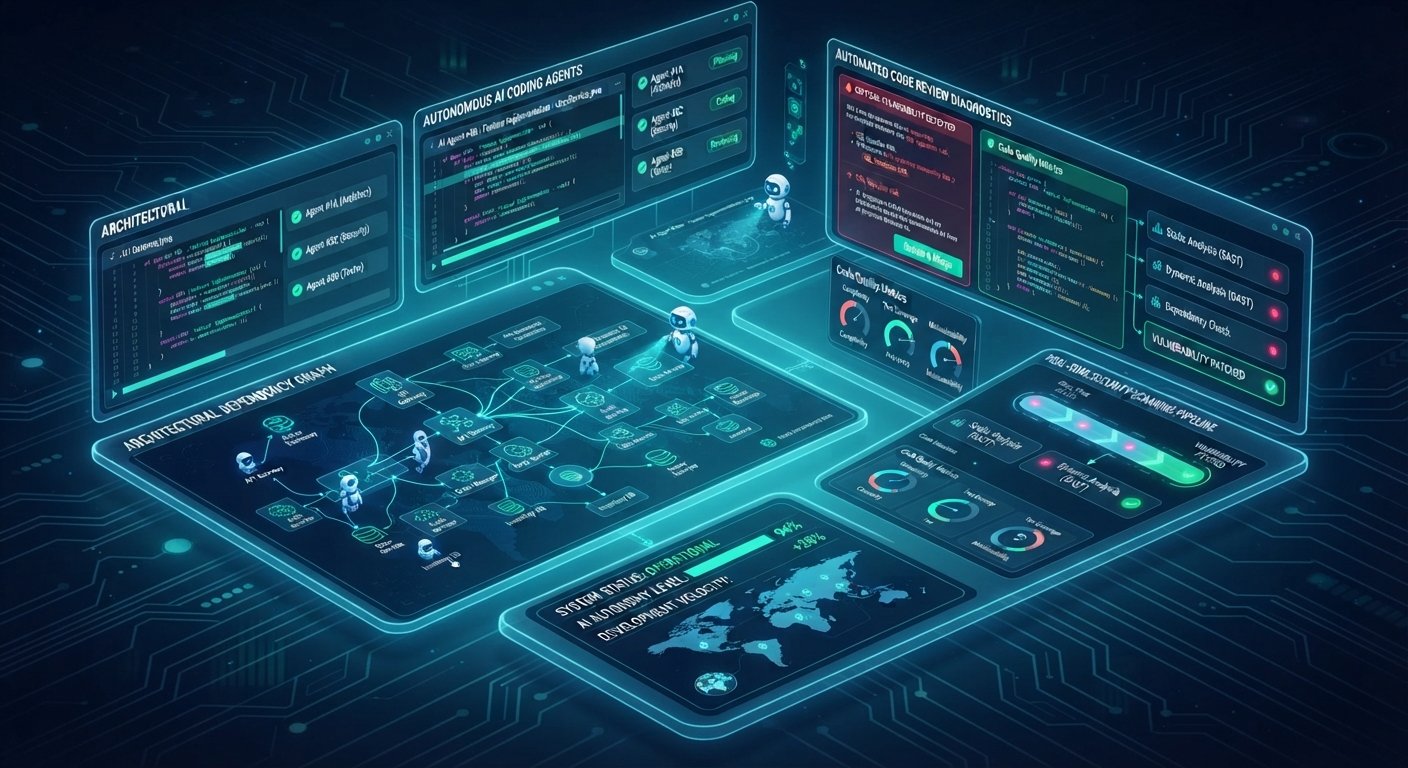
Enterprise software engineering is undergoing a structural paradigm shift. Artificial intelligence has evolved far beyond basic code autocomplete tools and line-level suggestions. Today, multi-agent systems, retrieval-augmented generation (RAG), and autonomous code maintenance platforms are reshaping how organizations design, build, test, and govern complex software applications.
Understanding the future of generative AI in enterprise software development requires moving past individual productivity gains and examining how enterprise engineering workflows are being systematically restructured. This guide details how autonomous agentic architectures, automated security pipelines, and governance frameworks are driving the next decade of enterprise software engineering.
Key Takeaways
- Shift from Assistive to Agentic AI: Enterprise development is transitioning from isolated code completion to autonomous multi-agent systems that execute complex, multi-step engineering tasks across the SDLC.
- Architecture-First Governance: Organizations are shifting focus toward AI code governance, using automated static analysis, sandbox execution, and policy checks to maintain system stability and prevent technical debt.
- Context-Aware Engineering with RAG: Combining LLMs with enterprise knowledge bases and codebase indexing ensures AI tools generate contextually accurate, compliant, and domain-specific code.
- Evolving Developer Roles: Engineers are stepping into high-level roles as system architects, code supervisors, and security auditors, orchestrating autonomous AI agents rather than writing boilerplates manually.
From Code Completion to Agentic SDLC Engineering
future of generative AI in enterprise software development Early enterprise AI adoption focused primarily on developer productivity—reducing keystrokes via intelligent line completion. While helpful, isolated code completion fails to solve systemic enterprise bottlenecks like architectural drift, cross-service coordination, and complex refactoring.
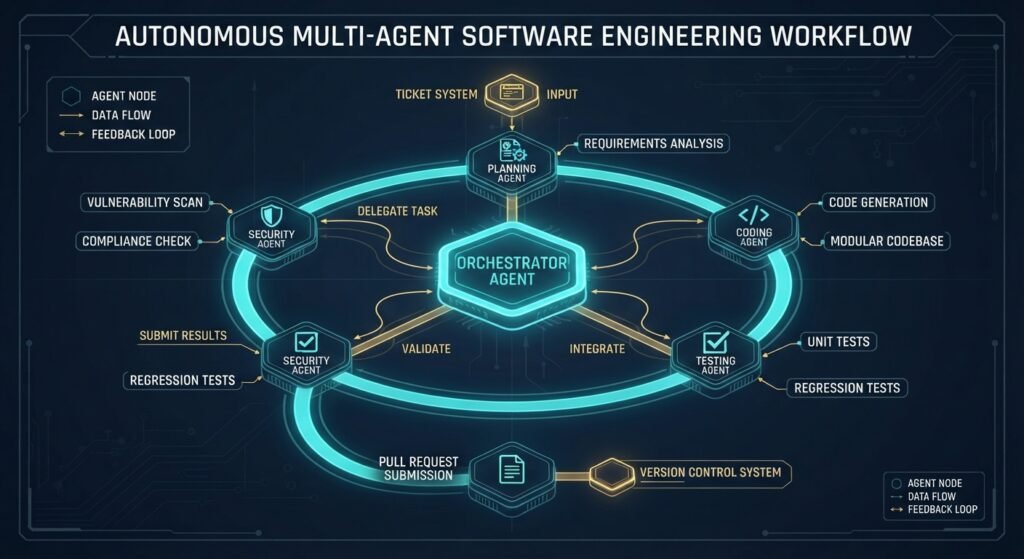
The enterprise standard centers on autonomous AI agents capable of understanding context, planning multi-step actions, and using developer tools independently. Gartner predicts that task-specific AI agents will be embedded across a vast majority of enterprise applications, fundamentally altering how teams manage engineering workloads.
Core Pillars Shaping the Future of Generative AI in Enterprise Software Development
To deploy generative AI effectively at scale, enterprise organizations must rely on four core architectural pillars:
1.Future of generative AI in enterprise software development
Generic AI models often fail in enterprise environments because they lack context regarding internal frameworks, legacy APIs, and proprietary coding standards. Advanced codebase indexing uses Retrieval-Augmented Generation (RAG) to ground AI models in a company’s unique software architecture, eliminating hallucinations and ensuring architectural alignment.
2. Autonomous Testing and AI-Augmented QA
Testing is one of the most resource-intensive phases of software engineering. Modern generative AI platforms automatically write, execute, and maintain end-to-end test suites. When application interfaces change, self-healing algorithms update brittle locators without human intervention.
3. Automated Governance, Security, and Compliance
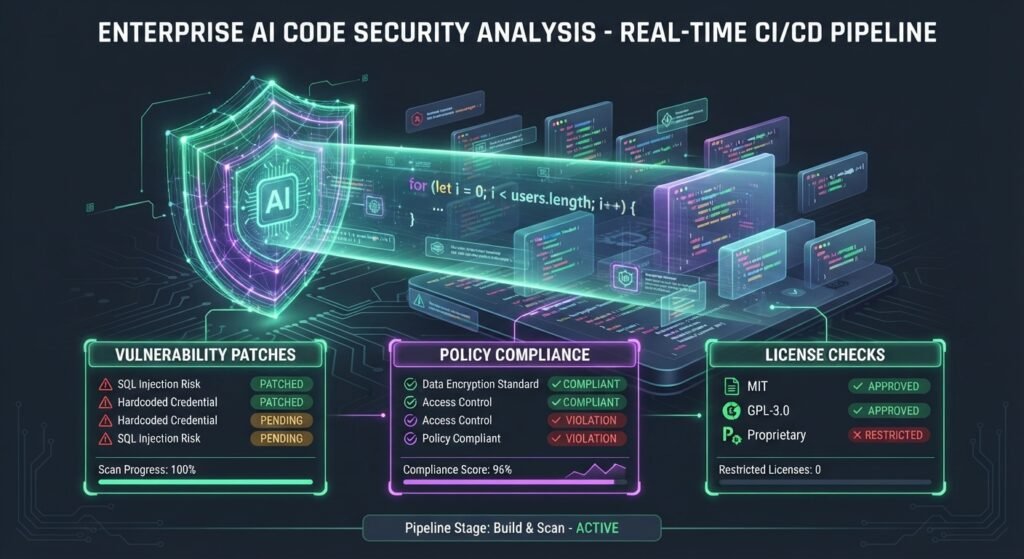
As the volume of AI-generated code increases, preventing technical debt and security vulnerabilities becomes paramount. Enterprise pipelines now integrate automated policy enforcement layers that evaluate generated code against strict security standards before it reaches human review future of generative AI in enterprise software development
4. MLOps 2.0 and FinOps Governance
Managing enterprise LLM deployments requires strict cost control and observability. Enterprise FinOps governance ensures token consumption, API calls, and compute usage are tracked across departments to maintain return on investment future of generative AI in enterprise software development.
Comparative Analysis: Enterprise AI Integration Models
| Architectural Dimension | Basic Assistive Copilots | Enterprise Agentic AI Systems |
|---|---|---|
| Primary Scope | Line-level autocomplete & snippet generation | End-to-end feature delivery and bug resolution |
| Context Horizon | Active file or open IDE tabs | Entire repository, dependency graphs, & ticket history |
| Execution Model | Synchronous, human-driven prompting | Asynchronous task execution with human checkpoints |
| Governance Layer | Manual developer code review | Automated static analysis, policy gates, & sandbox execution |
| Maintenance Burden | High manual maintenance for complex systems | Autonomous refactoring and self-healing test pipelines |
Strategic Implementation Roadmap for Software Teams
Successfully adopting generative AI at an enterprise level requires a phased, risk-managed roll-out.
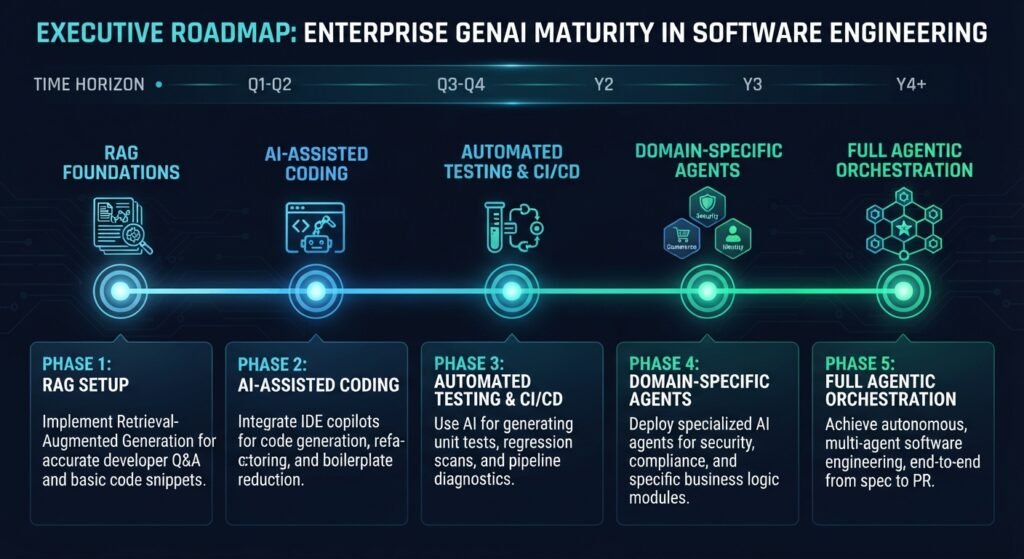
- Establish Enterprise Context: Index internal repositories, API documentation, and architecture decision records (ADRs) using secure RAG infrastructure.
- Deploy Bounded Agentic Pilots: Introduce autonomous agents for low-risk, repetitive tasks such as documentation generation, dependency upgrades, and unit test creation.
- Enforce Gatekeeping & Governance: Integrate static analysis, license scanners, and sandbox environments into your CI/CD pipelines to validate AI-generated pull requests automatically.
- Scale to Multi-Agent Workflows: Connect spec-writing, coding, testing, and security agents through orchestrator layers to automate broader feature delivery cycles.
Conclusion
The future of generative AI in enterprise software development is defined by systemic transformation rather than simple developer convenience. As software engineering organizations embrace autonomous multi-agent architectures, context-grounded RAG systems, and robust AI governance frameworks, the timeline from initial product idea to deployment accelerates dramatically. Enterprises that proactively restructure their engineering workflows around AI-human collaboration will establish lasting competitive advantages in software velocity, quality, and maintainability.
Frequently Asked Questions (FAQs)
How does the future of generative AI in enterprise software development impact software engineer jobs?
Generative AI is shifting the role of software engineers from manual syntax writing to high-level system design, architectural oversight, code auditing, and security management. Rather than replacing developers, AI tools allow engineers to operate as higher-level system orchestrators who manage autonomous software agents.
What is the difference between AI coding assistants and agentic AI systems?
AI coding assistants provide reactive suggestions (such as autocompleting functions or answering inline chat questions). In contrast, agentic AI systems can independently plan multi-step tasks, interact with external tools and APIs, run tests, debug code, and submit complete pull requests with minimal human intervention.
How do enterprise teams prevent security risks in AI-generated code?
Enterprises mitigate security risks by enforcing strict governance pipelines. This includes passing all AI-generated code through automated static application security testing (SAST), running code in sandboxed execution environments, grounding models with repository-specific RAG, and requiring mandatory human-in-the-loop approvals before production deployment future of generative AI in enterprise software development
future of generative AI in enterprise software development