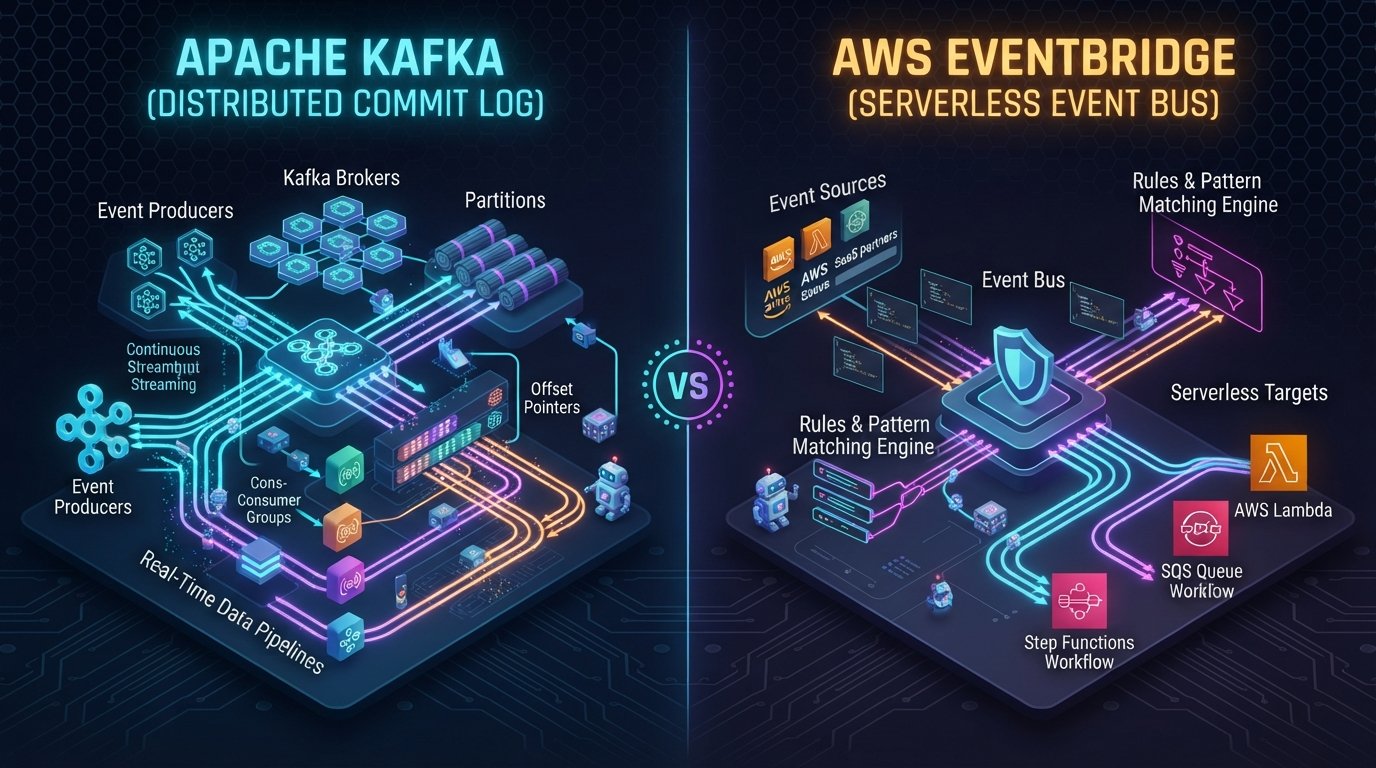
Modern distributed software systems rely heavily on decoupled, asynchronous communication to maintain high availability and elasticity. Event-Driven Architecture (EDA) replaces rigid, synchronous REST or gRPC HTTP chains with an asynchronous model where independent microservices react to events published into an intermediary message backbone.
However, choosing the right infrastructure backbone for event-driven systems is critical. Selecting between Event-Driven Architecture: Kafka vs EventBridge often shapes your engineering team’s operational overhead, data ingestion throughput, application coupling, and cloud expenditure. While Apache Kafka operates as a distributed, high-throughput event streaming platform, AWS EventBridge serves as a serverless, rule-based event bus optimized for application integration. This article breaks down their core architectural differences, trade-offs, and optimal deployment scenarios.
Key Takeaways
- Architectural Intent: Apache Kafka acts as a distributed commit log built for heavy, continuous data streams and real-time analytics. AWS EventBridge acts as a serverless event router designed for loose coupling between microservices, SaaS apps, and cloud resources.
- Routing Capabilities: EventBridge features native content-based routing that inspects JSON event payloads. Kafka routes messages primarily by topic and partition key, relying on consumer applications for payload filtering.
- Throughput and Latency: Kafka achieves sub-20ms latency and scales horizontally to millions of events per second. EventBridge handles moderate scale (thousands of events per second) with typical sub-100ms routing latency.
- Operational Overhead: EventBridge is entirely serverless with zero infrastructure management. Kafka requires cluster configuration, partition rebalancing, and ZooKeeper/KRaft maintenance (unless using managed offerings like MSK or Confluent Cloud).
Core Architectural Comparison
To understand how Event-Driven Architecture: Kafka vs EventBridge functions in production, architects must examine their underlying message transport mechanics.
Apache Kafka: Distributed Commit Log Architecture
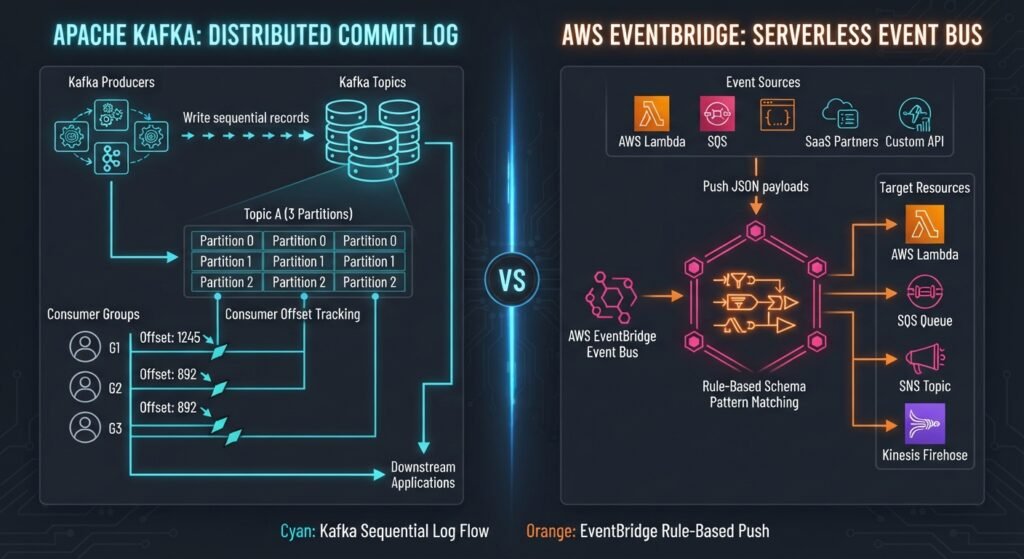
Apache Kafka relies on immutable, append-only disk logs organized into Topics. Topics are divided into Partitions distributed across multiple brokers.
- Pull-Based Consumers: Consumers track their own read positions (Offsets) and pull messages continuously from partitions.
- Replayability: Because events persist on disk based on time- or size-retention policies, consumers can re-read historical streams at any time.
- High-Throughput Partitioning: Parallel processing is achieved by assigning distinct partitions within a topic to separate consumers in a consumer group.
AWS EventBridge: Serverless Event Router
AWS EventBridge operates as a fully managed, serverless Event Bus. It captures events emitted from AWS services, custom microservices, or integrated third-party SaaS platforms (e.g., Auth0, Datadog, Salesforce).
- Push-Based Target Routing: EventBridge evaluates incoming JSON events against rule-based pattern matching filters and automatically pushes matching events to downstream targets (such as AWS Lambda, SQS, or API Gateway).
- Content-Based Filtering: Routing rules can inspect specific key-value pairs deep inside an event payload, ensuring targets only receive events they care about.
- Stateless Operations: EventBridge focuses on message routing rather than continuous storage, although archiving and event replaying can be enabled with dedicated configurations.
[Internal Link: Insert relevant internal URL here with anchor text – “Read our comprehensive guide on designing resilient microservices with event sourcing”]
Deep Dive: Kafka vs. EventBridge Feature Set
1. Payload Filtering & Message Routing
When evaluating Event-Driven Architecture: Kafka vs EventBridge, payload inspection is a major differentiator.
In Kafka, brokers are content-agnostic; they route events strictly by Topic name and optional Partition key. If a consumer only needs a subset of events on a topic, it must ingest all events and drop unwanted messages in code.
In EventBridge, content-based routing is built natively into the broker layer. You can define complex JSON match patterns (e.g., {"detail": {"status": ["FAILED"], "amount": [{"numeric": [">", 1000]}]}}). Unmatched events are ignored immediately without wasting downstream compute resources or invocations.
2. Scalability, Latency & Throughput
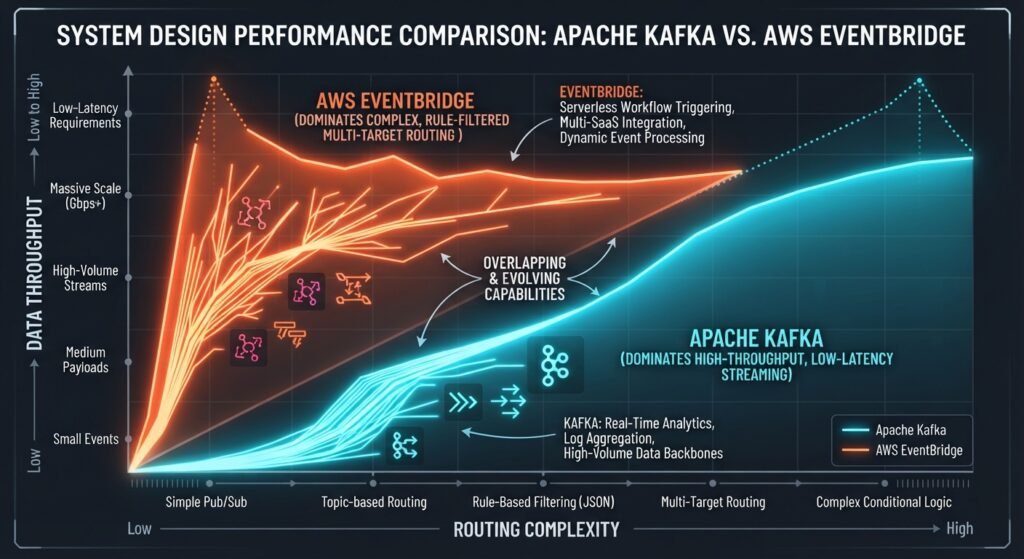
- Kafka is built for extreme performance, capable of sustaining millions of events per second with sub-20ms latency. It excels at real-time log aggregation, telemetry streams, and clickstream analytics.
- EventBridge is designed for asynchronous orchestration and integration workflows. Default soft quotas scale up to tens of thousands of requests per second depending on the AWS region, with typical latency ranging from 50ms to 200ms.
[External Link: Insert high-authority external URL here with anchor text – “Official AWS Documentation on EventBridge Quotas and Rule Matching Patterns”]
Structural Comparison Matrix
| Architectural Feature | Apache Kafka | AWS EventBridge |
| Primary Design Model | Distributed Append-Only Log | Serverless Pub/Sub Event Bus |
| Consumption Style | Pull (Consumers fetch via Offsets) | Push (Broker delivers to Targets) |
| Content-Based Routing | Application-level filtering | Native JSON payload pattern rules |
| Message Ordering | Strictly ordered per Partition | Unordered / Best-effort delivery |
| Data Retention & Replay | Native time/size log retention | Archive feature (Requires setup) |
| Infrastructure Overhead | High (Broker & cluster management) | Zero (Serverless pay-per-event) |
| Pricing Model | Provisioned infrastructure (EC2/MSK nodes) | Per 1 Million events ingested |
Hybrid Architectural Pattern: Combining Kafka and EventBridge
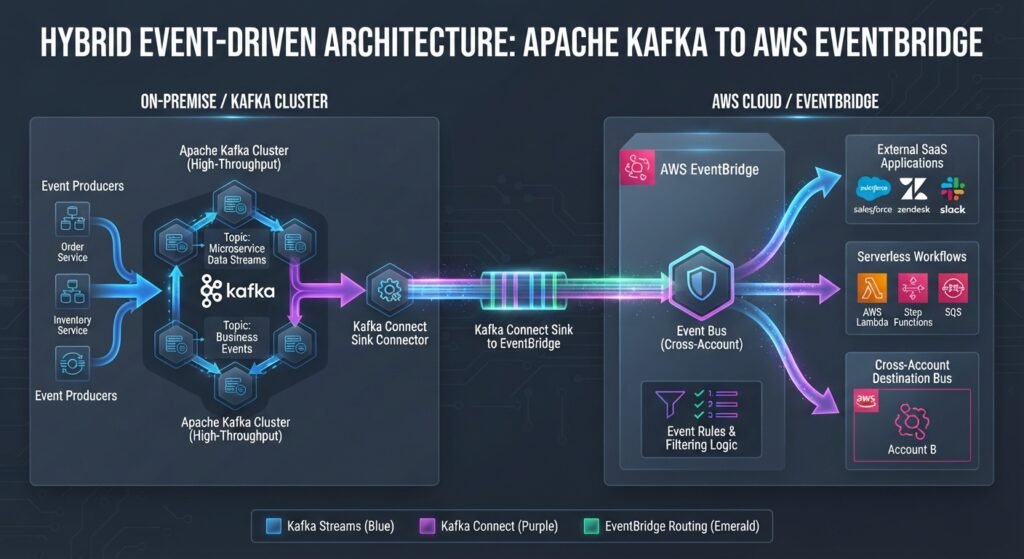
In enterprise software ecosystems, Event-Driven Architecture: Kafka vs EventBridge does not always have to be an either-or decision. Many organizations implement a hybrid event architecture that leverages the unique strengths of both platforms:
- Kafka as the Internal Streaming Backbone: High-volume telemetry, clickstream data, and microservice domain state changes stream into Kafka topics for real-time analytics and event-sourcing data pipelines.
- Event Bridge as the Operational Integration Layer: A dedicated connector reads filtered business events from Kafka (e.g.,
OrderPlacedorCustomerUpgraded) and publishes them to AWS EventBridge. - Serverless Orchestration: EventBridge routes those specific business events out to serverless AWS Lambda functions, third-party SaaS partners, and cross-account microservices without cluttering the core Kafka cluster.
Decision Framework: Which Backbone Should You Choose?
When deciding between technologies for your Event-Driven Architecture: Kafka vs EventBridge, evaluate your operational constraints:
- Choose Apache Kafka if:
- You require sustained, high-throughput streaming (10,000+ events/sec) with sub-20ms latency.
- You need native log retention and replayability to rebuild application state.
- You are running cross-cloud or hybrid on-premises workloads outside of AWS.
- Choose AWS EventBridge if:
- Your infrastructure is hosted natively on AWS and uses serverless components (Lambda, Step Functions, SQS).
- You need fine-grained JSON routing rules to target specific services without writing boilerplate consumer code.
- You want zero operational overhead and a pay-per-event pricing model for bursty or low-to-moderate event volumes.
Conclusion
Building a resilient Event-Driven Architecture: Kafka vs EventBridge comes down to matching your traffic volume and routing complexity to the right tool. Apache Kafka provides the raw power, continuous stream processing, and strict ordering required for heavy data pipelines. Meanwhile, AWS EventBridge delivers unmatched serverless simplicity, seamless AWS service integration, and fine-grained content filtering for application orchestration. Aligning these platforms with your system requirements ensures a scalable and maintainable event backbone.
Frequently Asked Questions (FAQs)
Can AWS EventBridge replace Apache Kafka completely?
No, EventBridge cannot completely replace Kafka for high-volume streaming workloads. While EventBridge excels at routing discrete business events between services, it is not designed for continuous, high-throughput stream processing, log aggregation, or sub-20ms data pipelines where millions of events pass per second.
How does pricing compare between Kafka and EventBridge at scale?
EventBridge uses a pay-per-event model (typically around $1.00 per million ingested events). For low-to-moderate or bursty traffic, this serverless model is extremely cost-effective. However, for high-volume streams handling billions of events monthly, EventBridge costs can scale rapidly, making provisioned Kafka clusters significantly more economical per message.
Does AWS EventBridge support event replay like Kafka?
Yes, EventBridge offers an optional Event Archive and Replay feature. While Kafka natively retains events directly in its distributed log partitions by default, EventBridge requires you to explicitly enable archiving on an event bus to store and replay past events back through routing rules.
1 thought on “Designing Event-Driven Architecture: Apache Kafka vs. AWS EventBridge”