
Node.js has become the backbone of modern web applications, microservices, and serverless architectures due to its asynchronous, event-driven runtime. However, its speed and modular ecosystem introduce a broad attack surface. Unhandled asynchronous exceptions, vulnerable npm packages, and flawed access control logic can expose enterprise applications to catastrophic security breaches.
How to prevent and remediate OWASP Top 10 security risks in Node.js is a fundamental discipline every backend engineer, full-stack developer, and DevSecOps practitioner must master. By implementing defensive secure coding patterns, automated dependency scanning, and robust runtime controls, development teams can systematically neutralize vulnerabilities before they reach production.
Key Takeaways
- Enforce Centralized Server-Side Authorization: Never rely on client-side controls. Validate user permissions on every request using Role-Based Access Control (RBAC) or Attribute-Based Access Control (ABAC) to mitigate Broken Access Control.
- Harden the Supply Chain: Audit third-party packages continuously using
npm audit, Snyk, or Socket, and pin exact package versions with lockfiles to prevent malicious dependency injection. - Parameterized Database Queries: Always use parameterized queries or object-relational mapping (ORM) abstractions with strict input validation to eliminate SQL and NoSQL Injection risks.
- Implement Strong Cryptography: Secure sensitive data at rest and in transit using modern algorithms like AES-256-GCM and hash credentials using memory-hard functions like Argon2 or bcrypt.
- Secure Runtime Configuration: Strip default headers, set restrictive HTTP security headers via Helmet, and disable verbose stack traces in production environments.
Mapping OWASP Top 10 Vulnerabilities in Node.js
Understanding how to prevent and remediate OWASP Top 10 security risks in Node.js begins with mapping common security flaws directly to Node.js development patterns.
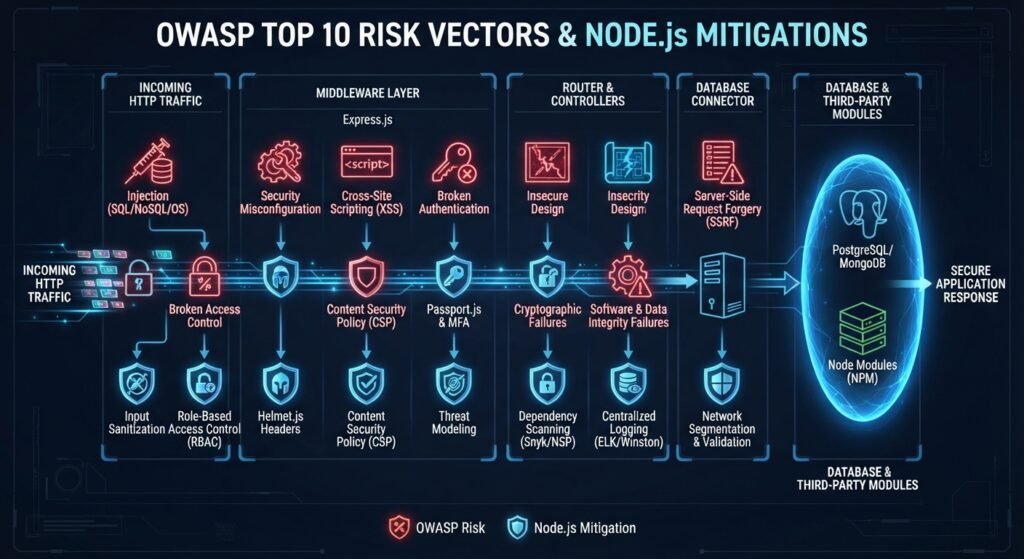
| OWASP Risk Category | Primary Node.js Root Cause | Key Remediation Strategy |
| A01: Broken Access Control | Exposing database IDs directly in endpoints (Insecure Direct Object References). | Enforce object-level permission checks in middleware. |
| A02: Security Misconfiguration | Running Express with default settings, exposing X-Powered-By: Express. | Use helmet(), disable debug logs, and automate baseline security audits. |
| A03: Software Supply Chain Failures | Pulling unverified, malicious, or outdated npm packages. | Implement lockfiles, software bills of materials (SBOM), and SAST/SCA scanners. |
| A04: Cryptographic Failures | Weak password hashing (crypto.createHash('md5')) or hardcoded secrets. | Hash passwords with Argon2/bcrypt and store secrets in secure key vaults. |
| A05: Injection | Concatenating untrusted user input into raw MongoDB or SQL queries. | Use parameterized queries, ORMs, and allow-list schema validation. |
| A06: Insecure Design | Lacking business logic rate limits, registration safeguards, or error handling boundaries. | Perform threat modeling during architecture design and enforce rate limiting. |
| A07: Authentication Failures | Missing brute-force protection, weak session management, or flawed JWT implementations. | Implement strong MFA, limit login attempts, and use secure, HttpOnly, SameSite cookies. |
| A08: Software & Data Integrity Failures | Insecure deserialization using functions like eval() or unverified CI/CD pipelines. | Ban eval(), verify package integrity signatures, and secure CI/CD runners. |
| A09: Logging & Alerting Failures | Failure to log security events or writing unredacted PII/credentials to logs. | Use structured loggers (Pino/Winston) with log redaction and real-time monitoring. |
| A10: Exceptional Conditions Handling | Crashing process on unhandled promise rejections or exposing raw stack traces. | Centralize error handling, catch all asynchronous exceptions, and return sanitized errors. |
Step-by-Step Remediation Strategies for Key Node.js Vulnerabilities
1. Eliminating NoSQL and SQL Injection (A05)
Injection happens when untrusted user input is passed directly to an interpreter as part of a command or query. In Node.js applications using MongoDB, attackers exploit query selector injection if input is not sanitized.
Vulnerable Code Example (NoSQL Injection):
JavaScript
// DANGEROUS: Passing raw request body directly allows query operator injection
// If req.body.password is {"$ne": null}, authentication is bypassed!
app.post('/api/v1/login', async (req, res) => {
  const user = await User.findOne({
    username: req.body.username,
    password: req.body.password
  });
  if (user) res.send('Authenticated');
});
Remediated Code Example (Validated & Sanitized):
JavaScript
import express from 'express';
import { z } from 'zod';
import mongoSanitize from 'express-mongo-sanitize';

const app = express();
app.use(express.json());
// Remove any keys containing $ or . to prevent NoSQL operator injection
app.use(mongoSanitize());

const loginSchema = z.object({
  username: z.string().trim().min(3).max(50),
  password: z.string().min(8)
});

app.post('/api/v1/login', async (req, res) => {
  // Validate schema before querying
  const parseResult = loginSchema.safeParse(req.body);
  if (!parseResult.success) {
    return res.status(400).json({ error: 'Invalid input format' });
  }

  const { username, password } = parseResult.data;
  const user = await User.findOne({ username: String(username) });

  if (!user || !(await verifyPassword(password, user.passwordHash))) {
    return res.status(401).json({ error: 'Invalid credentials' });
  }

  res.json({ status: 'Success' });
});
2. Securing the Software Supply Chain (A03)
Node.js applications rely heavily on external npm packages, creating supply chain attack targets. Compromised packages can execute arbitrary code during installation or at runtime.
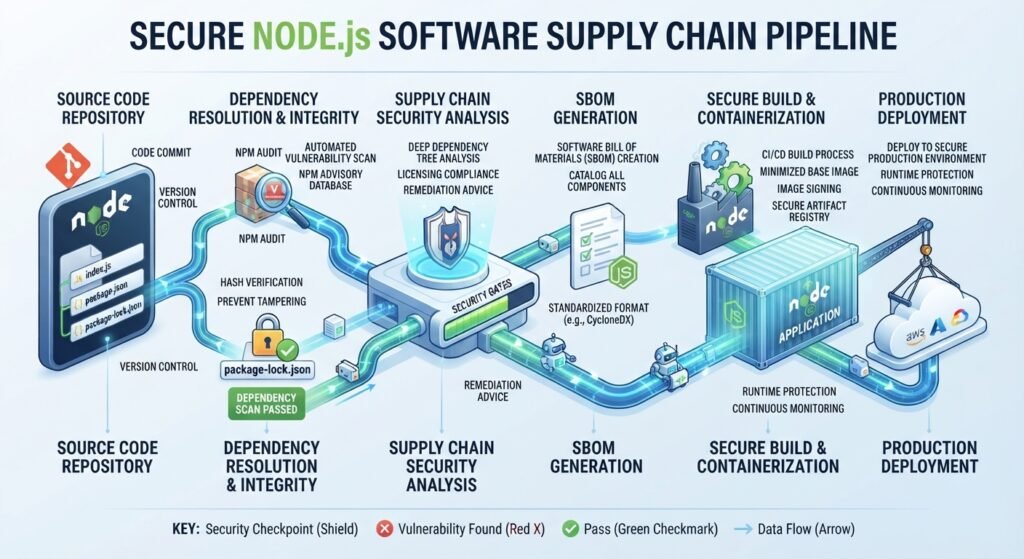
- Generate Lockfiles: Commit
package-lock.jsonorpnpm-lock.yamlto ensure deterministic builds. - Audit Dependencies Automatically: Integrate vulnerability audits into your CI/CD build scripts:Bash
npm audit --audit-level=high - Enforce Strict Dependency Scopes: Avoid wildcard version specifications (e.g.,
^1.2.3or*) in critical production services to prevent auto-pulling untrusted minor updates.
3. Fixing Broken Access Control (A01)
Broken access control allows unauthorized users to view, alter, or delete resources belonging to other accounts.
Remediated Code Example (Server-Side Authorization):
JavaScript
// Middleware enforcing Object-Level Access Control (BOLA/IDOR Prevention)
async function verifyDocumentOwnership(req, res, next) {
  const documentId = req.params.id;
  const authenticatedUserId = req.user.id;

  const document = await DocumentRepository.findById(documentId);
  if (!document) {
    return res.status(404).json({ error: 'Resource not found' });
  }

  // Enforce explicit server-side authorization check
  if (document.ownerId !== authenticatedUserId && !req.user.roles.includes('ADMIN')) {
    return res.status(403).json({ error: 'Forbidden: Access denied' });
  }

  req.document = document;
  next();
}

app.get('/api/v1/documents/:id', verifyDocumentOwnership, (req, res) => {
  res.json(req.document);
});
4. Hardening Express Framework Security Configurations (A02)
Default Express setups leak metadata and lack baseline security headers. Applying modern HTTP headers protects clients against cross-site scripting (XSS), clickjacking, and MIME-sniffing attacks.
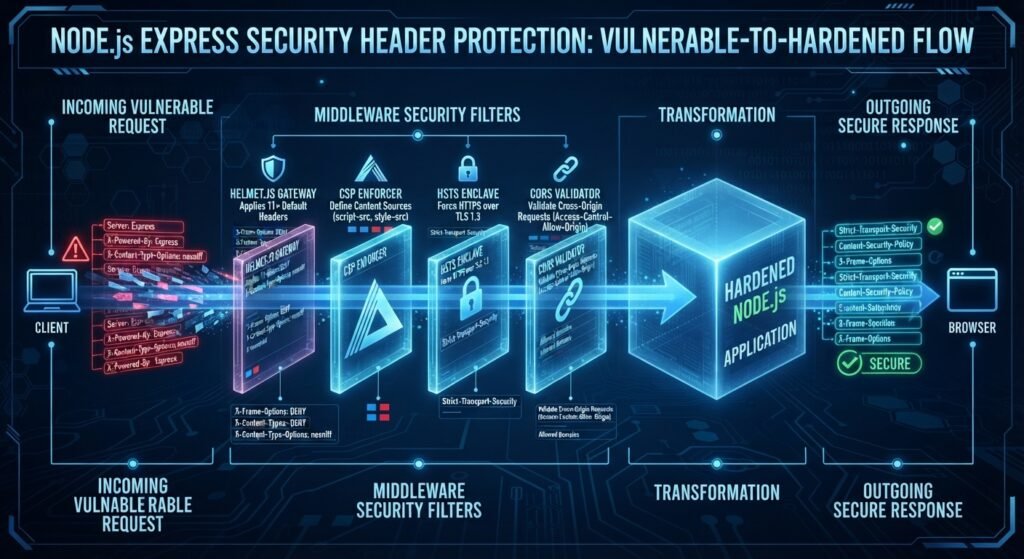
JavaScript
import express from 'express';
import helmet from 'helmet';
import cors from 'cors';

const app = express();

// Set HTTP security headers using Helmet
app.use(helmet());

// Configure strict Cross-Origin Resource Sharing (CORS)
const allowedOrigins = ['https://app.yourdomain.com'];
app.use(cors({
  origin: (origin, callback) => {
    if (!origin || allowedOrigins.includes(origin)) {
      callback(null, true);
    } else {
      callback(new Error('Blocked by CORS policy'));
    }
  },
  credentials: true,
  methods: ['GET', 'POST', 'PUT', 'DELETE']
}));

// Hide server implementation details
app.disable('x-powered-by');
Uncaught exceptions and unhandled promise rejections can cause application crashes or reveal sensitive internal implementation details through verbose stack traces.
JavaScript
// Centralized Error Handling Middleware
app.use((err, req, res, next) => {
  const isProduction = process.env.NODE_ENV === 'production';

  // Log error details securely for internal analysis
  logger.error({
    message: err.message,
    stack: err.stack,
    path: req.path,
    userId: req.user?.id
  });

  // Never expose raw stack traces to end users
  res.status(err.status || 500).json({
    error: {
      message: isProduction ? 'An unexpected server error occurred.' : err.message,
      code: err.code || 'INTERNAL_SERVER_ERROR'
    }
  });
});
Conclusion
Understanding how to prevent and remediate OWASP Top 10 security risks in Node.js is a continuous engineering practice, not a one-time task. By enforcing strict input validation, isolating server-side authorization logic, hardening external dependencies, and configuring secure runtime defaults, teams can protect Node.js microservices against evolving security threats.
Integrating security checks directly into local development flows and automated CI/CD pipelines ensures application resilience while maintaining fast deployment velocity.
Frequently Asked Questions (FAQs)
What is the most common vulnerability when evaluating how to prevent and remediate OWASP Top 10 security risks in Node.js?
Broken Access Control (A01) and Software Supply Chain Failures (A03) consistently rank among the most prevalent risks in Node.js environments. Broken Access Control stems from inadequate server-side authorization checks, while supply chain risks arise from Node’s heavy reliance on third-party npm packages.
How do I secure JWT authentication tokens in a Node.js backend?
Store JSON Web Tokens (JWTs) in HttpOnly, Secure, and SameSite=Strict cookies rather than browser local storage to prevent Cross-Site Scripting (XSS) token theft. Ensure short token expiration times and validate token signatures using strong asymmetric key pairs (e.g., RS256).
Is using an ORM like Prisma or Sequelize enough to prevent SQL and NoSQL Injection?
While ORMs use parameterized queries by default, they do not make applications completely immune to injection. Injection vulnerabilities can still occur if raw SQL/NoSQL clauses are executed, or if user inputs are passed directly into dynamic query fields. Always pair ORM usage with strict input validation schema tools like Zod or Joi.
1 thought on “How to Prevent and Remediate OWASP Top 10 Security Risks in Node.js”