Building real-time web applications requires moving beyond traditional HTTP request-response semantics. In standard web interactions, the client initiates every transaction, leaving the server unable to push spontaneous updates without explicit client polling. As modern web applications—such as collaborative workspace tools, financial trading terminals, live sports scores, and social notifications—demand instantaneous data delivery, software architects must select an optimal event-driven communication transport.WebSockets vs. Server-Sent Events vs. Long Polling
Understanding the structural differences in WebSockets vs Server-Sent Events vs Long Polling is vital for optimizing server memory footprints, network overhead, connection scalability, and edge infrastructure. Each transport strategy makes distinct trade-offs across state management, firewall traversal, and protocol framing. This architectural deep dive analyzes all three real-time communication patterns to guide your system design decisions.
Key Takeaways WebSockets vs. Server-Sent Events vs. Long Polling
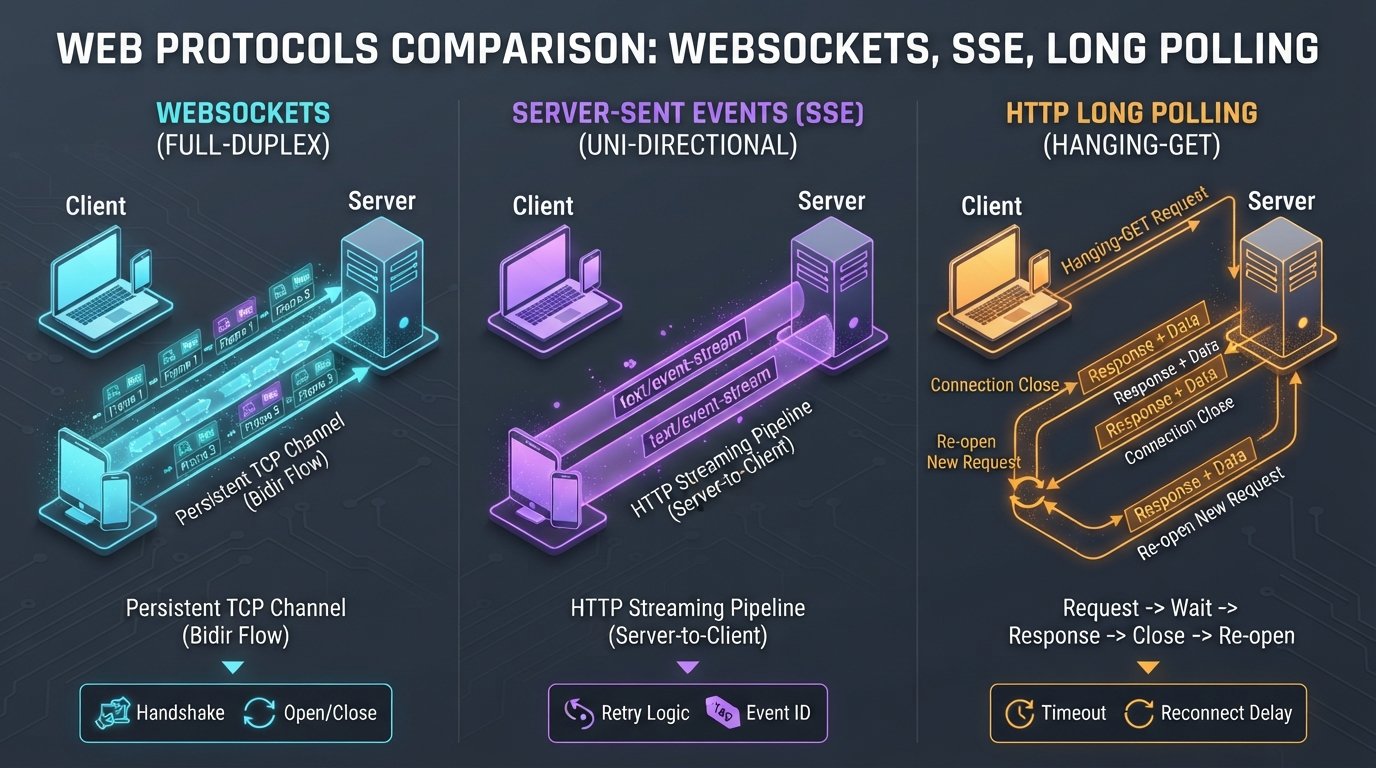
- Bi-directional vs. Uni-directional: WebSockets provide true full-duplex, bi-directional messaging over a single persistent TCP connection. SSE streams uni-directional updates strictly from server to client over standard HTTP, while Long Polling uses repetitive hanging HTTP requests.
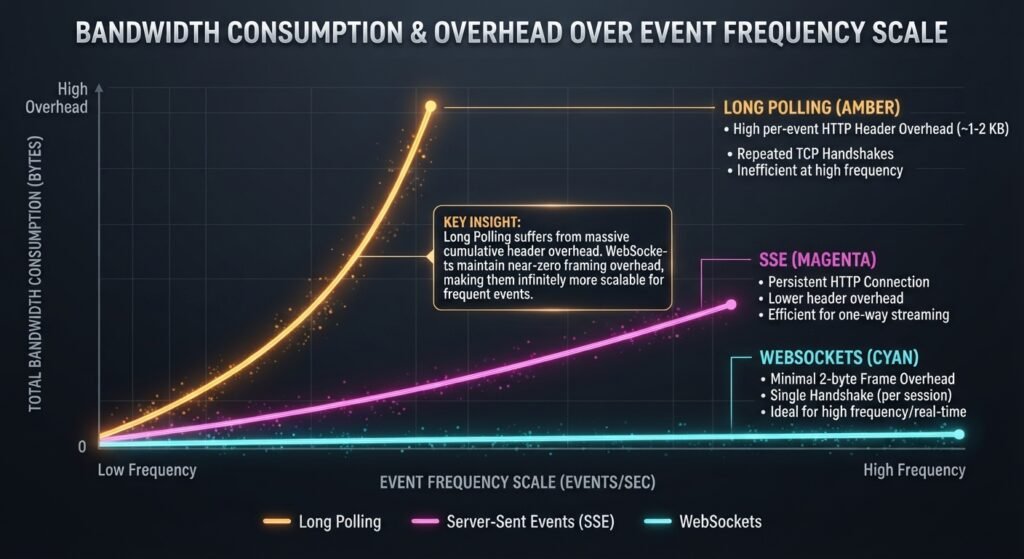
- Protocol Overhead: WebSockets reduce framed message overhead to just 2–10 bytes per frame after an initial HTTP handshake upgrade. SSE adds negligible text formatting overhead, whereas Long Polling incurs full HTTP header overhead (hundreds of bytes) on every single update cycle.
- Native Reconnection & HTTP/2 Support: SSE features native client auto-reconnection and event ID tracking out of the box using standard browser APIs (
EventSource). It also multiplexes naturally over HTTP/2. WebSockets require custom reconnect algorithms and bypass standard HTTP layers. - Infrastructure & Load Balancing: Long Polling and SSE leverage standard HTTP infrastructure (reverse proxies, CDNs, firewalls). WebSockets bypass standard HTTP routing after handshake, requiring stateful connection management, sticky sessions, or pub/sub backplanes (like Redis or NATS) for horizontal scaling.
Protocol Level Mechanisms & Architecture
To evaluate WebSockets vs Server-Sent Events vs Long Polling effectively, platform architects must examine how each protocol establishes and maintains connections at the TCP and HTTP abstraction layers.
Long Polling : Client Request ---> [Server Holds] ---> Data Response ---> [Close & Re-open]
SSE          : Client Request ---> HTTP Stream Open  ---> Push Event 1 ---> Push Event 2 ...
WebSockets   : HTTP Upgrade   ---> WS TCP Socket     <== Full-Duplex Data Framing ==>
1. HTTP Long Polling: The Emulated Push Workaround
Long Polling is a legacy emulation pattern designed to simulate real-time updates using standard HTTP primitives.
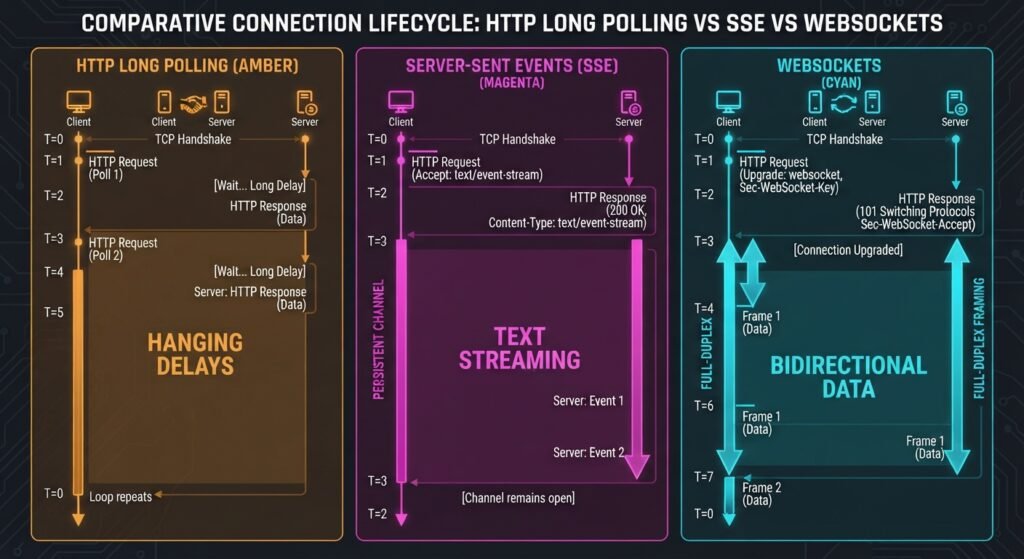
- Connection Lifecycle: The client opens an asynchronous HTTP request (
XHRorfetch). Instead of returning immediately, the server holds the connection open until data becomes available or a timeout threshold is reached. - Teardown & Re-establishment: Once the server responds with a payload, the HTTP connection completes and closes. The client immediately opens a brand-new HTTP request to wait for the next event.
- Overhead: Each exchange incurs full TCP handshake overhead (unless HTTP keep-alives are maintained) and forces complete HTTP request/response headers to be transmitted for every single event.
2. Server-Sent Events (SSE): Standardized Uni-Directional HTTP Streaming
Server-Sent Events provide a lightweight, standardized mechanism for pushing real-time server updates to web browsers over persistent HTTP connections using the text/event-stream MIME type.
- Connection Lifecycle: The client initializes a connection using the native
EventSourcebrowser API. The server responds with an HTTP200 OKheader containingContent-Type: text/event-streamandCache-Control: no-cache. The connection remains open indefinitely, with the server trickling line-delimited plain text events downstream. - Built-in Resiliency: If the connection drops, the browser automatically attempts to reconnect. If the server appends an
id:field to sent events, the browser automatically includes aLast-Event-IDheader upon reconnecting, allowing the backend to backfill missed messages seamlessly.
3. WebSockets: Full-Duplex Stateful TCP Sockets
The WebSocket protocol (RFC 6455) upgrades a standard HTTP connection into a persistent, bi-directional, full-duplex TCP socket connection.
- Connection Handshake: The client sends a standard HTTP/1.1 request with
Upgrade: websocketandConnection: Upgradeheaders along with aSec-WebSocket-Keyhash. If supported, the server returns an HTTP101 Switching Protocolsstatus code. - Bi-directional Framing: After the handshake succeeds, the underlying TCP connection switches from HTTP to raw WebSocket framing. Either party can transmit binary or text frames asynchronously without header overhead or request-response constraints.
- Statefulness: WebSockets are inherently stateful. The server maintains an open socket descriptor in memory for each connected client, requiring specialized cluster orchestration for horizontal scaling.
Comparative Feature & Architectural Matrix
| Architectural Dimension | HTTP Long Polling | Server-Sent Events (SSE) | WebSockets |
| Data Flow Direction | Uni-directional (Server $\rightarrow$ Client simulated) | Uni-directional (Server $\rightarrow$ Client strictly) | Bi-directional (Client $\leftrightarrow$ Server full-duplex) |
| Underlying Protocol | Standard HTTP/1.1 or HTTP/2 | Standard HTTP/1.1 or HTTP/2 | Custom WS/WSS protocol (Upgraded from HTTP) |
| Frame / Header Overhead | High (500B–2KB per event) | Very Low (Plain text formatting) | Minimal (2–10 bytes per frame) |
| Client Reconnection | Manual (Re-initiated in code) | Native (EventSource auto-reconnect) | Manual (Requires app-level exponential backoff) |
| Data Format Support | JSON, Text, Binary (Base64) | UTF-8 Text Strings / JSON | Raw Binary (ArrayBuffer/Blob) & Text |
| Browser Limit Constraints | Subject to domain connection limits | Max 6 connections per domain (HTTP/1.1) / Unlimited (HTTP/2) | Unlimited (Subject to memory/OS socket limits) |
| Proxy / Firewall Traversal | Seamless (Standard HTTP) | Seamless (Standard HTTP streams) | May be blocked by legacy strict HTTP proxies |
Infrastructure, Scalability, and Edge Considerations
When choosing between WebSockets vs Server-Sent Events vs Long Polling for enterprise applications, infrastructure orchestration is often the deciding factor:
1. Load Balancing and Connection Terminations
- Long Polling & SSE: Because they communicate over standard HTTP routes, traditional Application Load Balancers (ALBs), API Gateways, and reverse proxies (like NGINX or HAProxy) handle them natively. SSE scales efficiently over HTTP/2, as multiplexing allows multiple event streams to share a single TCP connection without running into browser domain connection limits.
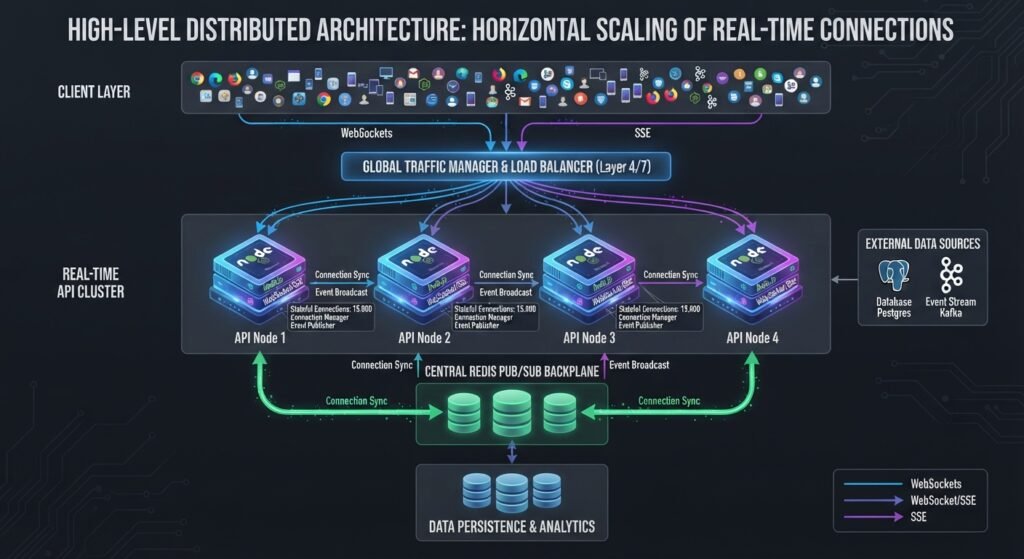
- WebSockets: WebSockets break standard HTTP request-response lifecycle assumptions. Reverse proxies must be explicitly configured to allow HTTP upgrades. Additionally, because connections are long-lived and stateful, simple round-robin load balancing is insufficient; system designers must implement sticky sessions or a centralized pub/sub distribution tier.
2. Scaling Stateful Connections with Pub/Sub Layers
When scaling WebSockets or SSE horizontally across multiple server instances, Server A may receive an incoming event that needs to reach a client connected to Server B.
To solve this, modern real-time architectures place an asynchronous message broker—such as Redis Pub/Sub, NATS, or Apache Kafka—behind the API instances. When a message is generated, it is published to a shared channel, allowing all backend nodes to broadcast the payload to their local connected client sockets.
Decision Framework: Selecting the Optimal Transport Strategy
To select among WebSockets vs Server-Sent Events vs Long Polling, evaluate your application’s communication patterns:
- Choose WebSockets when:
- You require sub-50ms bi-directional communication (e.g., multiplayer gaming, collaborative canvas editors, voice/video signaling, or interactive chat applications).
- The client sends messages to the server at a similar frequency as the server pushes messages to the client.
- You need to transmit raw binary data streams efficiently.
- Choose Server-Sent Events (SSE) when:
- You only need uni-directional server-to-client updates (e.g., live stock tickers, AI response streaming, dashboard metrics, or push notifications).
- You want simple implementation using standard HTTP infrastructure without managing complex custom socket reconnection logic.
- You leverage HTTP/2 and want built-in client reconnection resilience out of the box.
- Choose Long Polling when:
- You must support legacy web browsers or restrictive enterprise network environments that block non-standard HTTP connections or WebSocket upgrades.
- Event updates are rare or unpredictable, and infrastructure simplicity overrides latency performance.
Conclusion
Selecting the correct real-time communication strategy in WebSockets vs Server-Sent Events vs Long Polling depends on your application’s data flow, performance goals, and infrastructure constraints. While WebSockets remain the gold standard for full-duplex interactive applications, Server-Sent Events offer a simpler, HTTP-native alternative for server-to-client streaming scenarios like AI generation and dashboard updates. Long Polling continues to serve as an operational fallback for legacy networks. By aligning your choice with your traffic profile, you can build scalable and cost-effective real-time applications.
Frequently Asked Questions (FAQs)
Why is SSE often preferred over WebSockets for AI chat applications like ChatGPT?
AI text generation is fundamentally a uni-directional streaming process: the user submits a single prompt via a standard POST request, and the server streams the generated tokens back incrementally. SSE natively supports HTTP streaming, automatically handles client reconnections, works seamlessly with existing HTTP security headers and reverse proxies, and avoids the stateful complexity of managing full-duplex WebSockets.
How does HTTP/2 impact the comparison between SSE and WebSockets?
Under HTTP/1.1, browsers enforce a strict limit of 6 concurrent TCP connections per domain, which can quickly saturate if a user opens multiple browser tabs running individual SSE streams. Under HTTP/2, multiplexing allows multiple SSE streams to be multiplexed over a single underlying TCP connection, eliminating connection limits. WebSockets run on their own frame protocol and do not naturally multiplex over HTTP/2 without experimental extensions.
Are WebSockets more memory-intensive on backend servers than SSE?
Both technologies hold persistent connections open and require server memory to track open socket file descriptors. However, WebSockets require additional memory for bidirectional connection state tracking and custom application frame buffers. SSE utilizes standard HTTP connection pools, making it slightly lighter in terms of memory overhead per idle client connection.WebSockets vs. Server-Sent Events vs. Long Polling
1 thought on “WebSockets vs. Server-Sent Events vs. Long Polling: Architectural Deep Dive”