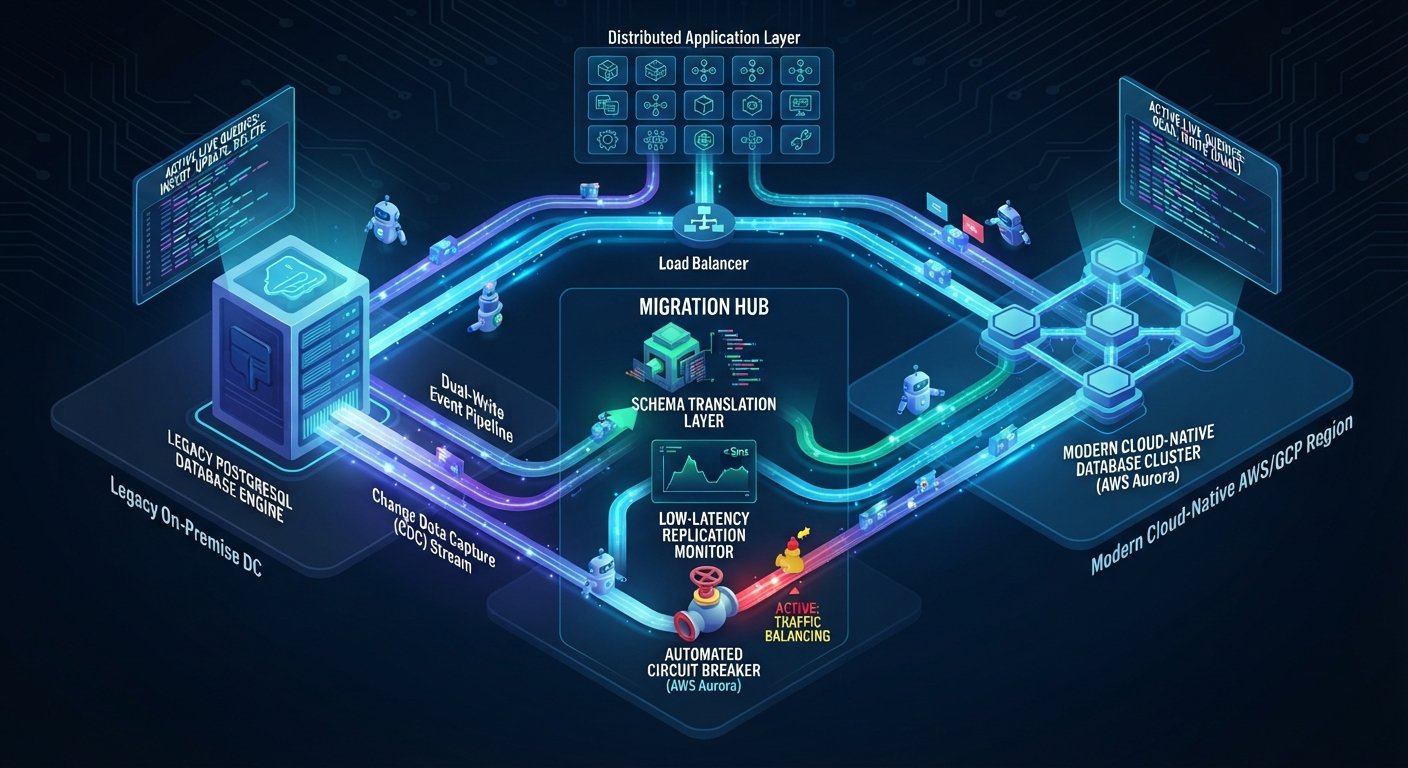
Executing schema changes or migrating database engines in high-traffic applications is one of the most operationally sensitive challenges in software engineering. In low-traffic legacy applications, operations teams could schedule weekend maintenance windows, set the system to read-only, dump the database, apply schema migrations, and point application instances to the new target. However, in modern global platforms handling thousands of writes per second, planned downtime costs revenue, violates Service Level Agreements (SLAs), and degrades customer trust.learn how to Design Zero-Downtime Database Migration.
Performing a zero-downtime database migration requires treating schema and engine updates as continuous, multi-phased software rollouts rather than single atomic operations. By coordinating backward-compatible schema changes, shadow dual-writing, background data backfilling, and Change Data Capture (CDC) streaming, platform teams can alter production database structures under heavy live loads without dropping a single write.
Key Takeaways
- The Expand-Contract Pattern is Essential: Never drop or rename columns in a single deployment. Expand the database schema first to support both old and new data structures simultaneously before contracting the legacy structure.
- Application Compatibility Matrix First: Always deploy backward-compatible application code before executing schema updates. Old and new application versions must be able to run concurrently during rolling deployments.
- Decouple Structural Migrations from Data Backfilling: Apply structural changes (like adding nullable columns) in fast, non-blocking DDL transactions, then move historical data in asynchronous, rate-limited background batches.
- Leverage Change Data Capture (CDC) for Engine Shifts: When migrating between distinct database instances or cloud engines, log-based CDC replication (e.g., Debezium) streams real-time writes continuously until replication lag reaches near zero for cutover.
Why Direct Schema Alterations Cause Downtime in High-Traffic Databases
In relational engines like PostgreSQL or MySQL, direct structural alterations—such as dropping columns, changing data types, or adding non-nullable columns without defaults—require Exclusive Table Locks (e.g., ACCESS EXCLUSIVE in Postgres).
When a high-traffic table receives thousands of concurrent read and write queries, a long-running lock acquisition blocks incoming requests. Incoming database connections rapidly fill the connection pool, leading to thread starvation, cascading application timeouts, and total outage. Furthermore, if new application binaries expecting an altered schema are deployed simultaneously while old instances are still serving traffic, queries fail due to missing or mismatched column references.
[Internal Link: Insert relevant internal URL here with anchor text – “Explore our complete engineering guide on high-availability PostgreSQL connection pooling and optimization”]
The Operational Phasing: The Expand-Contract (Parallel Change) Pattern
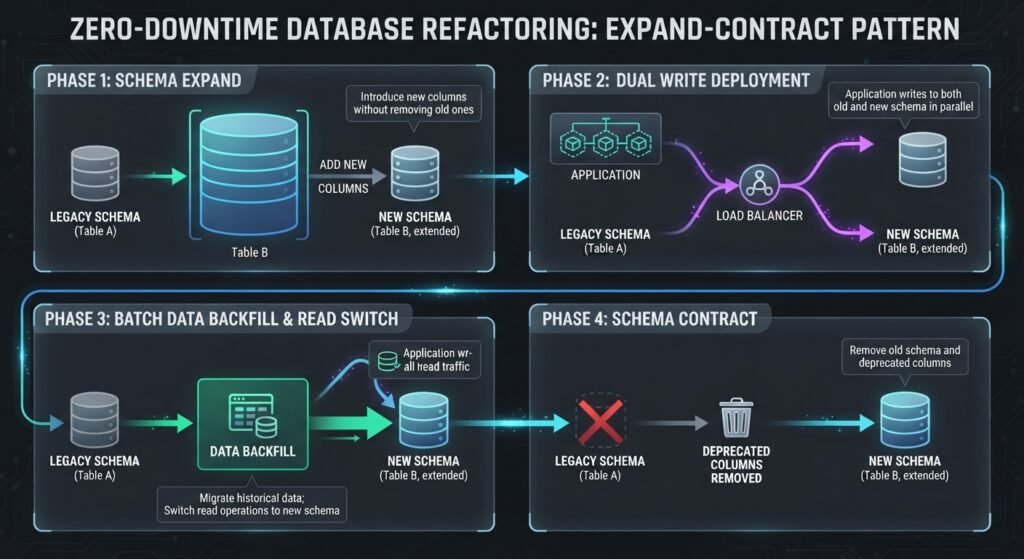
The core blueprint for executing a zero-downtime database migration for schema refactoring (e.g., splitting a field, renaming a column, or moving a table) is the Expand-Contract pattern. This breaks down a breaking structural change into four distinct, safe phases:
[Phase 1: Expand] ---> [Phase 2: Dual Write] ---> [Phase 3: Backfill & Read Switch] ---> [Phase 4: Contract]
Phase 1: Expand (Additive Schema Alteration)
Add the new schema structures alongside the existing ones as nullable columns or new tables. Because the new columns are optional and the existing columns remain untouched, existing application code continues running without interruption.
Phase 2: Dual-Writing (Application or Trigger Level)
Deploy an updated version of the application that writes to both the old and new schema locations simultaneously. This ensures that new data incoming to the system remains synchronized across both representations.
Phase 3: Historical Data Backfilling & Read Switching
Run an asynchronous background worker process to backfill existing historical records from the old schema structure into the new structure. Once backfilling is verified and complete, deploy application updates that switch read operations to the new schema.
Phase 4: Contract (Retiring Legacy Schemas)
After monitoring confirms that zero application services, background workers, or reporting jobs read from or write to the old column, release a deployment that removes references to the old structure. Finally, drop the legacy column or table from the database safely.
Cross-Database & Engine Migrations Using Change Data Capture (CDC)
When a zero-downtime database migration involves switching physical hardware, upgrading major database versions (e.g., PostgreSQL 14 to 17), or changing database technologies (e.g., monolith to microservice database), schema-level dual-writing inside application code becomes difficult to coordinate.
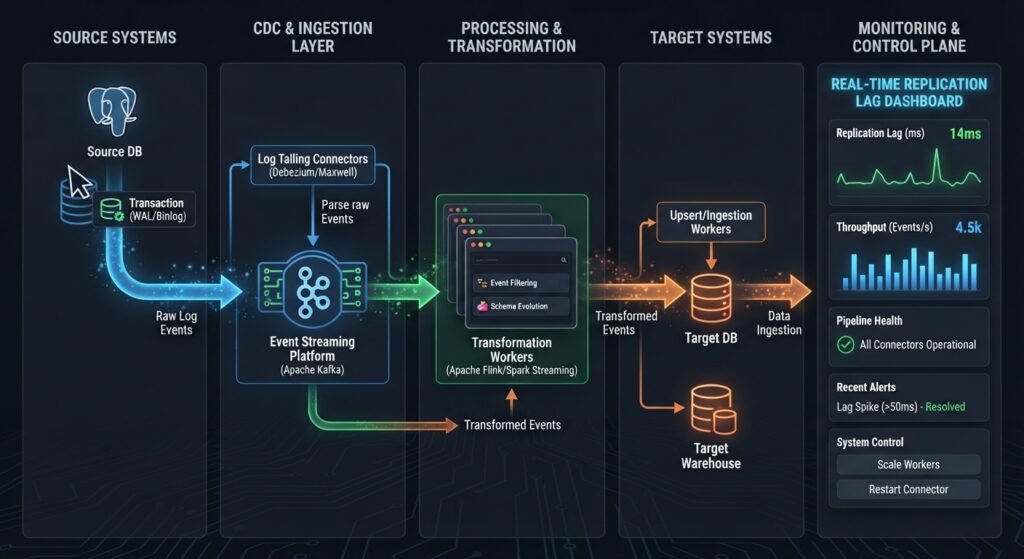
In these enterprise scenarios, Chang Data Capture (CDC) based on transaction log streaming provides the standard path forward:
- Initial Snapshotting: A secondary worker extracts a baseline snapshot of the source database and populates the target database.
- Log-Based CDC Streaming: Frameworks like Debezium or Kafka Connect continuously tail the transaction log (e.g., Postgres WAL or MySQL binlog) of the source database, streaming real-time row-level changes (INSERTS, UPDATES, DELETES) to the target database.
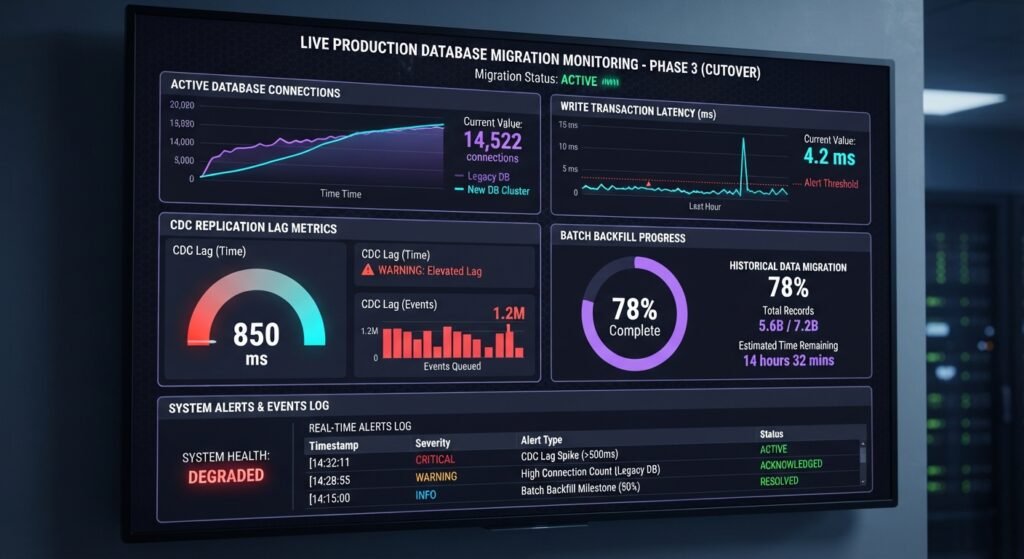
- Replication Lag Validation: Data verification tools constantly compare source and target checksums while monitoring replication lag.
- Controlled Cutover Execution: Once replication lag drops to near zero, the application momentarily pauses incoming write connections or sets a read-only state, allows the final CDC event queue to drain completely, redirects connection strings to the target database, and resumes full traffic.
[External Link: Insert high-authority external URL here with anchor text – “Official PostgreSQL Documentation on Logical Replication and WAL Capture”]
Technical Guardrails & Best Practices for High-Load Systems
To ensure safety during a zero-downtime database migration, engineering teams must enforce strict operational constraints:
- Batch Backfills with Rate Limiters: Never run a single unbounded
UPDATE table SET new_col = old_colquery on millions of rows. Backfill data in small, index-bounded chunks (e.g., 1,000 records per batch) with sleep intervals to avoid lock contention and CPU spikes. - Concurrent Index Creation: Always build indexes using non-blocking commands such as
CREATE INDEX CONCURRENTLYin PostgreSQL to prevent full table write locks. - Set Strict Lock Timeouts: Configure
lock_timeoutparameters in migration sessions so that schema alterations fail fast and gracefully if they cannot acquire a lock immediately, preventing thread blockages. - Validate Application Rollback Safety: At every step of the deployment sequence, ensure that rolling back the application code to a previous binary version will not cause catastrophic runtime errors against the current schema state.
Strategy Comparison Matrix
| Migration Strategy | Key Mechanism | Best Use Case | Operational Complexity | Risk Profile |
| Expand-Contract Pattern | Phased additive schema changes & dual writes | Column renames, data type alterations, schema splits | Medium (Requires multi-stage app releases) | Low (Fully reversible at each step) |
| CDC Log Streaming | Transaction log capture & target replication | Major version updates, engine switches, cloud shifts | High (Requires streaming pipeline management) | Low to Medium (Validated via lag checks) |
| Database Triggers | On-disk database triggers syncing shadow tables | Legacy monolith refactoring without app dual writes | Medium | Medium (Adds hidden write latency) |
| Blue/Green Switch | Read-only cutover with DNS/Proxy routing | Stateless database cutovers or low-write windows | Low | High (Risk of data loss if lag exists) |
Conclusion
Designing a zero-downtime database migration in high-traffic systems requires moving away from risky, single-step schema changes and adopting continuous, backward-compatible migration patterns. By decoupling schema expansions from data backfilling and leveraging modern CDC pipelines, engineering teams can refactor data architectures and migrate storage engines seamlessly under heavy production load. Adopting these technical guardrails safeguards uptime, maintains data consistency, and ensures high application availability throughout every deployment.
Frequently Asked Questions (FAQs)
What is the expand-contract pattern in zero-downtime database migrations?
The expand-contract pattern (also known as parallel change) is a refactoring strategy where you first expand a database schema by adding new structures alongside existing ones, deploy application code that supports both structures, backfill historical data, and finally contract the schema by removing the old structures once nothing depends on them.
How do you backfill millions of rows without locking a live database?
Backfilling large datasets without downtime requires running asynchronous background scripts that process data in small, rate-limited batches using indexed primary keys (e.g., updating 1,000 rows at a time). Including brief sleep delays between batches prevents CPU exhaustion, I/O saturation, and transaction lock contention on production databases.
How does Change Data Capture (CDC) prevent data loss during database cutover?
CDC continuously reads the database engine’s transaction log (such as the Postgres WAL or MySQL binlog) and streams incremental changes to the target database in real time. During cutover, writes are briefly set to read-only on the source to allow the remaining queued CDC transactions to process (bringing replication lag to zero) before routing application connections to the new target database.
1 thought on “How to Design Zero-Downtime Database Migration in High-Traffic Systems”