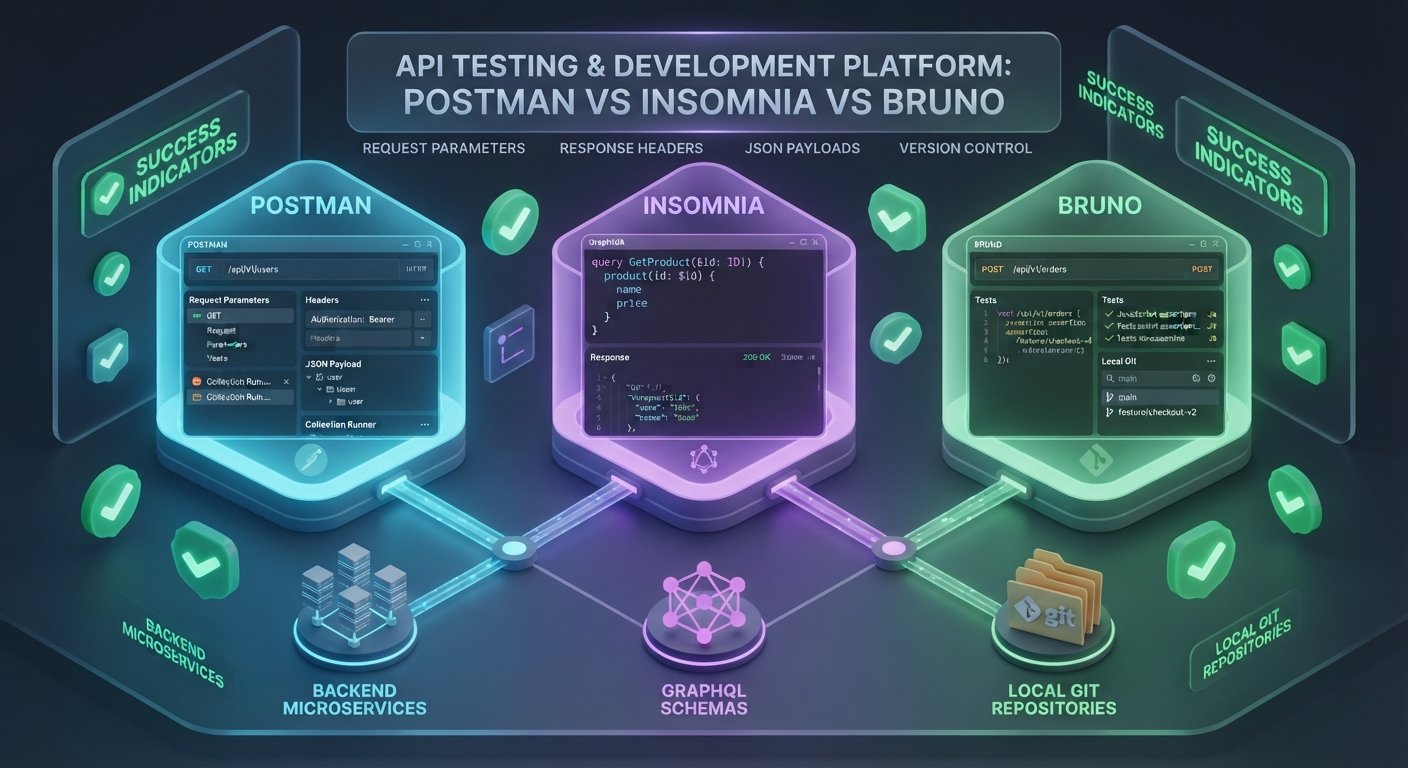
Selecting the right API client is critical for modern software engineering teams building microservices, web applications, and backend APIs. As API architectures grow in complexity, developers need testing tools that fit their team’s privacy rules, speed demands, and source control workflows.
Finding the best api testing tools for developers postman vs insomnia vs bruno requires looking beyond basic HTTP request execution. The API tooling space has shifted from centralized cloud platforms to privacy-focused, offline-first, Git-native desktop apps. This guide compares Postman, Insomnia, and Bruno across architecture, version control, offline support, team collaboration, and pricing to help you pick the right tool.
Key Takeaways
- Storage Model & Privacy: Bruno operates on an offline-first, Git-native model using plain-text
.brufiles directly in your repository. Postman and Insomnia default to cloud workspaces, though Insomnia supports hybrid local options. - Enterprise Features: Postman remains the industry platform for enterprise governance, offering built-in mock servers, automated monitors, API documentation generation, and role-based access control (RBAC).
- Design-First Workflows: Insomnia excels at spec-first API development, providing native OpenAPI/Swagger editing alongside gRPC, GraphQL, and WebSocket support in a clean interface.
- Performance & Resource Consumption: Open-source Bruno provides fast app startup times (~1.5s) and zero seat fees, avoiding heavy cloud overhead or forced cloud sync.
Architectural Comparison: How Storage and Sync Differ
The main difference between Postman, Insomnia, and Bruno comes down to where API collections live and how teams sync changes.
┌────────────────────────────────────────────────────────────────────────┐
│                    API CLIENT STORAGE & SYNC ARCHITECTURES             │
├───────────────────────────────┬────────────────────────────────────────┤
│ CLOUD-FIRST (POSTMAN)         │ HYBRID STORAGE (INSOMNIA)              │
├───────────────────────────────┼────────────────────────────────────────┤
│ - Central Cloud Workspace     │ - Hybrid Cloud & Local Encryption      │
│ - Account Sign-in Required    │ - Native OpenAPI / Swagger Integration │
│ - Enterprise RBAC & Audit     │ - Multi-protocol (GraphQL, gRPC, HTTP) │
├───────────────────────────────┴────────────────────────────────────────┤
│ GIT-NATIVE / LOCAL-FIRST (BRUNO)                                      │
│ - Plain-Text Files (.bru) Stored Directly in Code Repository           │
│ - Offline-First, Zero Cloud Dependency & Direct PR Code Reviews        │
└────────────────────────────────────────────────────────────────────────┘
1. Postman: The Ecosystem Giant
Postman stores collections, environments, and mock data inside its proprietary cloud infrastructure. While this setup enables instant workspace sharing, it requires user accounts and creates third-party data compliance concerns for sensitive API tokens.
2. Insomnia: The Flexible Middle Ground
Kong’s Insomnia offers a hybrid model. It supports local vaults, Git sync, and encrypted cloud sync side-by-side, giving teams flexibility without locking them into a single cloud workflow.
3. Bruno: The Git-Native Innovator
Bruno discards proprietary cloud sync completely. It stores API collections as plain-text .bru files directly inside your source repository. Collaboration happens naturally through standard Git pull requests, code reviews, and branch merges.
To see how frontend layout patterns consume API data offline, read our technical breakdown on [Building Progressive Web Apps (PWAs): Best Practices and Architecture Overview]([Internal Link: Insert relevant internal URL here with anchor text]).
Tool-by-Tool Breakdown
1. Postman
Postman is a complete API platform rather than a simple desktop client. It covers the entire API lifecycle—from design and mock servers to automated monitoring and developer portals.
- Pros: Built-in mock servers, scheduled collection runners, enterprise governance, and wide integration ecosystems.
- Cons: High memory footprint, required cloud sign-in, and costly team pricing tiers.
- Best For: Enterprise organizations requiring centralized API discovery, RBAC, and automated cloud monitoring.
2. Insomnia
Insomnia is built for clean, design-first API workflows. Its native OpenAPI editor lets developers write specifications and test live endpoints in the same view.
- Pros: Clean UI, strong GraphQL introspection, OpenAPI integration, and flexible local/cloud options.
- Cons: Lacks built-in mock servers and scheduled background collection runners.
- Best For: Developers who want spec-first OpenAPI development, GraphQL exploration, and a uncluttered UI.
3. Bruno
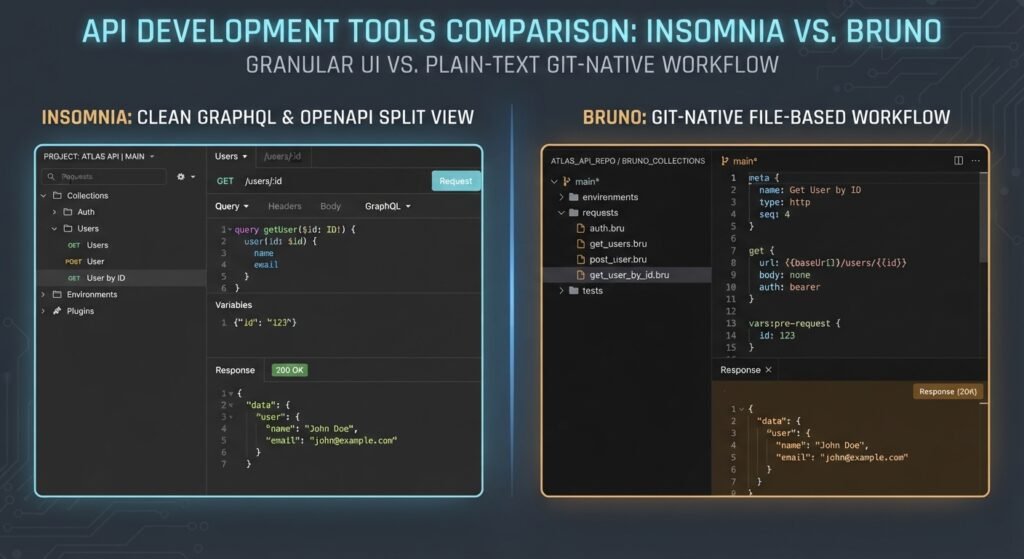
Bruno is a fast, open-source API client that treats your API collections like source code.
- Pros: Fast startup, completely offline and private, native Git file structure, zero seat license fees, and a free CLI runner.
- Cons: No native mock servers, hosted documentation hubs, or cloud-scheduled monitors.
- Best For: Code-first engineering teams, open-source maintainers, and privacy-focused developers who prefer Git versioning.
Detailed Feature Comparison Matrix
| Feature / Metric | Postman | Insomnia | Bruno |
|---|---|---|---|
| Primary Storage Model | Cloud Workspace | Hybrid (Local / Cloud / Git) | Git-Native Plain-Text (.bru) |
| Offline Capability | Limited / Cloud Sync Primary | Supported (Local Vault) | 100% Offline-First |
| Collaboration Model | Cloud Workspaces & Roles | Enterprise Sync & Git | Native Git Branching & PRs |
| OpenAPI / Swagger Support | Import & Export | First-Class Spec Editor | Import / Export |
| Mock Servers & Monitors | Native Built-In | Third-Party Plugins | None (Use CLI / Local Mocks) |
| App Performance & Boot Time | Heavy (~6–10s) | Moderate (~3s) | Ultra-Fast (~1.5s) |
| CLI Pipeline Integration | Newman CLI | Inso CLI | Bru CLI (Free & Open Source) |
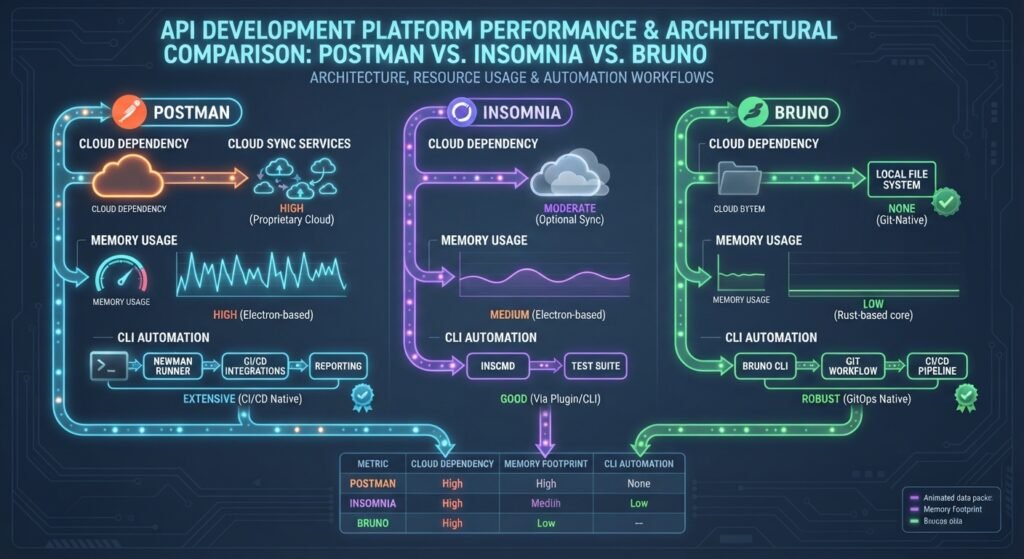
CI/CD Pipeline Automation & CLI Runners
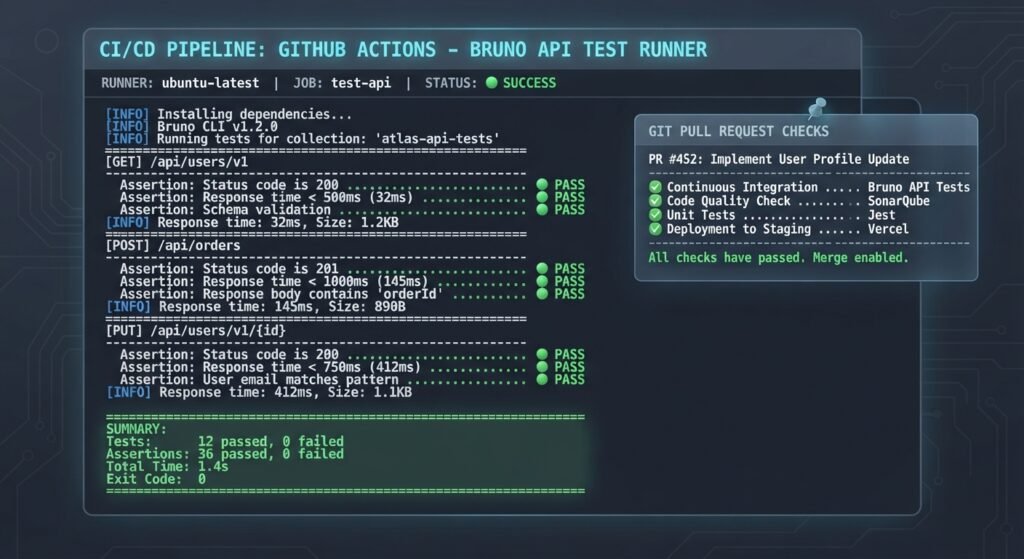
Running API tests inside automated build pipelines is essential for modern continuous integration. All three clients support CLI execution, but their implementations differ:
┌─────────────────────────────────────────────────────────────────────────────────┐
│                     CONTINUOUS INTEGRATION (CI) EXECUTION FLOW                  │
├──────────────┬──────────────────┬──────────────────┬────────────────────────────┤
│ STEP 1       │ STEP 2           │ STEP 3           │ STEP 4                     │
│ Commit API   │ Pull Request     │ Run CLI Tests    │ Block / Merge              │
│ Collection   │ Triggers Pipeline│ (Bru / Inso /    │ Deployment                 │
│ Changes      │ Execution        │ Newman)          │ Pipeline                   │
└──────────────┴──────────────────┴──────────────────┴────────────────────────────┘
- Postman (Newman): Requires exporting JSON collection and environment blobs or authenticating via API keys to pull cloud workspaces during CI runs.
- Insomnia (Inso CLI): Uses the
insoCLI to parse local files or Git repos, making it easy to run REST and GraphQL linting steps. - Bruno (Bru CLI): Uses
bru rundirectly against the.brudirectory in your project repo. Because tests travel alongside backend source code, CI pipelines run assertions without extra export steps or cloud secrets.
For web compatibility standards and API HTTP specifications, consult the official MDN Web APIs Overview.
Final Decision Framework: Which Tool Should You Choose?
When deciding on the best api testing tools for developers postman vs insomnia vs bruno, pick the platform that matches your team’s workflow:
- Choose Postman if: Your enterprise needs mock servers, automated cloud monitoring, central workspace governance, or public API network exposure.
- Choose Insomnia if: You prioritize design-first OpenAPI editing, build heavily with GraphQL, or want a clean interface with hybrid local/cloud storage.
- Choose Bruno if: You want lightweight, open-source API testing without cloud lock-in, prefer versioning API collections in Git alongside source code, and want zero per-seat costs.
Frequently Asked Questions (FAQs)
Can I migrate my existing collections from Postman to Bruno or Insomnia?
Yes. Both Bruno and Insomnia provide built-in import utilities for Postman Collection v2.1 JSON files and environment variables. Most endpoints, headers, and basic pre-request scripts translate cleanly.
Is Bruno completely open-source and free for commercial use?
Yes, Bruno’s core app and CLI runner are open-source and free to use under the MIT license, making them suitable for commercial and enterprise teams.
How does Bruno handle sensitive credentials like API keys and passwords in Git repositories?
Bruno uses environment files with secrets separation. Developers commit .bru template collections containing placeholder variables (e.g., {{apiKey}}) while keeping local secrets in .gitignore-backed environment files or local process environment variables.
1 thought on “Best API Testing Tools for Developers: Postman vs Insomnia vs Bruno”