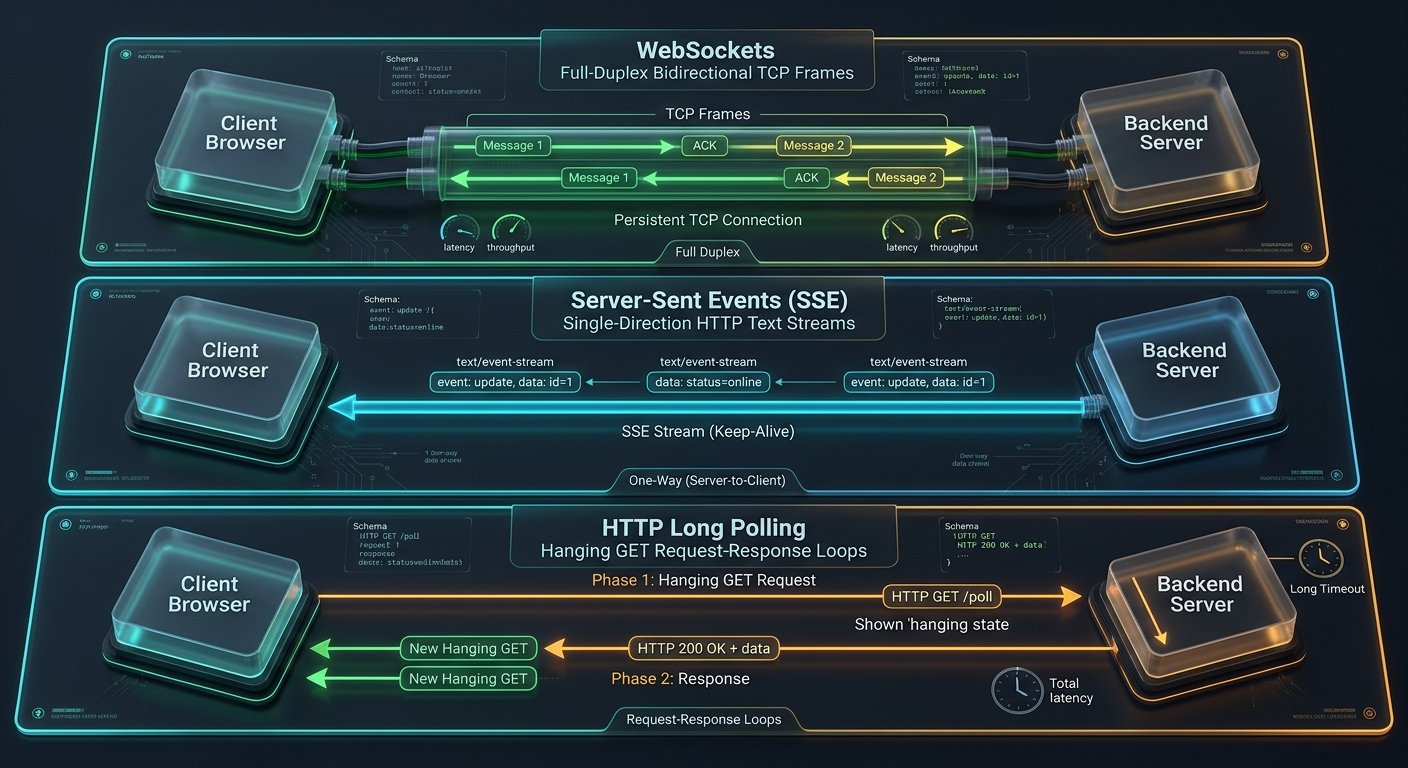
WebSockets vs. Server-Sent Events vs. Long Pollingweb applications demand instantaneous data updates. Whether powering collaborative document editing, live sports scoreboards, real-time telemetry dashboards, or streaming AI chatbot responses, users expect interfaces to update without manual page refreshes. However, building reliable, scalable real-time communication channels requires choosing the right underlying transport protocol.
Engineers evaluating WebSockets vs Server-Sent Events (SSE) vs Long Polling must navigate distinct trade-offs across protocol overhead, network topology, firewall compatibility, and server resource consumption. While traditional HTTP was built on a short-lived request-response model, modern real-time requirements demand persistent connections that allow servers to push data proactively.
This comprehensive architectural deep dive analyzes how each protocol operates under the hood, examines their performance and scalability profiles, and provides a clear decision framework for production applications.
Key Takeaways
- Full-Duplex vs. Uni-Directional: WebSockets provide a true full-duplex, bidirectional communication channel over a single TCP connection. SSE and Long Polling are uni-directional push channels where data flows strictly from server to client.
- Protocol Layers: Long Polling relies entirely on standard HTTP requests/responses (simulating push via hanging GETs). SSE uses a single, long-lived HTTP connection using the
text/event-streamcontent type. WebSockets upgrade the connection away from HTTP entirely into persistent TCP/binary frames. - Reconnection & Resilience: SSE features built-in browser automatic reconnection and
Last-Event-IDstate tracking. WebSockets require custom heartbeat (ping/pong) and reconnection logic, while Long Polling handles reconnects naturally through its iterative request loop. - The AI Streaming Standard: Server-Sent Events (SSE) have become the industry standard for streaming generative AI model responses (such as ChatGPT and Claude) due to their simplicity and native browser
EventSourcesupport.
The Evolution of Real-Time Web Communications
To understand the core differences between these three paradigms, we must examine how they manage network lifecycles over standard TCP connections
WebSockets vs. Server-Sent Events vs. Long Polling
┌────────────────────────────────────────────────────────────────────────┐
│               REAL-TIME TRANSPORT PROTOCOL OVERVIEW                    │
├───────────────────┬───────────────────┬────────────────────────────────┤
│ PROTOCOL          │ CONNECTION TYPE   │ COMMUNICATION DIRECTION        │
├───────────────────┼───────────────────┼────────────────────────────────┤
│ Long Polling      │ Iterative HTTP    │ Simulated Push (Client pulls,  │
│                   │ Requests          │ server holds response)         │
├───────────────────┼───────────────────┼────────────────────────────────┤
│ Server-Sent       │ Persistent HTTP   │ Uni-Directional Server Push    │
│ Events (SSE)      │ Stream            │ (Client sends separate HTTP)   │
├───────────────────┼───────────────────┼────────────────────────────────┤
│ WebSockets        │ Persistent TCP    │ Full-Duplex Bidirectional      │
│                   │ Socket Frames     │ (Both sides send anytime)      │
└───────────────────┴───────────────────┴────────────────────────────────┘
1. HTTP Long Polling: The Legacy Compatibility Fallback
HTTP Long Polling is a communication technique that simulates server push over traditional HTTP/1.1 request-response cycles. Instead of the server returning an immediate empty response when no data is ready, it “hangs” the request open until new data becomes available or a timeout threshold is reached.
Scribd
Client ──(HTTP GET /wait)──► Server [Holds Request Open]
Client ◄──(Data Response)─── Server (Data ready or timeout)
Client ──(HTTP GET /wait)──► Server [Immediately re-establishes]
Mechanics & Workflow
- The client sends an HTTP GET request to the server.Scribd
- If no new data exists, the server holds the connection open (a “Hanging GET”).Scribd
- Once an event occurs or a timeout triggers, the server sends a standard HTTP response.Scribd
- Upon receiving the payload, the client immediately initiates a new long-poll request, restarting the cycle.Scribd
Advantages & Drawbacks
- Pros: Works through virtually all corporate firewalls, strict HTTP proxies, and legacy load balancers because it relies entirely on standard HTTP requests.
- Cons: High connection churn and header overhead. Every single message requires a fresh TCP handshake (unless HTTP keep-alive is optimized), new HTTP headers, authentication checks, and server routing overhead.At scale, this creates massive CPU and memory consumption.VickyBytes
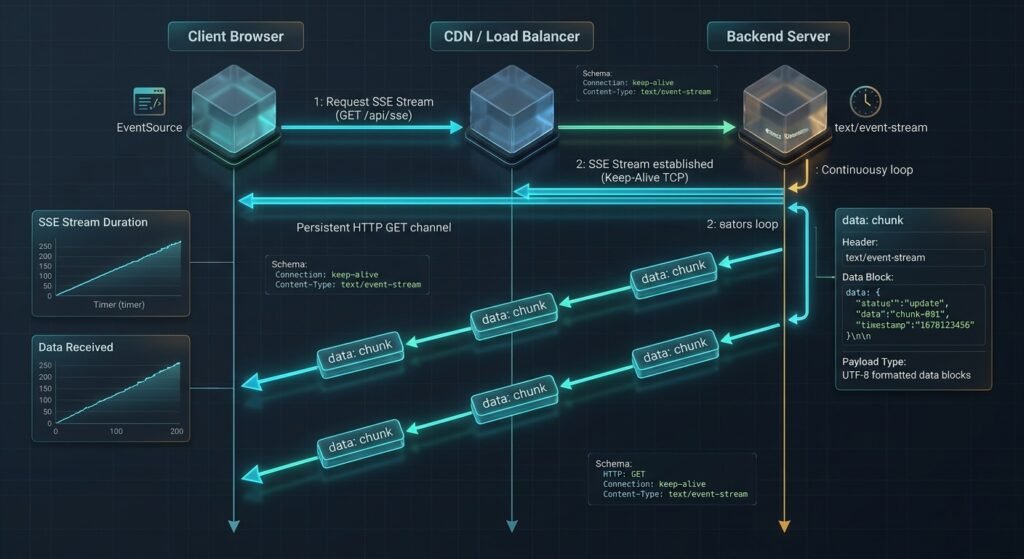
Server-Sent Events provide a lightweight, native browser mechanism for streaming data from a server to a client over a single, long-lived HTTP connection.
DEV Community
Client ──(HTTP GET /stream, Accept: text/event-stream)──► Server
Client ◄──(data: update payload \n\n)─────────────────── Server (Persistent)
Client ◄──(data: another event \n\n)──────────────────── Server
Mechanics & Workflow
- The client initiates an HTTP request with the header
Accept: text/event-stream. - The server responds with
Content-Type: text/event-streamand keeps the connection open indefinitely, writing UTF-8 formatted event frames separated by double newlines (\n\n).Back4app - The browser’s native
EventSourceAPI consumes the stream automatically, parsingdata:,event:, andid:fields.Back4app - If the connection drops, the browser automatically attempts reconnection, passing the last received event ID via the
Last-Event-IDheader.Back4app
Advantages & Drawbacks
- Pros: Extremely simple to implement on both client and server. Native automatic reconnection, built-in event IDs, multiplexing support over HTTP/2, and compatibility with standard web infrastructure. Perfect for streaming AI text generation (ChatGPT/Claude web clients).DEV Community+ 1
- Cons: Strictly uni-directional (server-to-client). If the client needs to send data back to the server, it must use standard separate HTTP requests (like fetch or axios), making it inefficient for high-frequency bidirectional chatter.Back4app
.
3. WebSockets: The Full-Duplex Real-Time Powerhouse
The WebSocket protocol (RFC 6455) establishes a persistent, bi-directional communication channel operating over a single TCP connection. It begins with an HTTP/HTTPS handshake that “upgrades” the connection, after which HTTP is discarded entirely in favor of lightweight TCP framing.
Scribd+ 1
Client ──(GET /ws, Upgrade: websocket)──► Server
Client ◄──(101 Switching Protocols)────── Server (Connection Upgraded)
Client ◄──────(Binary / Text Frames)─────► Server (Full-Duplex Bi-directional)
Mechanics & Workflow
- The client sends an HTTP request containing
Upgrade: websocketandConnection: Upgradeheaders.Back4app - If supported, the server responds with status
101 Switching Protocols.Back4app - The connection transitions from HTTP to the WebSocket protocol (
ws://or encryptedwss://). - Both client and server can now send lightweight text or binary frames asynchronously at any time with minimal header overhead (~2 to 14 bytes per frame).Back4app
Advantages & Drawbacks
- Pros: True full-duplex communication with ultra-low latency, capable of transmitting both text and heavy binary payloads efficiently. Ideal for real-time collaborative editing, multiplayer gaming, and high-frequency financial trading.Back4app+ 1
- Cons: Bypasses standard HTTP caching and proxy mechanisms, which can complicate load balancing (requiring sticky sessions). Furthermore, you must build your own application-level protocol on top of raw frames (such as heartbeat pings, reconnection backoff, message acknowledgments, and backpressure handling).DEV Community+ 1
Technical Comparison Matrix
┌─────────────────────────────────────────────────────────────────────────────────┐
│                      REAL-TIME PROTOCOL COMPARISON MATRIX                       │
├──────────────┬──────────────────┬──────────────────┬────────────────────────────┤
│ FEATURE      │ LONG POLLING     │ SERVER-SENT      │ WEBSOCKETS                 │
│              │                  │ EVENTS (SSE)     │                            │
├──────────────┼──────────────────┼──────────────────┼────────────────────────────┤
│ Communication│ Simulated Push   │ Uni-Directional  │ Full-Duplex                │
│ Direction    │ (Pull-based loop)│ (Server ➔ Client)│ (Bidirectional)            │
├──────────────┼──────────────────┼──────────────────┼────────────────────────────┤
│ Protocol     │ Standard HTTP/1.1│ HTTP Stream      │ TCP Framing                │
│ Foundation   │                  │ (text/event-     │ (Post-handshake            │
│              │                  │ stream)          │ upgrade)                   │
├──────────────┼──────────────────┼──────────────────┼────────────────────────────┤
│ Header       │ High (Every      │ Low (Single      │ Extremely Low              │
│ Overhead     │ poll request)    │ connection setup)│ (~2–14 bytes per frame)    │
├──────────────┼──────────────────┼──────────────────┼────────────────────────────┤
│ Auto-        │ Manual (Custom   │ Native (Built into│ Manual (Requires custom   │
│ Reconnect    │ client loops)    │ browser API)     │ logic or libraries like    │
│              │                  │                  │ Socket.io)                 │
├──────────────┼──────────────────┼──────────────────┼────────────────────────────┤
│ Binary Data  │ Supported (Base64│ Requires Base64  │ Native Binary Support      │
│ Support      │ encoded via HTTP)│ text encoding    │ (ArrayBuffer / Blob)       │
└──────────────┴──────────────────┴──────────────────┴────────────────────────────┘
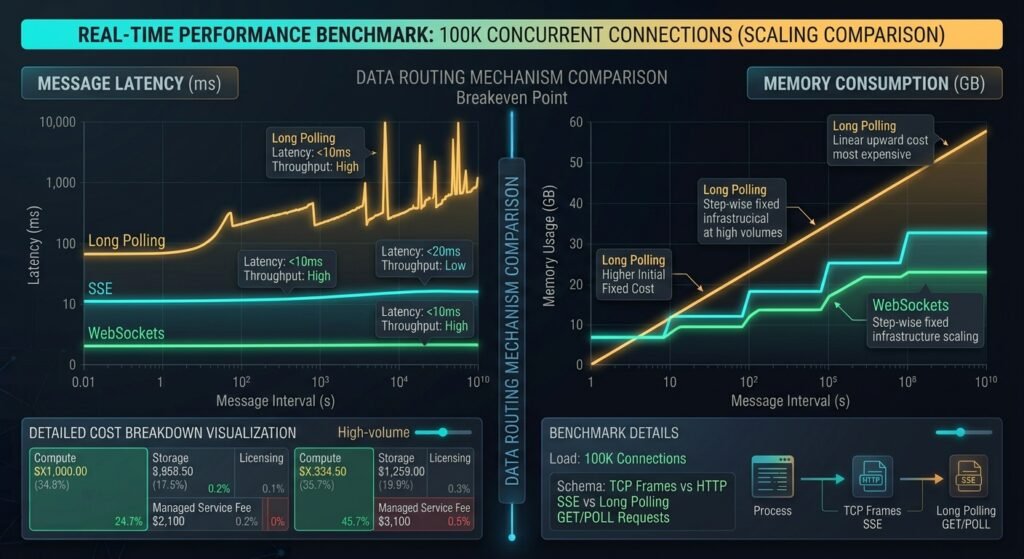
Production Considerations & Edge Cases
When deploying these protocols into production environments, several architectural bottlenecks frequently emerge:
- Proxy and Firewall Interference: Strict corporate proxies or older corporate firewalls may drop upgrade headers required for WebSockets or buffer long-lived HTTP streams for SSE. Always test your transport layer through real-world network infrastructure.Back4app
- Load Balancing & Horizontal Scaling: Because WebSockets and SSE maintain stateful, persistent connections, standard round-robin load balancing can break multi-instance messaging. Deploying an intermediary pub/sub message broker (such as Redis Pub/Sub or Apache Kafka) is essential to synchronize messages across scaled backend nodes.
- Server File Descriptors: Every open WebSocket or SSE connection consumes a socket file descriptor on the server. Tuning your operating system’s
nofilelimits (viaulimitor systemd service configurations) is critical to preventEMFILE: too many open filescrashes under high load.
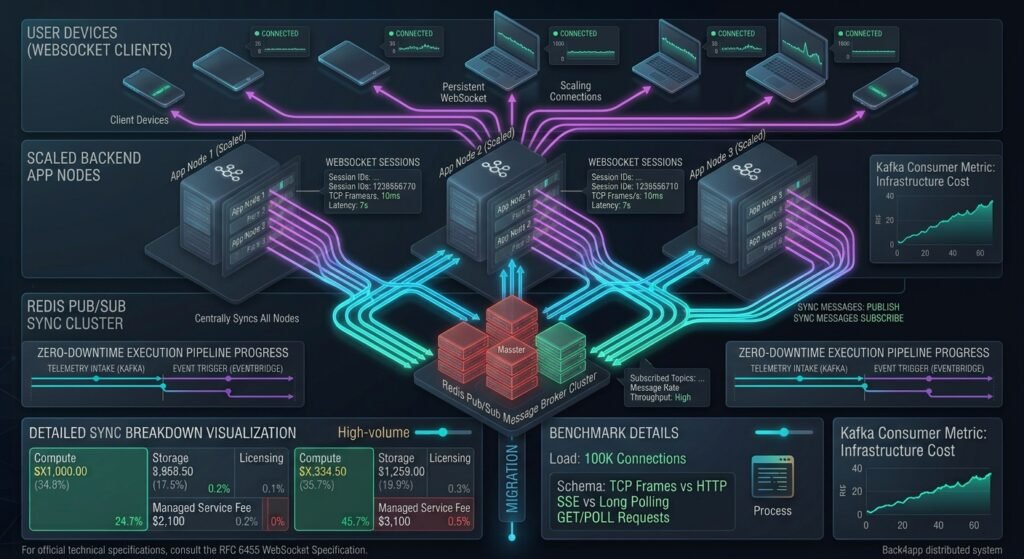
For official technical specifications on WebSocket framing, protocol handshakes, and security considerations, consult the RFC 6455 WebSocket Specification.
Back4app
Decision Framework: Which Protocol Should You Choose?
- Choose HTTP Long Polling When: You must support legacy enterprise environments with hostile proxies that block persistent connections, or when you need a reliable fallback mechanism when WebSockets fail to connect.Back4app
- Choose Server-Sent Events (SSE) When: Your application requires one-way server-to-client updates—such as live news tickers, notification badges, stock price feeds, or streaming LLM responses (ChatGPT/Claude interfaces)—and you want built-in auto-reconnection with minimal code complexity.DEV Community
- Choose WebSockets When: You are building real-time, highly interactive, bidirectional applications—such as live chat rooms, multi-user collaborative editing tools, multiplayer web games, or high-frequency telemetry dashboards where the client sends data as frequently as the server.DEV Community
Conclusion
Navigating WebSockets vs. Server-Sent Events (SSE) vs. Long Polling demonstrates that no single real-time protocol fits every architectural scenario. Long Polling survives primarily as a legacy fallback. Server-Sent Events offer an elegant, resilient, and simple solution for 80% of server-push requirements. WebSockets remain the definitive choice for high-frequency, full-duplex interactive communication.
Back4app+ 2
By carefully matching your application’s data flow direction, message frequency, and infrastructure constraints to the appropriate protocol, you can build responsive, highly scalable web systems that delight users without unnecessary architectural bloat.
Frequently Asked Questions (FAQs)
What is the primary difference between WebSockets and Server-Sent Events?
The primary difference is communication direction. WebSockets provide full-duplex, bidirectional communication where both client and server can send messages at any time over a single connection. Server-Sent Events (SSE) are strictly uni-directional, allowing only the server to push data to the client over a long-lived HTTP stream.
Back4app+ 1
Why do AI chat apps like ChatGPT use Server-Sent Events instead of WebSockets?
AI chat applications stream text generation unidirectionally from the server to the client. SSE is preferred over WebSockets because it uses standard HTTP/2, includes built-in automatic reconnection, integrates natively with the browser’s EventSource API, and avoids the extra protocol complexity of WebSockets.
DEV Community
Can WebSockets fallback to Long Polling automatically?
Native WebSockets cannot fall back automatically. However, popular abstraction libraries like Socket.io handle this automatically—attempting a WebSocket connection first and gracefully falling back to HTTP Long Polling if firewalls or proxies block the WebSocket handshake.
DEV Community
1 thought on “WebSockets vs. Server-Sent Events vs. Long Polling: Architectural Deep Dive”