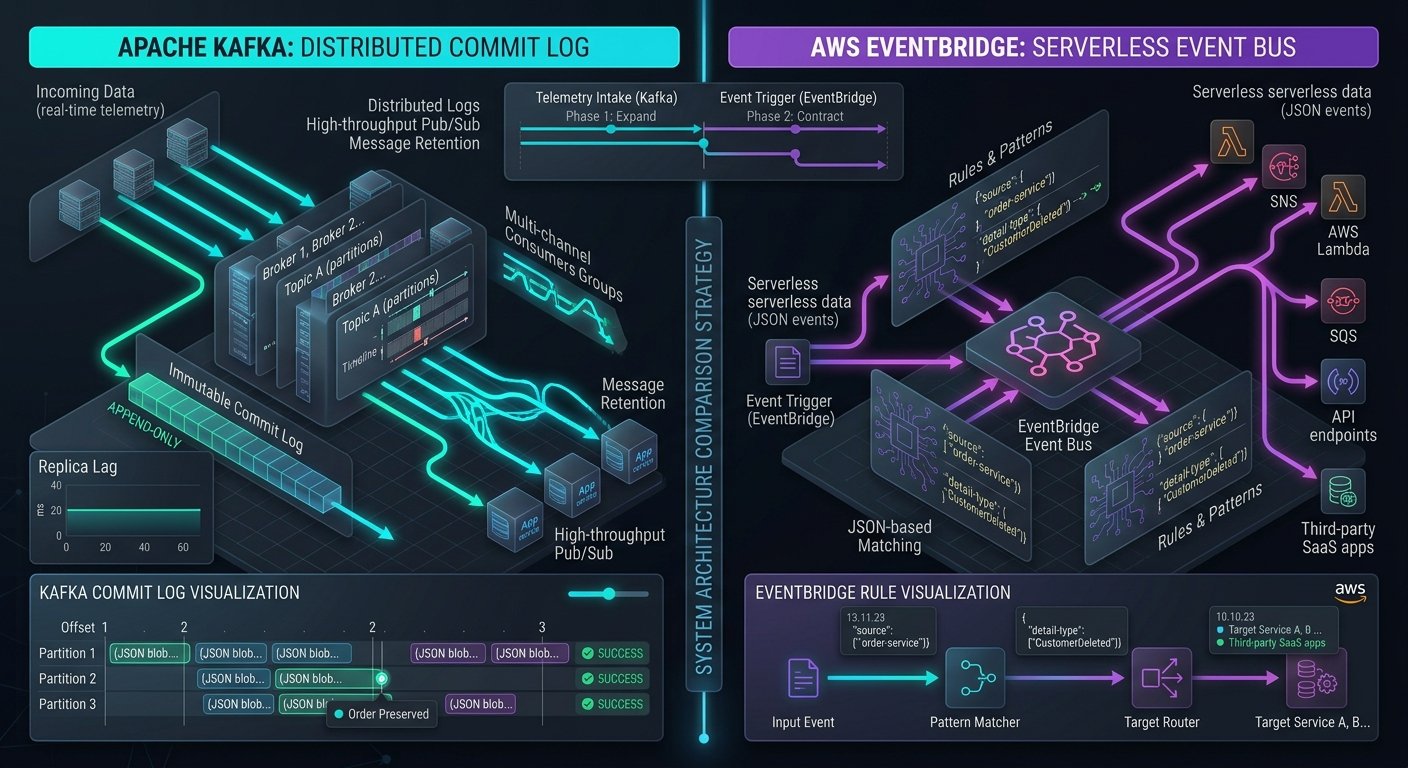
Designing Event-Driven Architectures: Apachevs. AWS ,modern distributed systems rely heavily on asynchronous event-driven architectures (EDA) to decouple services,enhance fault tolerance, and scale applications dynamically. When designing these systems, architects frequently encounter a fundamental tooling choice: should they deploy a distributed event streaming platform like Apache Kafka,or leverage a fully managed, serverless event router like AWS EventBridge?
While both technologies facilitate event-driven patterns, they operate at completely different layers of the infrastructure stack. Kafka functions as a distributed commit log built for heavy, continuous data streams, real-time analytics, and strict message ordering. Conversely, AWS EventBridge acts as a serverless event bus optimized for application integration, cloud resource orchestration, and content-based routing across AWS services and SaaS partners.
Algoroq+ 2
Choosing the right backbone when comparing Apache Kafka vs AWS EventBridge is vital for preventing technical debt, managing operational costs, and satisfying performance SLAs. This comprehensive guide breaks down their core architectural differences, trade-offs, and optimal deployment scenarios.
Key Takeaways
- Architectural Intent: Apache Kafka acts as a distributed commit log built for heavy, continuous data streams, event sourcing, and high-throughput real-time stream processing.Svix
- Routing Capabilities: AWS EventBridge features native content-based routing that inspects JSON event payloads, routing messages via rule patterns without custom consumer code.Algoroq
- Operational Overhead: EventBridge is entirely serverless with zero infrastructure management. Kafka requires cluster management, partition planning, and cluster tuning (unless using managed tiers like Amazon MSK or Confluent Cloud).MatterAI+ 1
- Message Retention & Replay: Kafka retains immutable events directly on disk for configurable periods, allowing consumers to reset offsets and replay historic data. EventBridge requires explicitly enabled archiving features to store and replay past events.MatterAI+ 1
Core Architectural Differences
To evaluate Apache Kafka vs AWS EventBridge effectively, architects must examine their underlying message transport mechanics and storage models.
nexabizz.com –
┌────────────────────────────────────────────────────────────────────────┐
│               KAFKA vs. EVENTBRIDGE ARCHITECTURAL COMPARISON           │
├───────────────────────────────┬────────────────────────────────────────┤
│ ARCHITECTURAL DIMENSION       │ APACHE KAFKA                           │ AWS EVENTBRIDGE                       │
├───────────────────────────────┼────────────────────────────────────────┼───────────────────────────────────────┤
│ Infrastructure Model          │ Distributed cluster (Self-hosted or    │ Fully managed, serverless cloud       │
│                               │ Managed MSK / Confluent Cloud)         │ service (Zero servers to manage)      │
├───────────────────────────────┼────────────────────────────────────────┼───────────────────────────────────────┤
│ Primary Message Model         │ Append-only distributed commit log     │ Serverless event bus with JSON        │
│                               │ partitioned by keys                    │ pattern matching rules                │
├───────────────────────────────┼────────────────────────────────────────┼───────────────────────────────────────┤
│ Payload Routing Logic         │ Content-agnostic; routed by Topic      │ Content-based routing inspecting      │
│                               │ name and optional partition key        │ any field inside the JSON payload     │
├───────────────────────────────┼────────────────────────────────────────┼───────────────────────────────────────┤
│ Message Retention             │ Time-based or size-based durable       │ Ephemeral by default; optional        │
│                               │ storage (days, weeks, or permanent)    │ explicit archive and replay config    │
└───────────────────────────────┴────────────────────────────────────────┴───────────────────────────────────────┘
Apache Kafka: The Distributed Commit Log
Kafka treats data as a continuous, immutable stream of events organized into named Topics. Each topic is divided into partitions distributed across cluster brokers.
MatterAI
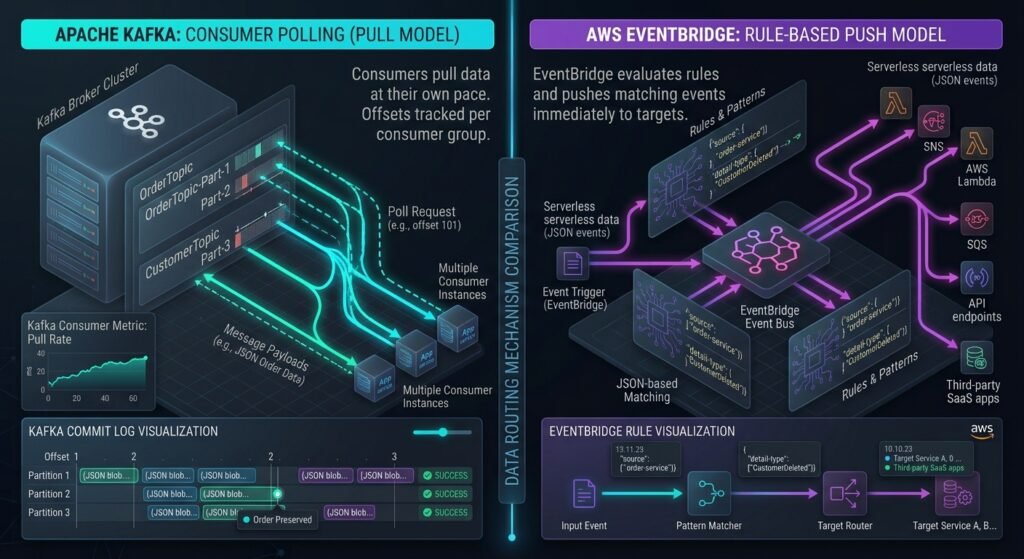
- Consumer-Managed Offsets: Consumers track their own consumption progress by committing offsets, allowing multiple independent consumer groups to read the same stream at their own pace without destroying data.MatterAI
- Ordering Guarantees: Kafka guarantees strict message ordering within a single partition, making it ideal for event-sourcing patterns and stateful stream processing.
AWS EventBridge: The Serverless Event Router
EventBridge operates as a managed brokerless event bus that ingests events from AWS services, custom applications, and authorized SaaS partners (such as Datadog, Zendesk, and Salesforce).
Algoroq
- Declarative Rules and Targets: Instead of consumer applications polling a topic, EventBridge evaluates incoming JSON payloads against defined rule patterns. If a pattern matches, EventBridge transforms and routes the payload directly to targets like AWS Lambda, SQS, Step Functions, or API Gateways.Algoroq
- Zero Infrastructure Management: Because it is fully serverless, EventBridge scales automatically with incoming event volume without requiring instance provisioning or partition resizing.MatterAI
Payload Filtering, Routing, and Extensibility
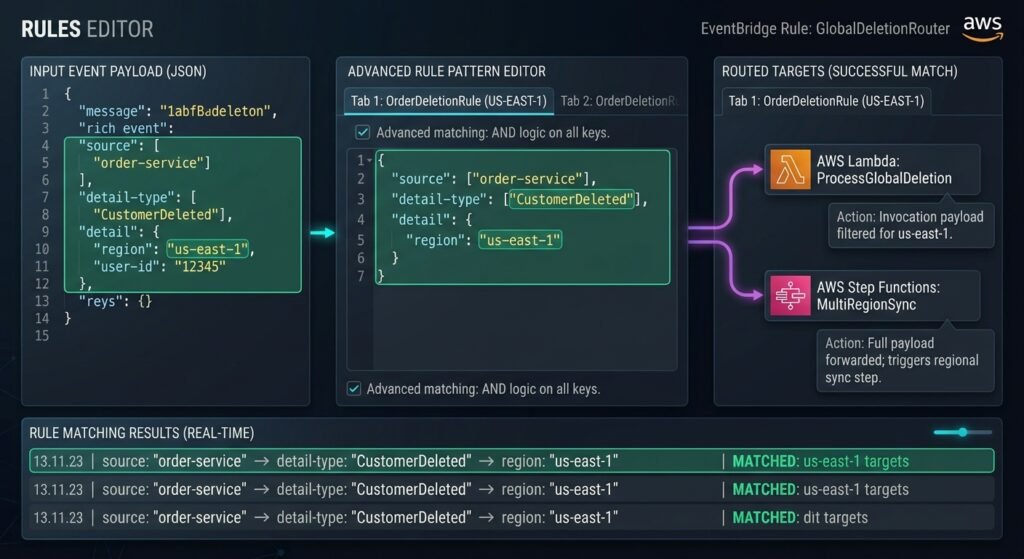
When comparing Apache Kafka vs AWS EventBridge, payload inspection represents a major operational differentiator.
Kafka: Content-Agnostic Brokers
Kafka brokers are intentionally content-agnostic. They do not parse or inspect message bodies; they simply append bytes to a partition log.
- Filtering Trade-Off: If a downstream consumer only cares about specific events (e.g.,
order_amount > 500), that consumer must ingest the entire topic stream and filter events inside application code.Algoroq - Custom Stream Processing: Complex transformations require deploying dedicated stream-processing applications using frameworks like Kafka Streams or ksqlDB.MatterAI
EventBridge: Advanced JSON Pattern Matching
EventBridge excels at fine-grained routing without boilerplate application code.
- Declarative Filtering: You can configure rules that inspect nested keys inside JSON payloads (e.g., matching events where
detail.currencyequals"USD"anddetail.totalexceeds1000). - Schema Registry Integration: EventBridge includes a managed schema registry that discovers and serializes event schemas, helping teams maintain contract safety across decoupled services.
Scalability, Latency, and Throughput
System performance and latency profiles differ substantially between the two platforms.
- Throughput and Latency: Kafka is engineered for extreme performance, capable of sustaining millions of events per second with sub-20ms end-to-end latency when configured with proper batching. It excels at high-volume data pipelines, IoT telemetry, and clickstream tracking.Algoroq+ 1
- EventBridge Scale: EventBridge is built for asynchronous event-driven application orchestration. While default soft quotas scale up to tens of thousands of requests per second per bus (adjustable upon request), it is not optimized for bulk data streaming or continuous high-frequency ingestion. Typical latency ranges from 50ms to 200ms.Algoroq
For official architectural best practices on distributed messaging and cloud scalability, consult the AWS Well-Architected Framework Documentation.
Operational Complexity and Cost Structures
Operating streaming and event infrastructure introduces distinct financial and engineering commitments.
Apache Kafka: Fixed Infrastructure & Operational Overhead
- Management Burden: Self-hosting Kafka requires managing brokers, ZooKeeper (or KRaft consensus mode), partition rebalancing, JVM tuning, and disk storage monitoring. Managed services like Amazon MSK or Confluent Cloud reduce this burden but still require capacity planning.MatterAI+ 1
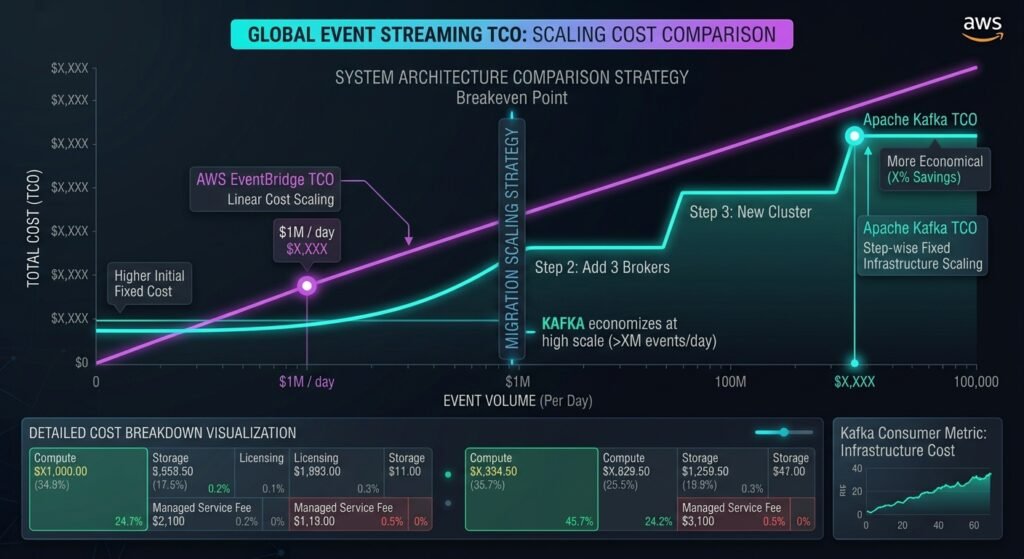
- Cost Efficiency at Scale: Kafka pricing is tied to provisioned infrastructure (EC2 instances and EBS storage).For massive, high-volume event streams handling billions of messages monthly, Kafka is significantly more economical per message than serverless alternatives.MatterAI
AWS EventBridge: Zero Operations & Pay-per-Event Pricing
- Zero Maintenance: AWS manages underlying availability, scaling, patching, and fault tolerance.
- Linear Cost Scaling: EventBridge charges based on the number of events ingested and routed ($1.00 per million events baseline, plus archive/schema costs). While extremely cost-effective for low-to-moderate or bursty workloads, costs can scale rapidly and become cost-prohibitive at extreme data volumes compared to provisioned clusters.MatterAI
| Evaluation Criteria | Choose Apache Kafka When… | Choose AWS EventBridge When… |
|---|---|---|
| Throughput & Volume | Sustained high-throughput streams (>10,000 events/sec) | Bursty, moderate, or sporadic event volumes |
| Cloud Environment | Multi-cloud, hybrid on-premises, or non-AWS infrastructure | Native AWS-centric cloud architecture |
| Data Replay & Retention | Need native log retention and historical state replay | Real-time stateless routing; archiving is secondary |
| Routing Complexity | Consumers handle custom filtering in application code | Need declarative JSON payload pattern matching rules |
| Team Operations | Dedicated platform/SRE team available for cluster ops | Zero infrastructure management desired |
Conclusion
Evaluating Apache Kafka vs AWS EventBridge highlights that these technologies are complementary rather than mutually exclusive. Apache Kafka remains the gold standard for high-throughput stream processing, real-time log aggregation, and large-scale event-sourcing pipelines requiring permanent storage and message replay. Conversely, AWS EventBridge provides unmatched serverless simplicity, seamless third-party SaaS integration, and fine-grained content filtering for modern cloud application orchestration.
Svix+ 1
Many sophisticated enterprise architectures successfully utilize both: deploying EventBridge for edge application integration and AWS service orchestration, while routing high-volume core data streams through Apache Kafka.Aligning your architectural choice with your throughput requirements, operational capacity, and cloud strategy will ensure a scalable event-driven backbone.
Algoroq
Frequently Asked Questions (FAQs)
Can AWS EventBridge completely replace Apache Kafka?
No. EventBridge cannot replace Kafka for high-volume streaming workloads. While EventBridge excels at routing discrete business events between services, it is not designed for continuous high-throughput stream processing, bulk log aggregation, or sub-20ms data pipelines handling millions of events per second.
nexabizz.com –
Is Apache Kafka difficult to operate in production?
Self-hosting Kafka introduces notable operational complexity, requiring expertise in partition management, broker tuning, and cluster recovery. However, managed offerings like Amazon MSK or Confluent Cloud significantly reduce this operational overhead.
MatterAI
Can AWS EventBridge replay past events?
Yes, but it requires explicit configuration. EventBridge offers an optional Event Archive and Replay feature, whereas Apache Kafka retains events natively in its distributed log partitions by default.
1 thought on “Designing Event-Driven Architectures: Apache Kafka vs. AWS EventBridge”