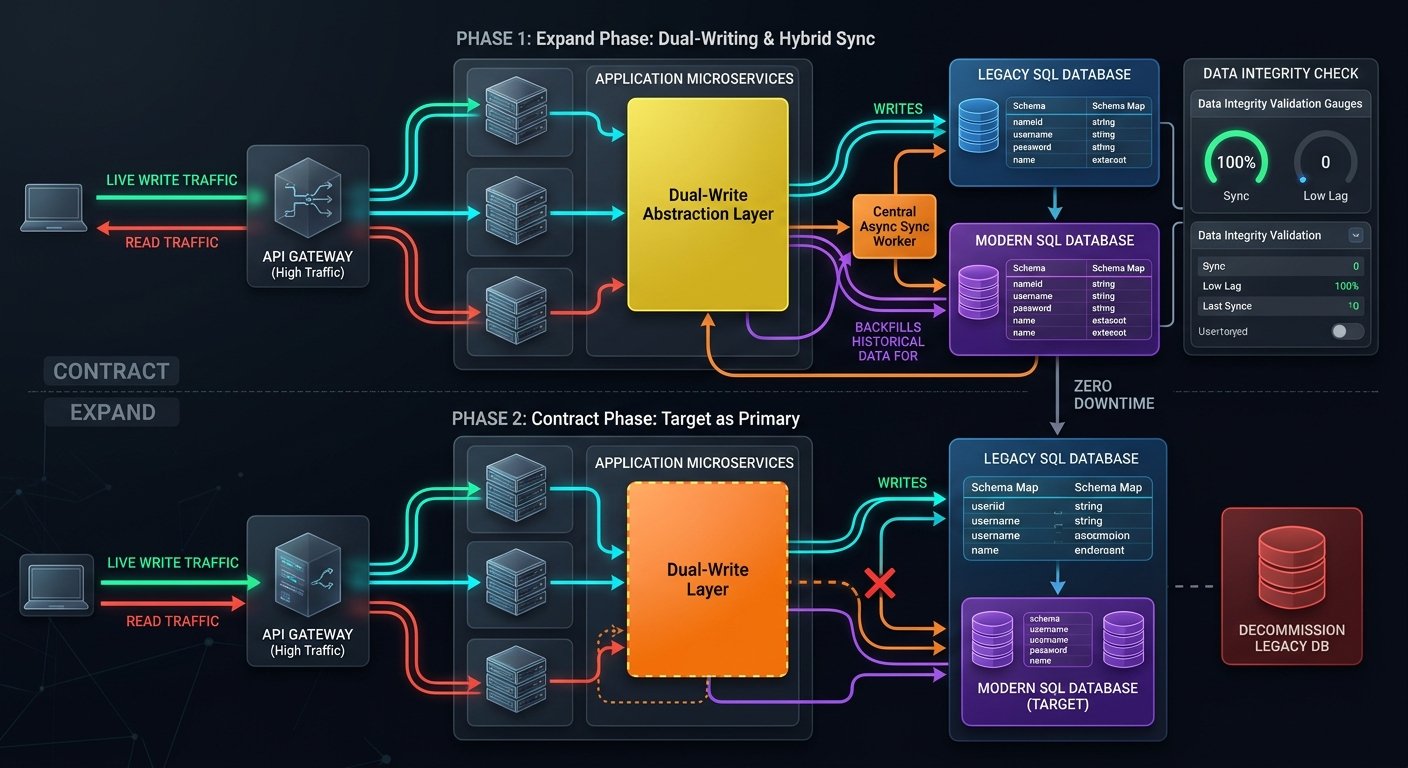
Executing schema updates or data model modifications in low-traffic or staging environments is straightforward: brief maintenance windows and exclusive table locks are acceptable trade-offs. However, in production microservices processing thousands of read/write transactions per second, taking a database offline for schema updates is unacceptable. A single blocking table lock can exhaust application connection pools, trigger cascading system failures,and breach strict availability SLAs.
Learning how to design zero-downtime database migrations in high-traffic systems requires moving away from destructive, single-step schema updates toward phased, backward-compatible deployment strategies. By implementing the Expand-Contract pattern (also known as Parallel Run), decoupled dual-writing mechanisms, and non-blocking Data Definition Language (DDL) operations, engineering teams can update production database schemas safely while maintaining continuous application availability.
This comprehensive guide breaks down the core architecture, step-by-step implementation phases, and risk-mitigation strategies required to execute seamless zero-downtime database migrations in demanding high-throughput environments.
Key Takeaways
- The Expand-Contract Pattern: Zero-downtime schema changes require breaking a single migration into four distinct deployment phases: Expand, Dual-Write, Backfill, and Contract.
- Backward Compatibility First: Application code must always support both old and new schema structures simultaneously before any legacy columns or tables are altered or dropped.
- Non-Blocking DDL Operations: High-traffic relational databases (like PostgreSQL and MySQL) require explicit non-blocking flags—such as
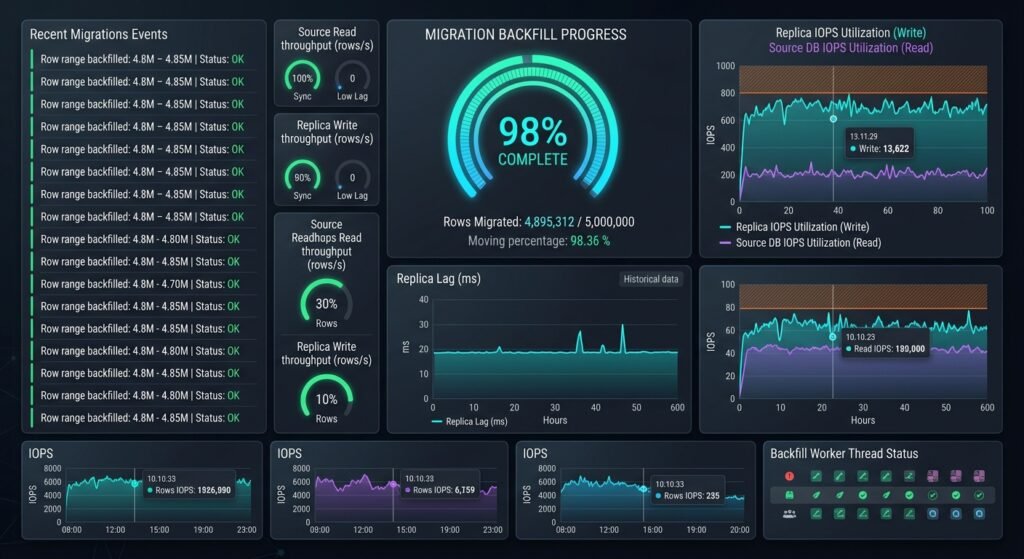
CREATE INDEX CONCURRENTLYorALGORITHM=INPLACE—to prevent long-running table locks. - Asynchronous Data Backfilling: Historical record migration must be executed in small, batched background jobs to avoid exhausting database IOPS or causing replication lag on read replicas.
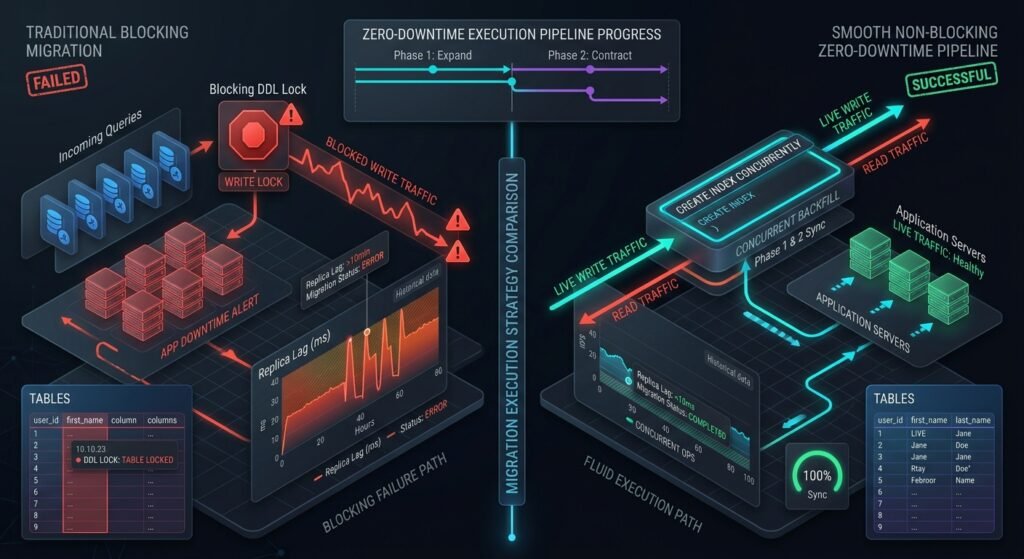
Why Traditional Single-Step Migrations Fail in High-Traffic Systems
Traditional database migrations combine schema modification and code updates into a single atomic deployment step.While simple, this approach introduces significant vulnerabilities in high-throughput environments:
- Exclusive Table Locks: Destructive operations like
ALTER TABLE ADD COLUMN NOT NULL DEFAULT ...or dropping a column lock the entire table. In high-traffic systems, incoming write queries queue up behind the lock, quickly exhausting database connection pools and causing system-wide timeouts. - Deployment Rollback Failures: If a combined application and database deployment fails halfway through,rolling back application code becomes impossible if the database schema was modified in a backward-incompatible way.
- Replication Lag: Unthrottled data updates on primary database nodes saturate WAL (Write-Ahead Logging) buffers, introducing massive replication lag across read replicas and degrading application performance.
┌────────────────────────────────────────────────────────────────────────┐
│             SINGLE-STEP vs. PHASED ZERO-DOWNTIME MIGRATION             │
├───────────────────────────────┬────────────────────────────────────────┤
│ TRADITIONAL MIGRATION         │ ZERO-DOWNTIME EXPAND-CONTRACT PATTERN  │
├───────────────────────────────┼────────────────────────────────────────┤
│ Single atomic deployment      │ Multi-phase backward-compatible rollout│
│ Acquires exclusive table locks│ Non-blocking DDL with background sync  │
│ High risk of service outage   │ Zero application downtime or locks     │
│ Rollback breaks compatibility │ Independent deployment rollbacks safe  │
└───────────────────────────────┴────────────────────────────────────────┘
The Four-Phase Expand-Contract Migration Framework
Understanding how to design zero-downtime database migrations in high-traffic systems centers on the Expand-Contract Pattern. This architectural approach decouples schema expansion from legacy contraction, ensuring that database structures and application code remain backward-compatible at every stage.
┌────────────────────────────────────────────────────────────────────────┐
│                     EXPAND-CONTRACT MIGRATION TIMELINE                 │
├────────────────────────────────────────────────────────────────────────┤
│ PHASE 1: EXPAND          │ Add new schema structures (e.g., new column)│
│                          │ without removing old ones. Fully backward-   │
│                          │ compatible with current live application.   │
├──────────────────────────┼─────────────────────────────────────────────┤
│ PHASE 2: DUAL-WRITE      │ Deploy application code that reads from the │
│                          │ old schema but writes to both old and new.  │
├──────────────────────────┼─────────────────────────────────────────────┤
│ PHASE 3: BACKFILL        │ Asynchronously copy historical records from  │
│                          │ old schema to new schema in small batches.  │
├──────────────────────────┼─────────────────────────────────────────────┤
│ PHASE 4: CONTRACT        │ Switch reads to new schema, remove dual-    │
│                          │ write logic, and drop legacy columns.       │
└──────────────────────────┴─────────────────────────────────────────────┘
Step-by-Step Practical Implementation Strategy
To illustrate this framework in practice, consider a common production scenario: splitting a legacy single name column in a high-traffic users table into distinct first_name and last_name columns without taking the application offline.
Phase 1: Expand (Additive Schema Modification)
Begin by adding the new first_name and last_name columns to the database. The new columns must be nullable or carry a valid default value so that existing application instances running the legacy code can continue inserting records into users without failing constraint checks.
SQL
-- PostgreSQL Non-Blocking Addition
ALTER TABLE users
  ADD COLUMN first_name VARCHAR(255),
  ADD COLUMN last_name VARCHAR(255);
Crucial Rule: Never add a
NOT NULLconstraint without a default value during the Expand phase. Doing so causes inserts from legacy application code to fail instantly.
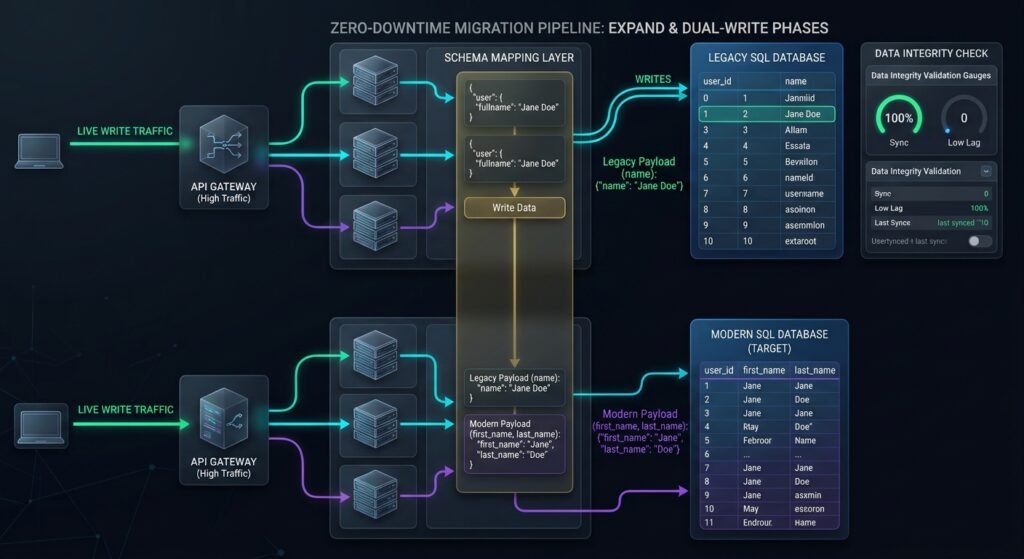
Phase 2: Dual-Writing (Data Synchronization)
Deploy a new version of the application code configured to execute dual-writes. During this phase:
- Reads continue querying the legacy
namecolumn. - Writes execute against both the legacy
namecolumn and the newfirst_name/last_namecolumns simultaneously within the same application transaction.
TypeScript
// Dual-Write Application Logic Example
async function createUser(userData: CreateUserDTO) {
  const { firstName, lastName } = parseName(userData.fullName);

  return await db.transaction(async (tx) => {
    return await tx.user.create({
      data: {
        // Legacy column (Preserves compatibility)
        name: `${firstName} ${lastName}`,
        // New columns (Prepares for transition)
        first_name: firstName,
        last_name: lastName,
      },
    });
  });
}
At this point, all new incoming records are mirrored across both schema representations.
Phase 3: Asynchronous Backfilling (Historical Data Migration)
While new writes populate both fields, historical records created prior to the migration still have NULL values in first_name and last_name. A dedicated, background migration worker must backfill these records asynchronously in small, controlled batches.
Python
# Asynchronous Throttled Backfill Worker Example
def backfill_user_names(batch_size=500, sleep_interval_sec=0.1):
    while True:
        # Fetch un-migrated records using indexed primary keys
        unmigrated_users = db.query(
            "SELECT id, name FROM users WHERE first_name IS NULL LIMIT %s",
            (batch_size,)
        )
        if not unmigrated_users:
            break # Backfill complete

        for user in unmigrated_users:
            first, last = split_name(user.name)
            db.execute(
                "UPDATE users SET first_name = %s, last_name = %s WHERE id = %s",
                (first, last, user.id)
            )

        # Pause to prevent IOPS saturation and replication lag
        time.sleep(sleep_interval_sec)
Best Practices for Backfilling:
- Query via Indexed Primary Keys: Always iterate over primary keys (
WHERE id > last_processed_id LIMIT 500) instead of running largeOFFSETqueries, which trigger expensive sequential scans. - Throttle Executions: Introduce brief pauses between batches to keep CPU usage, disk IOPS, and replica lag within safe limits.
- Validate Data Integrity: Run automated audit scripts to confirm that zero records remain un-migrated before proceeding to the Contract phase.
Phase 4: Contract (Legacy Deprecation)
Once historical data backfilling is complete and verified, proceed to the final Phase 4 contraction steps:
- Switch Application Reads: Deploy an updated application version that reads primary user data directly from
first_nameandlast_name. - Remove Dual-Writing: Stop writing to the legacy
namecolumn once the new read layer is verified in production. - Enforce Schema Constraints: Add
NOT NULLconstraints to the new columns safely using non-blocking operations:SQL-- PostgreSQL: Validate constraint without blocking writes ALTER TABLE users ADD CONSTRAINT check_first_name_not_null CHECK (first_name IS NOT NULL) NOT VALID; ALTER TABLE users VALIDATE CONSTRAINT check_first_name_not_null; - Drop Legacy Columns: Drop the deprecated column in a final, isolated DDL migration step:SQL
ALTER TABLE users DROP COLUMN name;
To review how specialized database GUI interfaces aid in monitoring live schema migrations, query performance, and connection states, read our guide on the [Top Database Management & GUI Clients for Postgres and MySQL]([Internal Link: Insert relevant internal URL here with anchor text]).
Safe DDL Patterns for High-Throughput Relational Databases
Executing DDL statements on high-traffic databases requires leveraging engine-specific non-blocking execution modes:
┌─────────────────────────────────────────────────────────────────────────────────┐
│                    SAFE DDL COMMAND REPOSITORIES                                │
├──────────────┬──────────────────────────────────┬───────────────────────────────┤
│ OPERATION    │ POSTGRESQL SAFE PATTERN          │ MYSQL (InnoDB) SAFE PATTERN   │
├──────────────┼──────────────────────────────────┼───────────────────────────────┤
│ Create Index │ CREATE INDEX CONCURRENTLY        │ CREATE INDEX ...              │
│              │ idx_name ON table(col);          │ ALGORITHM=INPLACE, LOCK=NONE; │
├──────────────┼──────────────────────────────────┼───────────────────────────────┤
│ Add Column   │ ALTER TABLE t ADD COLUMN c text; │ ALTER TABLE t ADD COLUMN c    │
│              │ (Nullable / Default in PG 11+)   │ varchar(255), ALGORITHM=INPLACE;│
├──────────────┼──────────────────────────────────┼───────────────────────────────┤
│ Add Foreign  │ ADD CONSTRAINT ... NOT VALID;    │ ALTER TABLE t ADD CONSTRAINT  │
│ Key          │ Followed by VALIDATE CONSTRAINT; │ ... ALGORITHM=INPLACE;        │
└──────────────┴──────────────────────────────────┴───────────────────────────────┘
For official technical documentation on running concurrent index builds without locking concurrent writes, consult the PostgreSQL Concurrent Indexing Guide.
Technical Edge Cases and Risk Mitigation
Mastering how to design zero-downtime database migrations in high-traffic systems requires handling subtle edge cases:
- Managing Database Connection Limits: Heavy migration tasks can exhaust application connection pools.Ensure background backfill scripts use dedicated connection parameters with strict statement timeouts.
- Handling Transaction Deadlocks: When performing dual-writes across multiple tables, always acquire locks and write to tables in the exact same order across all application endpoints to prevent deadlocks under high concurrency.
- Feature Flag Integration: Wrap dual-writing and new-schema read logic inside dynamic feature flags. If issues arise during rollout, you can instantly revert read paths to the legacy column without rolling back the application deployment.
To explore how connection pooling issues and database limits can impact high-traffic systems during active deployments, read our guide on [How to Fix “FATAL: Exceeded maximum connection limit” in PostgreSQL]([Internal Link: Insert relevant internal URL here with anchor text]).
Conclusion
Mastering how to design zero-downtime database migrations in high-traffic systems is an essential discipline for modern software engineers, database administrators, and platform architects. By decoupling database schema changes into phased Expand-Contract stages—supported by dual-writing, throttled background backfilling, and non-blocking DDL statements—engineering teams can evolve database architectures safely without risking production downtime or compromising performance.
Adopting backward-compatible migration workflows ensures that high-throughput applications remain highly available, resilient, and responsive, even during major structural database updates.
Frequently Asked Questions (FAQs)
How do you design zero-downtime database migrations in high-traffic systems without locking tables?
Zero-downtime migrations use the Expand-Contract pattern. Instead of modifying existing columns directly, you add new columns as nullable fields, write to both old and new schemas concurrently (dual-writing), backfill historical data in background batches, and drop old columns only after all reads have successfully switched.
What is dual-writing in database migrations and why is it necessary?
Dual-writing is the practice of updating both the legacy database schema and the new schema within the same application transaction. It is necessary because it allows newly deployed application code to populate new structures without breaking legacy code paths that still rely on old schemas.
How do you add a NOT NULL column to a large PostgreSQL table without causing downtime?
In PostgreSQL, add the column as nullable first. Next, populate the data via dual-writing and background backfilling.Then, add a CHECK constraint using the NOT VALID clause, which avoids scanning the table under a lock. Finally, run VALIDATE CONSTRAINT in a separate step to enforce NOT NULL safety without blocking writes.
1 thought on “How to Design Zero-Downtime Database Migrations in High-Traffic Systems”