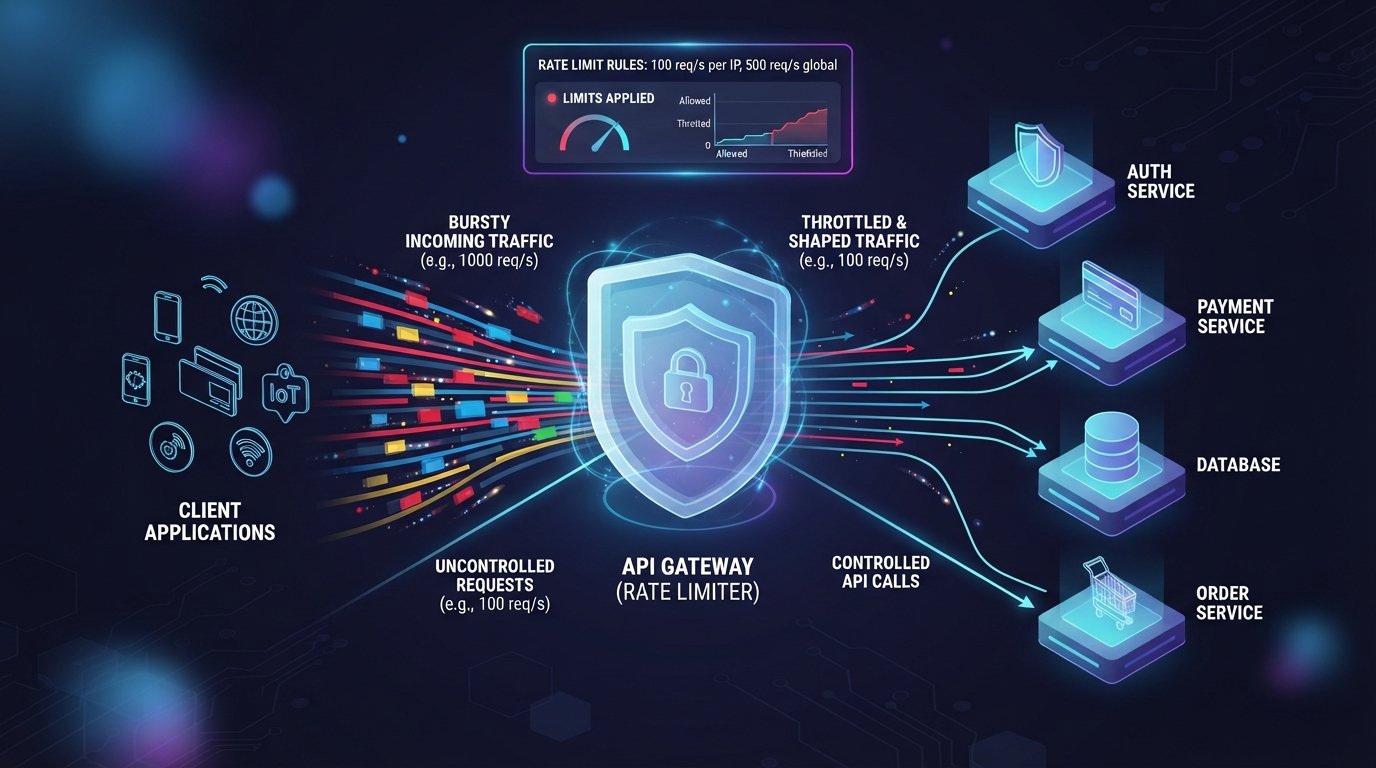
Implementing Rate Limiting and Throttling Algorithms
In distributed backend architectures, system stability hinges on how gracefully services handle traffic spikes. Uncontrolled API traffic—whether from legitimate user surges, aggressive web scrapers, or distributed denial-of-service (DDoS) attacks—can exhaust database pools, degrade latency, and trigger cascading service failures across your infrastructure.
Implementing rate limiting and throttling algorithms in microservices is the primary defensive strategy used by backend engineers to protect application resilience. Rate limiting caps the total number of requests a client can make within a defined time frame, while throttling dynamically regulates request execution speeds to flatten bursty traffic.
Understanding the underlying algorithms, architectural patterns, and state-management trade-offs is crucial for building robust, high-throughput microservices systems.
Key Takeaways
- Core Protection: Rate limiting controls request volume per time window, protecting microservices from resource starvation, noisy-neighbor problems, and abusive traffic.
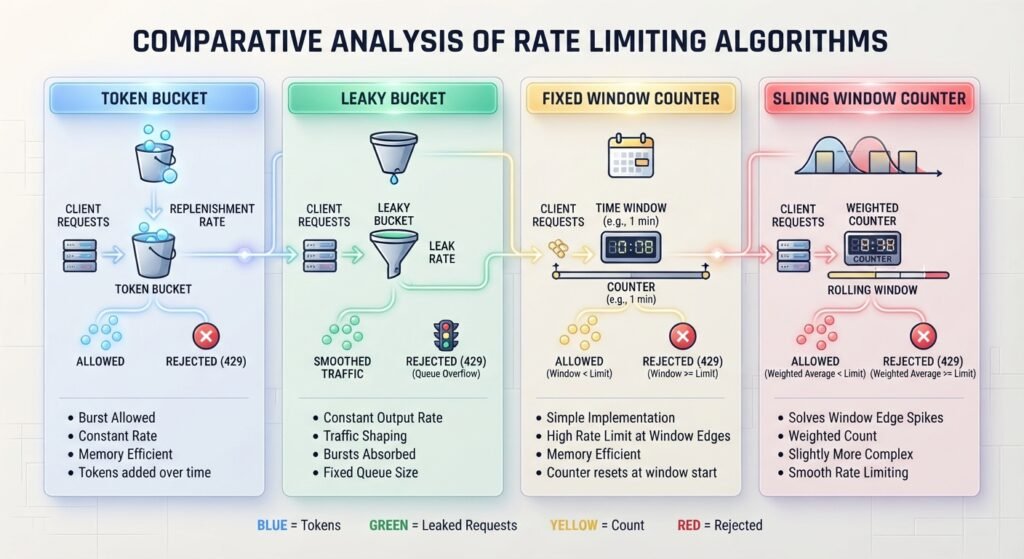
- Algorithm Selection Matters: Different algorithms suit different use cases. Token Bucket allows controlled traffic bursts, Leaky Bucket flattens traffic spikes, and Sliding Window Counter provides high precision with low memory overhead.
- Centralized vs. Local Enforcement: API Gateways (Kong, Envoy, NGINX) manage global edge limits, whereas service-level limiters protect specific high-cost operations (e.g., payment gateways or report generators).
- Distributed State Synchronization: Multi-instance microservice deployments require atomic, low-latency key-value stores like Redis (using Lua scripting) to avoid race conditions.
- Standardized HTTP Responses: Always notify clients of rate limits using standard headers (
X-RateLimit-Limit,X-RateLimit-Remaining) and HTTP status429 Too Many Requestsaccompanied by aRetry-Afterdirective.
Rate Limiting vs. Throttling: Key Differences
While frequently used interchangeably, rate limiting and throttling serve distinct control functions in API management:
| Attribute | Rate Limiting | Throttling |
|---|---|---|
| Primary Goal | Reject requests exceeding a strict volumetric quota within a time window. | Regulate, delay, or queue request velocity to match processing capacity. |
| Behavior on Exceedance | Immediately rejects additional requests with HTTP 429. | Queues requests, degrades service quality, or slows execution speed. |
| Typical Target | Client IP addresses, API Keys, Tenant IDs, or specific route endpoints. | Global service capacity, database connection pools, or message queues. |
| Primary Algorithm | Token Bucket, Fixed Window, Sliding Window Log / Counter. | Leaky Bucket, Token Bucket (with queueing), Adaptive Backoff. |
Choosing the right algorithm directly impacts system latency, memory footprint, and burst handling.
1. Token Bucket Algorithm
The Token Bucket algorithm maintains a bucket with a pre-configured capacity. Tokens are added to the bucket at a continuous, fixed refill rate. Every incoming request consumes one or more tokens. If sufficient tokens exist, the request proceeds; if empty, the request is rejected immediately.
- Pros: Supports short, legitimate bursts of traffic up to full bucket capacity. Memory efficient (tracks only bucket size and last refill timestamp).
- Cons: Requires tuning refill rates and capacity parameters to prevent resource overload.
- Best Used For: General public-facing Web APIs handling variable user activity.
2. Leaky Bucket Algorithm
The Leaky Bucket algorithm models incoming requests as water entering a bucket with a fixed capacity. Requests are placed into a FIFO queue and processed (leaked) out at a constant, uniform rate regardless of incoming traffic density Implementing Rate Limiting and Throttling Algorithms.
- Pros: Smooths out traffic spikes, providing predictable downstream load.
- Cons: Introduces latency for requests waiting in the bucket queue. Drops burst requests if the bucket overflows.
- Best Used For: Background job processing, database write smoothing, and third-party API webhooks.
3. Fixed Window Counter
Fixed Window divides time into static intervals (e.g., 1-minute blocks) and increments a counter for each arriving request. Once the limit is reached, all subsequent requests in that block are blocked until the next window resets the counter.
- Pros: Simple to implement with minimal memory usage.
- Cons: Vulnerable to traffic boundary bursts. A client can send max requests at the end of Window A and max requests at the start of Window B, doubling allowed throughput in a short timeframe.
4. Sliding Window Counter
Sliding Window Counter combines the memory efficiency of Fixed Window with the accuracy of Sliding Log. It estimates real-time throughput by calculating a weighted sum of request counts from the current window and the previous window based on overlapping time ratios.
Estimated Requests=Current Window Count+(Previous Window Count×(1−Window DurationTime Elapsed in Current Window))
- Pros: Smooths boundary bursts effectively while retaining low memory overhead (2 integers per client key).
- Cons: Assumes request distribution in the previous window was uniform (minor approximation error).
- Best Used For: High-scale distributed microservices requiring strict window accuracy.
Implementing Distributed Rate Limiting in Microservices
In a stateless, multi-node microservices deployment, enforcing rate limits within application memory creates inconsistent quotas because requests route across multiple instances. To enforce global rate limits, instances must synchronize request states via a centralized store like Redis.
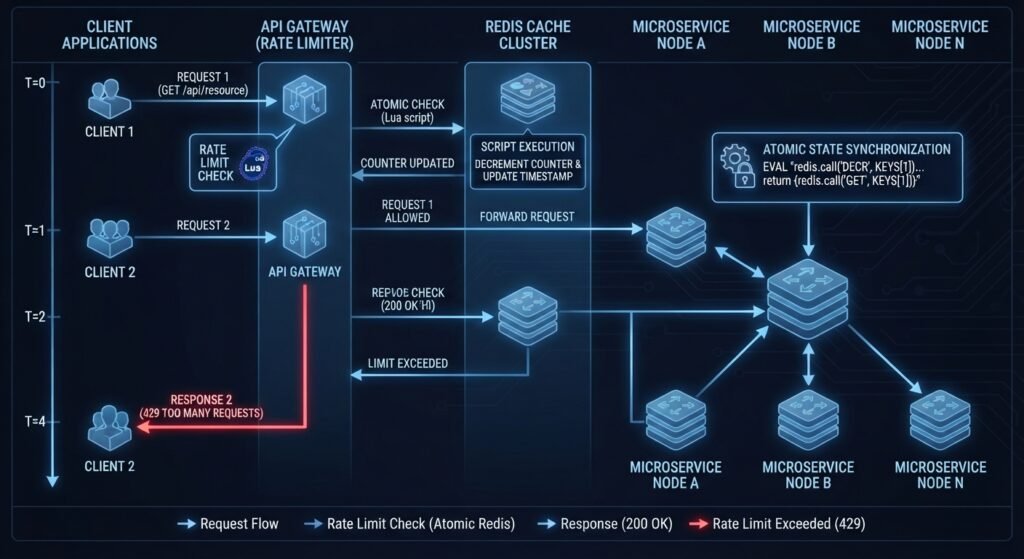
To avoid race conditions across multi-threaded operations, execute rate-limiting logic inside Redis atomically using Lua scripts:
Lua
-- KEYS[1]: Rate limit key (e.g., rate_limit:user_123)
-- ARGV[1]: Max bucket capacity
-- ARGV[2]: Refill rate per second
-- ARGV[3]: Current epoch timestamp (seconds)
-- ARGV[4]: Requested tokens (usually 1)

local key = KEYS[1]
local capacity = tonumber(ARGV[1])
local refill_rate = tonumber(ARGV[2])
local now = tonumber(ARGV[3])
local requested = tonumber(ARGV[4])

-- Retrieve current state or initialize
local data = redis.call("HMGET", key, "tokens", "last_updated")
local tokens = tonumber(data[1])
local last_updated = tonumber(data[2])

if not tokens then
    tokens = capacity
    last_updated = now
else
    -- Calculate elapsed time and add refilled tokens
    local delta = math.max(0, now - last_updated)
    tokens = math.min(capacity, tokens + delta * refill_rate)
    last_updated = now
end

-- Check if enough tokens exist
if tokens >= requested then
    tokens = tokens - requested
    redis.call("HMSET", key, "tokens", tokens, "last_updated", last_updated)
    redis.call("EXPIRE", key, math.ceil(capacity / refill_rate))
    return {1, math.floor(tokens)} -- Allowed
else
    return {0, math.floor(tokens)} -- Denied
end
Architectural Placement: Where to Enforce Rate Limits?
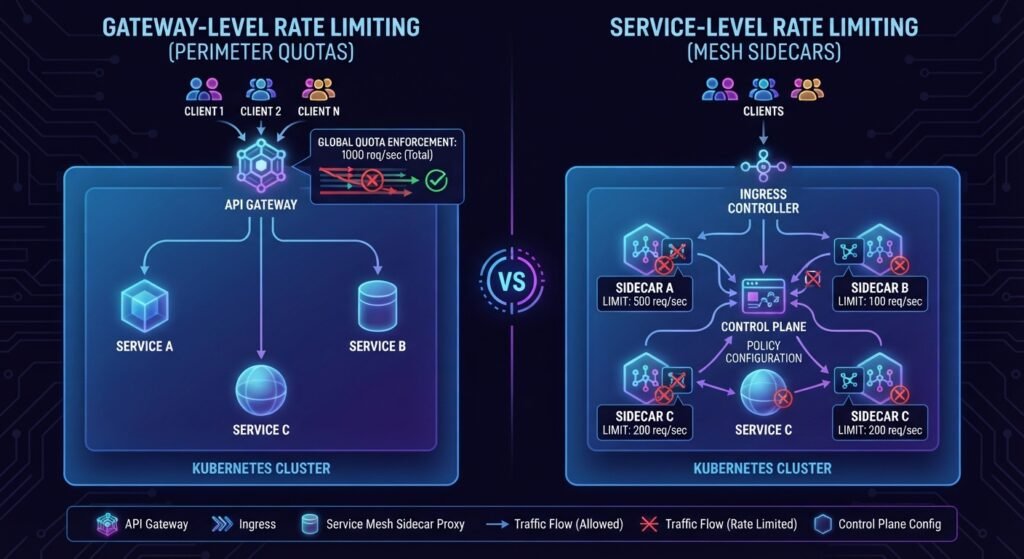
Enforcing rate limits at the API Gateway (e.g., Kong, Ambassador, NGINX, Spring Cloud Gateway) blocks malicious or surplus traffic before it hits internal network infrastructures.
- Best for: Protecting against volumetric DDoS attacks, enforcing monetization tiers, and managing global public IP/API key quotas.
2. Service Level (Internal Protection)
Enforcing limits directly inside microservices or via Service Mesh sidecars (e.g., Envoy, Istio) provides granular protection tailored to specific internal business logic.
- Best for: Preventing database exhaustion on heavy endpoints, controlling resource-intensive PDF/report generation, and mitigating internal noisy-neighbor issues.
HTTP Standard Headers and Error Handling
When implementing rate limiting and throttling algorithms in microservices, communicating quota states transparently allows clients to back off gracefully. Always return standardized HTTP headers alongside a 429 Too Many Requests status code:
HTTP
HTTP/1.1 429 Too Many Requests
Content-Type: application/json
Retry-After: 30
X-RateLimit-Limit: 100
X-RateLimit-Remaining: 0
X-RateLimit-Reset: 1700000030

{
  "error": "Too Many Requests",
  "message": "Quota exceeded. Please retry after 30 seconds."
}
Conclusion
Successfully implementing rate limiting and throttling algorithms in microservices requires balancing systemic security, operational overhead, and client experience. For general API edge protection, the Token Bucket algorithm combined with an API Gateway and Redis storage offers an ideal mix of burst tolerance, atomic speed, and horizontal scalability. For steady downstream data processing, the Leaky Bucket pattern provides unmatched stability.
By pairing centralized gateway enforcement with standardized HTTP 429 response contracts, engineering teams can guarantee reliable performance under high concurrency.
Frequently Asked Questions (FAQs)
What is the best algorithm when implementing rate limiting and throttling algorithms in microservices?
The ideal algorithm depends on your application pattern. Use Token Bucket if your system needs to tolerate brief user traffic bursts. Use Leaky Bucket if you need to smooth traffic out to protect fragile downstream services. Use Sliding Window Counter if you need high accuracy per time window with minimal memory usage.
How do I handle rate limiting in a multi-region distributed system?
Use a distributed key-value store such as Redis or AWS ElastiCache alongside local in-memory caching tiers. Local in-memory limiters handle high-volume brute-force attacks at the edge, while asynchronous syncing with Redis enforces global user quotas across regions.
How do clients handle HTTP 429 rate limit responses gracefully?
Clients should implement Exponential Backoff with Jitter algorithms. When receiving a 429 Too Many Requests status code, the client pauses for the duration specified in the Retry-After header before retrying, exponentially increasing the wait time on subsequent failures to prevent thundering herd problems.
SD 26 | Rate Limiting Algorithms: Token Bucket & Leaky Bucket
This video provides an in-depth visual comparison of the Token Bucket and Leaky Bucket algorithms, which directly supplements the architectural patterns discussed in this guide.
Implementing Rate Limiting and Throttling Algorithms
1 thought on “Implementing Rate Limiting and Throttling Algorithms in Microservices”