
Top Automated E2E Testing Frameworks,Modern web applications rely on complex, asynchronous architectures—combining single-page frontends (React, Next.js, Vue) with microservices, GraphQL endpoints, and multi-tenant cloud databases. Validating these applications requires end-to-end (E2E) testing that simulates real user workflows across browsers, devices, and operating systems. However, traditional test scripts often break due to dynamic DOM updates, timing issues, and flakiness, turning test suites into maintenance bottlenecks.
Choosing the best automated E2E testing frameworks and SaaS platforms requires balancing execution speed, parallelization costs, cross-browser fidelity, and AI-driven self-healing capabilities. This guide evaluates top open-source automation frameworks alongside enterprise SaaS cloud grids to help development and QA teams ship reliable code faster.
Key Takeaways
- Playwright Leads Open-Source Scripting: Driven by native browser context isolation and out-of-the-box parallelization, Microsoft Playwright has become the default open-source framework for cross-browser testing.
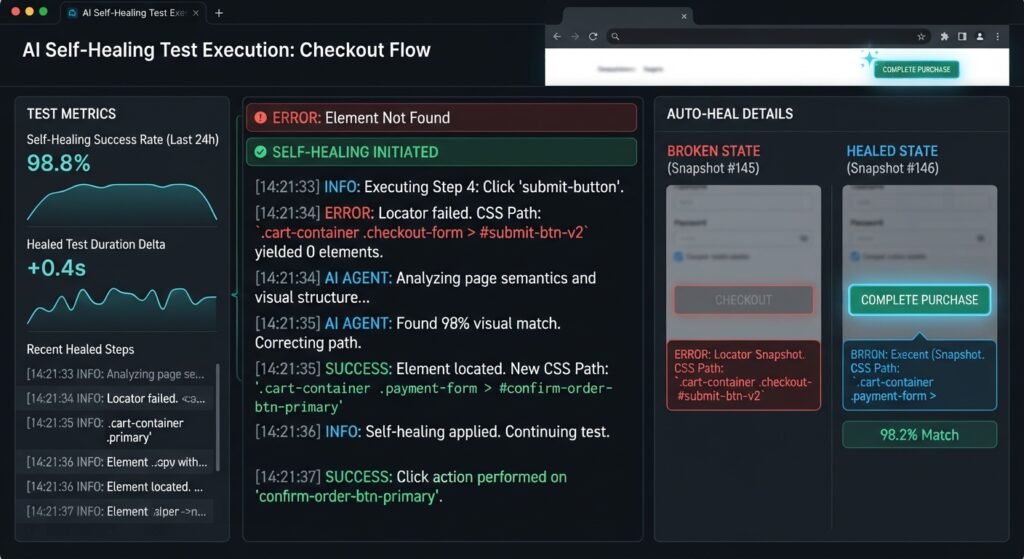
- Shift to AI-Native Self-Healing: Next-generation SaaS platforms are replacing fragile CSS/XPath selectors with AI computer vision and LLM-driven self-healing algorithms.
- Unified Cross-Layer Testing: Leading platforms now unify UI, API, visual regression, and mobile web testing into single test pipelines.
- Zero-Cost Local Parallelism vs. Managed Cloud Scaling: Frameworks like Playwright allow free local and CI sharding, while enterprise platforms (BrowserStack, Sauce Labs) provide instant access to thousands of real devices without infrastructure overhead.
Core Criteria for Evaluating E2E Testing Tools
Selecting the right E2E testing architecture requires assessing both authoring workflows and infrastructure execution constraints:
- Flakiness Mitigation & Auto-Waiting: Built-in mechanisms to verify element actionability (visibility, stability, and enablement) before firing events.
- Browser & Device Coverage: Native support for Chromium, WebKit (Safari), Firefox, and real mobile device clouds.
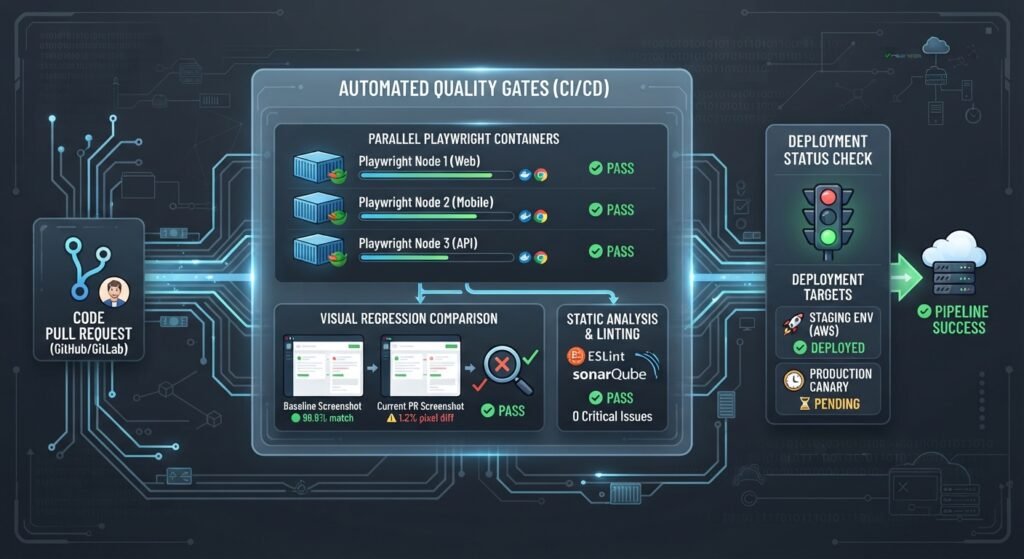
- Parallel Execution & CI/CD Sharding: Ability to split and run test suites concurrently across multiple workers without complex setup.
- Debugging Observability: Access to time-travel execution traces, network traffic logs, video recordings, and DOM snapshots.
- Visual Regression Testing: Pixel-by-pixel and layout-aware diffing to catch unintended UI rendering regressions automatically.
[Internal Link: Insert relevant internal URL here with anchor text – “Explore our guide on automated CI/CD pipeline security and quality gates”]
Top Open-Source E2E Testing Frameworks
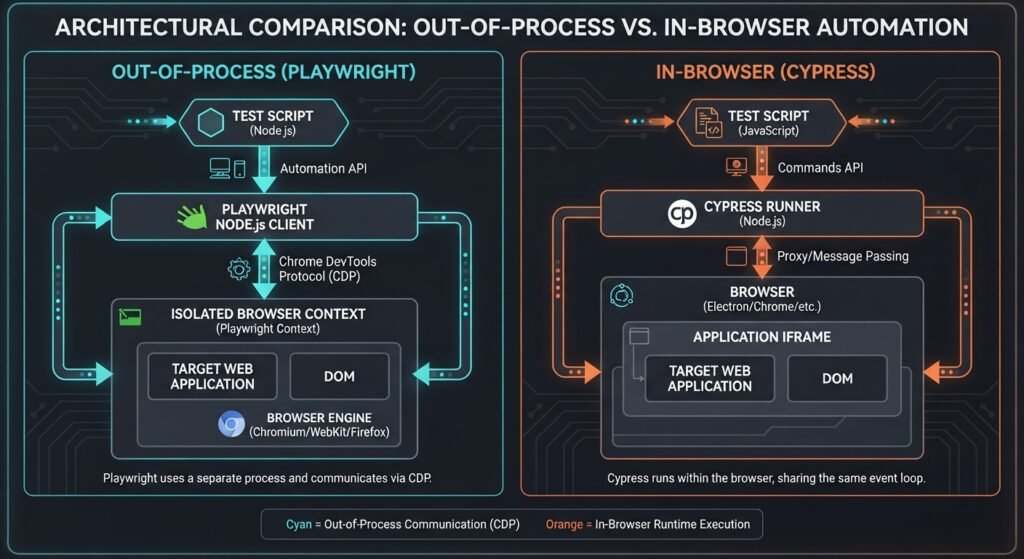
1. Playwright (Microsoft): The Enterprise Open-Source Standard
Playwright controls web browsers through native automation protocols, delivering fast execution speed, zero flakiness, and full cross-browser support.
- Best For: Scale-stage engineering teams requiring fast, reliable cross-browser automation (Chromium, WebKit, Firefox).
- Key Features: Native parallel workers, isolated browser contexts, auto-waiting, multi-tab support, and built-in network mocking.
- Pros: Free built-in parallel execution, excellent execution speed, supports WebKit natively.
- Cons: Requires coding proficiency in TypeScript, JavaScript, Python, C#, or Java.
2. Cypress: Best for Developer Experience
Cypress runs directly inside the browser alongside your application, offering an interactive debugging experience for frontend developers.
- Best For: Frontend developers seeking rapid local TDD (Test-Driven Development) workflows and component testing.
- Key Features: Time-traveling DOM debugger, automatic waiting, real-time reload, and component test runner.
- Pros: Great local developer experience and intuitive setup.
- Cons: Safari/WebKit support remains limited; native parallelization requires Cypress Cloud or third-party orchestrators.
Top Cloud SaaS & AI Automation Platforms
3. BrowserStack Enterprise Grid: Universal Real-Device Testing
BrowserStack provides an enterprise testing cloud with access to over 3,000 real mobile devices and desktop browser combinations.
- Best For: Large QA organizations needing broad real-device coverage without managing physical device labs.
- Key Features: Real-device cloud execution, automated Playwright/Cypress/Selenium grid scaling, Percy visual testing, and accessibility testing.
- Pros: Eliminates local infrastructure maintenance; extensive mobile coverage.
- Cons: Cloud latency can slow down test suite speeds compared to headless local runs.
4. Katalon Platform: Unified AI-Powered Test Automation
Katalon bridges low-code authoring with script-based flexibility, offering an AI-assisted test automation environment for cross-functional teams.
- Best For: QA teams with mixed technical backgrounds seeking codeless test generation alongside full script customization.
- Key Features: Autonomous self-healing locators, low-code recorder, cross-platform execution (Web, Mobile, API, Desktop), and test analytics.
- Pros: Lowers barrier to entry; strong test management dashboards.
- Cons: Licensing costs scale with execution volume.
Feature Comparison Matrix
| Feature / Tool | Playwright | Cypress | BrowserStack | Katalon Platform |
| Type | Open-Source Library | Open-Source Framework | Cloud Real-Device SaaS | All-in-One AI Platform |
| Target Audience | Software Engineers / SDETs | Frontend Engineers | Enterprise QA Teams | Cross-Functional QA |
| Browser Engines | Chromium, Firefox, WebKit | Chromium, Firefox | 3000+ Real Browsers/Devices | Multi-Engine & Mobile |
| Parallel Execution | Native & Free | Requires Cloud/Plugin | Massively Parallel Cloud | Managed Execution Cloud |
| Self-Healing AI | Community Plugins | Community Plugins | Integrated (Percy/Visual) | Built-in Native Feature |
How to Choose the Right E2E Testing Stack
To select the best automated E2E testing frameworks and SaaS platforms, align your technical requirements with team capabilities:
- For Modern TypeScript/JavaScript Applications: Choose Playwright. Its native browser context isolation, WebKit support, and free parallelization make it cost-effective for web automation.
- For Rapid Local Component Debugging: Choose Cypress if your frontend developers write and run tests locally in real time.
- For High-Fidelity Mobile and Compliance Audits: Combine an open-source framework (like Playwright or Appium) with BrowserStack to validate execution on real iOS and Android hardware.
conclusion(top automated E2E testing frameworks)
Selecting the best automated E2E testing frameworks and SaaS platforms is essential for maintaining deployment velocity without compromising application quality. While open-source tools like Playwright and Cypress dominate test authoring, SaaS platforms and AI self-healing mechanisms solve infrastructure and maintenance challenges. By adopting a modern framework that fits your team’s workflow, you can reduce test flakiness, lower maintenance overhead, and ship software with confidence.
Frequently Asked Questions (FAQs)
What is the best free automated E2E testing framework?
Microsoft Playwright is widely considered the best free, open-source E2E testing framework due to its multi-browser support (Chromium, Firefox, WebKit), fast execution, and built-in parallel worker capabilities without subscription requirements.
How do AI self-healing test platforms reduce test flakiness?
AI self-healing platforms analyze DOM changes, visual layouts, and semantic element attributes dynamically during test execution. If an element’s ID or class changes, the AI algorithm identifies the element by alternative properties (such as visual positioning or context) and updates the test locator automatically, preventing build failures.
Why should teams use cloud SaaS device grids instead of local headless browsers?
Headless browsers on local CI servers are fast, but they cannot replicate real-world hardware conditions—such as GPU rendering differences, mobile network throttling, device-specific browser quirks, or OS touch interactions. SaaS grids like BrowserStack provide real-device verification before production releases.
1 thought on “Top Automated E2E Testing Frameworks & SaaS Platforms: 2026 Guide”