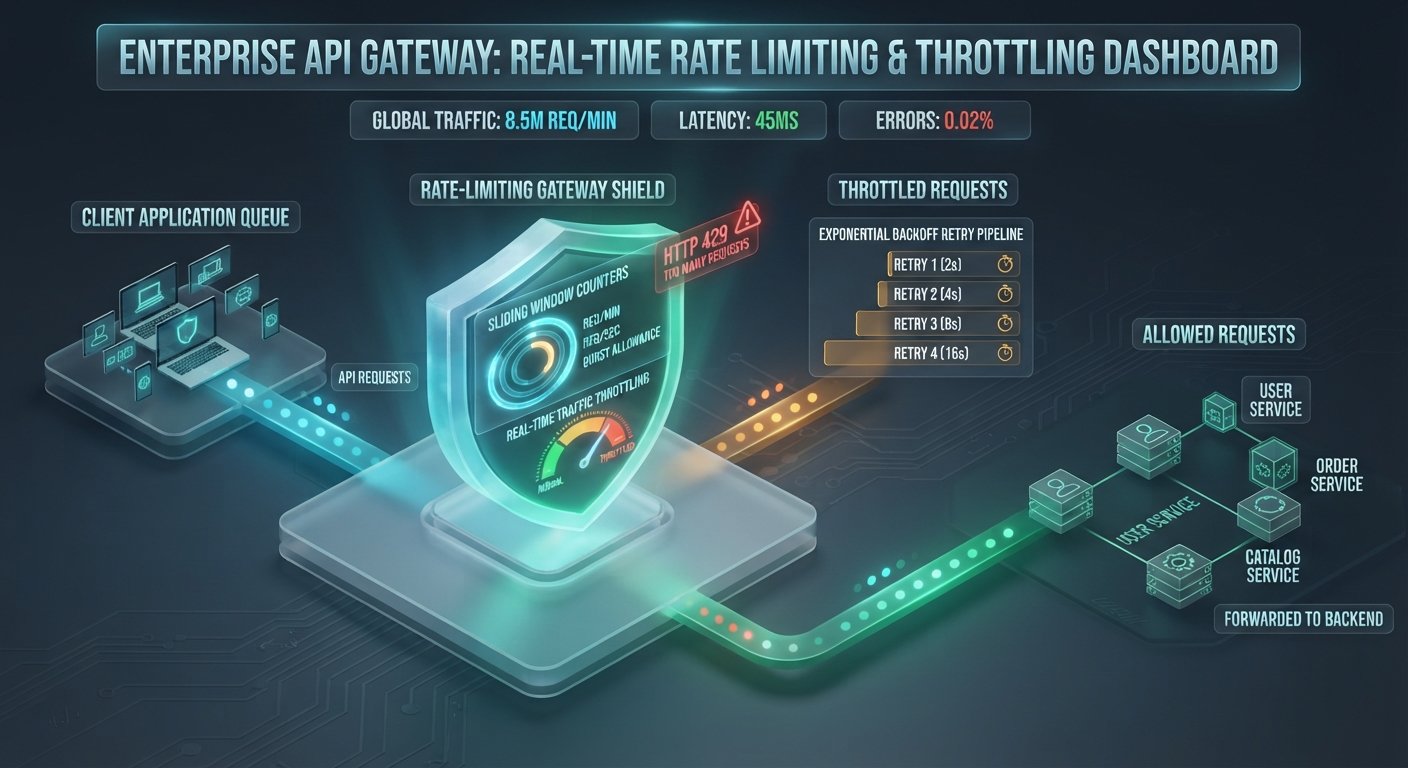
API rate limiting is an indispensable defense mechanism used by modern SaaS platforms and cloud APIs to prevent server overload, defend against denial-of-service (DoS) attacks, and maintain fair service availability across multi-tenant infrastructures. However, encountering HTTP 429 Too Many Requests errors can severely disrupt user workflows, drop critical data payloads, and trigger cascading application failures if your client application is unprepared to handle throttling gracefully.
Learning how to fix API rate limit errors with causes and client-side best practices is essential for building resilient, enterprise-grade software. This comprehensive guide breaks down why API providers enforce rate limits, how common throttling algorithms operate behind the scenes, and the exact client-side engineering strategies—such as exponential backoff with jitter, client-side caching, and request queuing—needed to handle rate limit thresholds seamlessly.
Key Takeaways
- Decode Standard Rate Limit Headers: Always inspect response headers such as
X-RateLimit-Limit,X-RateLimit-Remaining, andRetry-Afterto understand your current consumption rate and dynamically calculate backoff pauses. - Implement Exponential Backoff with Jitter: When retrying failed requests after receiving an HTTP 429 status code, space out retry intervals exponentially and add randomized jitter to prevent the “thundering herd” problem.
- Optimize Request Payload Strategy: Reduce total API request volume by leveraging batch operations, GraphQL queries, and aggressive client-side caching for stagnant or infrequently updated data.
- Queue and Throttle Outbound Requests: Implement in-memory or distributed task queues (like Redis-backed queues) to throttle outbound request rates before they breach API provider limits.
Why API Providers Enforce Rate Limits (Common Causes)
Before attempting to fix client-side errors, it is important to understand why API rate limiting exists and how server-side algorithms enforce boundaries.
┌────────────────────────────────────────────────────────────────────────┐
│                   COMMON SERVER-SIDE RATE LIMITING CAUSES              │
├───────────────────────────────┬────────────────────────────────────────┤
│ PROTECTIVE MEASURE            │ OPERATIONAL IMPACT                     │
├───────────────────────────────┼────────────────────────────────────────┤
│ - Server Capacity Protection  │ Prevents sudden traffic surges from    │
│                               │ crashing backend database nodes.       │
├───────────────────────────────┼────────────────────────────────────────┤
│ - DoS & Abuse Mitigation      │ Blocks aggressive scraping, brute-     │
│                               │ force attacks, and runaway loops.      │
├───────────────────────────────┼────────────────────────────────────────┤
│ - Monetization & Tiering      │ Restricts free-tier usage while        │
│                               │ reserving high throughput for paid.    │
└───────────────────────────────┴────────────────────────────────────────┘
Popular Server-Side Throttling Algorithms
API gateways rely on specific mathematical models to evaluate request velocity:
- Token Bucket: Tokens are added to a bucket at a constant fill rate. Each incoming API call consumes a token. If the bucket is empty, the server returns an HTTP 429 error.
- Leaky Bucket: Requests enter a queue and leak out at a steady, fixed rate. If the queue overflows, additional requests are dropped immediately.
- Sliding Window Log / Counter: Tracks timestamps or request counts across a rolling time window (e.g., 100 requests per sliding 60-second window), providing smooth traffic enforcement.
How to Fix API Rate Limit Errors: Client-Side Best Practices
Handling rate limits successfully requires shifting from a reactive “retry on failure” mindset to a proactive, resilient request distribution model.
┌─────────────────────────────────────────────────────────────────────────────────┐
│                   CLIENT-SIDE RATE LIMIT MITIGATION TIER                        │
├──────────────┬──────────────────┬──────────────────┬────────────────────────────┤
│ TIER 1       │ TIER 2           │ TIER 3           │ TIER 4                     │
│ Inspect      │ Implement        │ Apply Local      │ Throttle Outbound          │
│ Response     │ Exponential      │ Caching &        │ Request Queues             │
│ Headers      │ Backoff + Jitter │ Batching         │                            │
└──────────────┴──────────────────┴──────────────────┴────────────────────────────┘
1. Parse Rate Limit Headers Dynamically
Well-designed REST APIs communicate their current throttling state through standard HTTP response headers:
HTTP
HTTP/1.1 429 Too Many Requests
Content-Type: application/json
Retry-After: 30
X-RateLimit-Limit: 1000
X-RateLimit-Remaining: 0
X-RateLimit-Reset: 1710000000
Retry-After: Tells the client exactly how many seconds (or epoch timestamp) to wait before sending another request.X-RateLimit-Remaining: Indicates how many requests remain in the current quota window.X-RateLimit-Reset: Displays the UTC epoch time when the current rate limit quota refreshes.
Always configure your HTTP client interceptors to inspect these headers dynamically. If X-RateLimit-Remaining approaches zero, pause or throttle client requests before encountering an HTTP 429 error.
2. Implement Exponential Backoff with Randomized Jitter
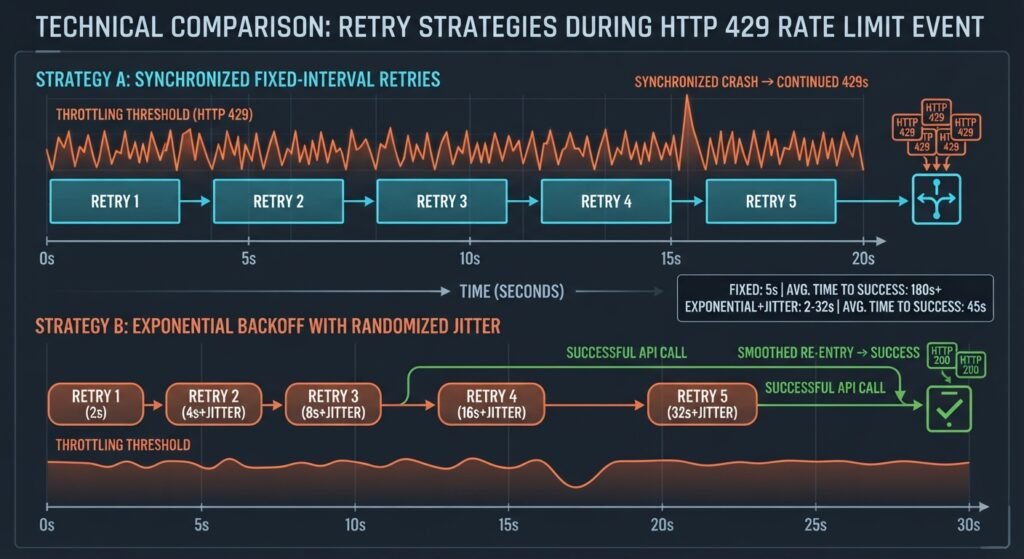
When an HTTP 429 error occurs, retrying immediately or at fixed intervals (e.g., every 1 second) causes retry storms that keep your application blocked. Instead, use exponential backoff combined with randomized jitter.
The standard exponential backoff formula with full jitter is:
$$t_{\text{sleep}} = \text{random}(0, \, \min(t_{\text{max}}, \, t_{\text{base}} \times 2^{\text{attempt}}))$$
Where $t_{\text{base}}$ is the initial delay, $t_{\text{max}}$ is the maximum allowable retry delay, and $\text{attempt}$ is the current retry iteration count. Adding randomness prevents synchronized client retries from overwhelming the API server simultaneously (the “thundering herd” problem).
3. Implement Local Caching and Request De-Duplication
The fastest and cheapest API request is the one you never make. Reduce unnecessary outbound requests by implementing a robust caching layer:
- In-Memory Caching (Redis / TTL Caches): Cache stagnant response data locally using a reasonable Time-To-Live (TTL).
- Conditional Requests (
ETag&If-None-Match): Use standard HTTP conditional headers. If the resource has not changed, the server responds with a lightweight304 Not Modifiedstatus, which often does not count against your primary rate limit quota. - Request De-duplication: If multiple concurrent component trees in your client app request the exact same endpoint simultaneously, collapse them into a single flight request.
4. Queue Outbound Requests and Batch Payloads
When bulk processing large volumes of data, never execute hundreds of simultaneous async requests across un-throttled promises.
- Client-Side Concurrency Limits: Use worker pools or queue libraries (like
p-limitin JavaScript/Node.js or Celery in Python) to cap concurrent outbound requests to a safe threshold (e.g., maximum 5 concurrent connections). - Batch Endpoints: Check if the API provider offers multi-item or batch endpoints (e.g.,
POST /api/v1/users/batch) allowing you to create or update 50 records in a single HTTP request instead of issuing 50 separate requests.

Production Monitoring and Alerting for API Limits
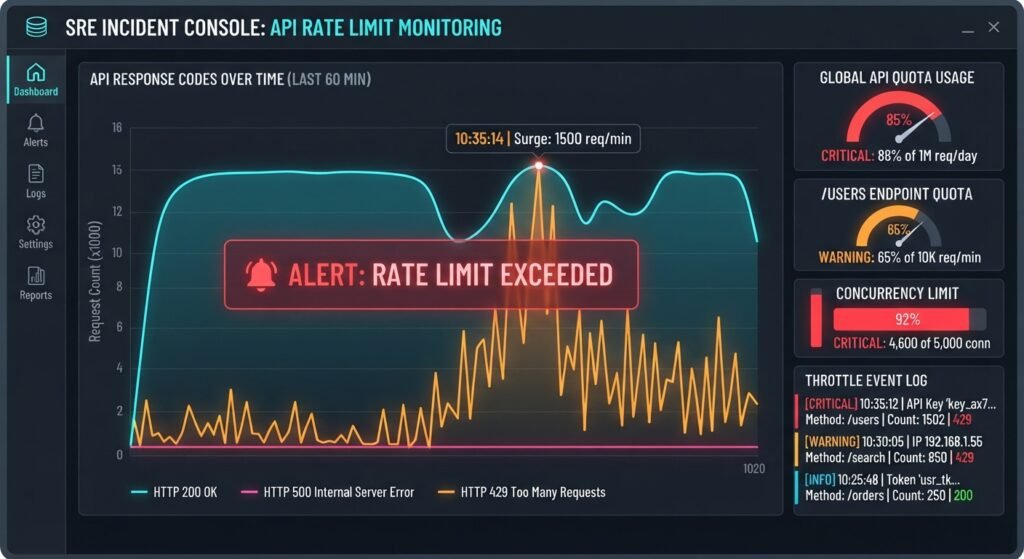
To prevent silent rate-limit degradation in production environments, implement continuous monitoring and diagnostic telemetry:
┌─────────────────────────────────────────────────────────────────────────┐
│               API RATE LIMIT MONITORING CHECKLIST                        │
├───────────────────┬─────────────────────────────────────────────────────┤
│ MEASUREMENT AREA  │ ACTIONABLE METRIC                                   │
├───────────────────┼─────────────────────────────────────────────────────┤
│ Telemetry Logs    │ Track total count of HTTP 429 status codes per      │
│                   │ vendor endpoint in real-time.                       │
├───────────────────┼─────────────────────────────────────────────────────┤
│ Warning Alerts    │ Trigger Slack/PagerDuty alerts when                 │
│                   │ `X-RateLimit-Remaining` drops below 10%.            │
├───────────────────┼─────────────────────────────────────────────────────┤
│ Circuit Breakers  │ Trip local circuit breakers when an API provider is  │
│                   │ completely down or persistently returning 429s.     │
└───────────────────┴─────────────────────────────────────────────────────┘
For official protocol specifications regarding rate limit status codes, consult the IETF RFC 6585 Specification for HTTP Status Code 429.
Conclusion
Understanding how to fix API rate limit errors with causes and client-side best practices empowers developers to build applications that remain stable under heavy load. By dynamically inspecting response headers, integrating exponential backoff with full jitter, caching responses locally, and throttling outbound request queues, you can eliminate disruptive HTTP 429 errors and deliver a smooth, uninterrupted user experience.
Frequently Asked Questions (FAQs)
What does the HTTP 429 Too Many Requests status code mean?
The HTTP 429 Too Many Requests status code indicates that the client has sent too many requests to the server within a given timeframe. It serves as a rate-limiting signal informing the client to halt requests until a specific quota window resets.
What is the difference between hard rate limits and soft rate limits?
A soft rate limit temporarily delays or throttles incoming requests (or allows brief bursts above the quota) without immediately rejecting traffic. A hard rate limit strictly blocks any request that exceeds the threshold by immediately returning an HTTP 429 error or dropping the connection entirely.
How does adding “jitter” help when retrying failed API requests?
Jitter adds a randomized delay to the exponential backoff calculation. If an API outage or rate-limit event affects hundreds of clients simultaneously, exponential backoff without jitter causes all clients to retry at the exact same synchronized intervals. Adding randomized jitter spreads retries out over time, preventing sudden retry spikes.