
How to Secure Modern REST APIs: Authentication and Authorization Best Practices
RESTful APIs serve as the digital backbone of modern web applications, mobile platforms, and cloud microservices. However, as organizations decouple systems to increase velocity, APIs have turned into the primary vector for enterprise cyberattacks. According to recent industry security studies, API security incidents continue to rise, with broken object-level authorization (BOLA) and credential misuse topping the list of reported vulnerabilities.
Securing modern REST APIs requires a strict defense-in-depth approach. You cannot rely solely on standard transport-layer security (TLS); you must implement robust, stateless, and verifiable identity systems. This guide breaks down essential strategies for establishing bulletproof authentication, granular authorization, and continuous API threat mitigation across your organization.
Key Takeaways
- Separate Identity Verification from Permission Enforcement: Use Authentication (OAuth 2.0/OIDC, mTLS) to verify who the caller is, and Authorization (RBAC, ABAC) to dictate what they are permitted to do.
- Eliminate Broken Object-Level Authorization (BOLA): Always enforce server-side ownership checks on every request, verifying that the authenticated user explicitly owns the requested resource ID.
- Implement Short-Lived Stateless Tokens: Use JSON Web Tokens (JWTs) with cryptographically secure signatures (RS256/ES256), short expiration windows, and secure refresh token storage mechanisms.
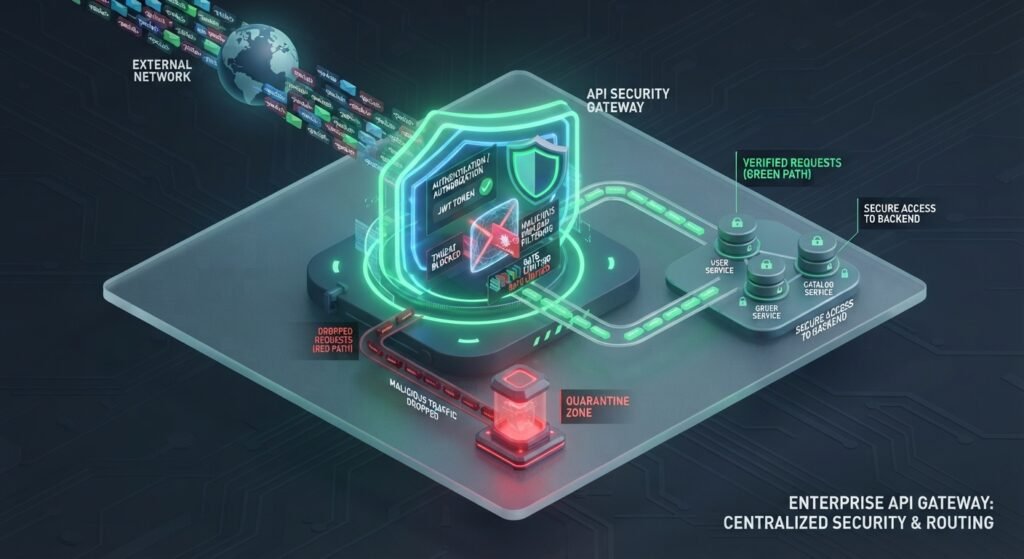
- Protect API Gateways with Zero Trust Controls: Apply rate limiting, IP throttling, threat scanning, and automated schema validation at your API Gateway perimeter before requests reach downstream services.
The Core Foundations: Authentication vs. Authorization
A common pitfall in REST API design is confounding authentication (AuthN) with authorization (AuthZ). Understanding this distinction is vital to building resilient access controls.
┌────────────────────────────────────────────────────────────────────────┐
│                   IDENTITY & ACCESS CONTROL MATRIX                     │
├───────────────────────────────┬────────────────────────────────────────┤
│ AUTHENTICATION (AuthN)        │ AUTHORIZATION (AuthZ)                  │
├───────────────────────────────┼────────────────────────────────────────┤
│ - Verifies Identity ("Who are │ - Enforces Permissions ("What are      │
│   you?")                      │   you allowed to do?")                 │
│ - Validates credentials, mTLS,│ - Evaluates Roles, Scopes, Claims, and │
│   and SAML/OIDC assertions    │   Resource Ownership (RBAC/ABAC)       │
│ - Executed at Gateway / Auth  │ - Executed at Service Layer & Resource │
│   Server Boundary             │   Endpoints                            │
└───────────────────────────────┴────────────────────────────────────────┘
When designing RESTful architectures, authentication verifies client credentials and converts them into a verifiable token. Authorization then inspects that token on every request to evaluate resource policies.
Step-by-Step REST API Authentication Best Practices
Authenticating clients across distributed, stateless environments requires token-based protocols capable of scaling without relying on sticky sessions.
1. Standardize on OAuth 2.0 and OpenID Connect (OIDC)
Never build custom authentication protocols. Use industry-standard frameworks:
- OAuth 2.0: Handles delegation and authorization workflows.
- OpenID Connect (OIDC): Adds an identity layer on top of OAuth 2.0 to deliver user profile assertions via ID tokens.
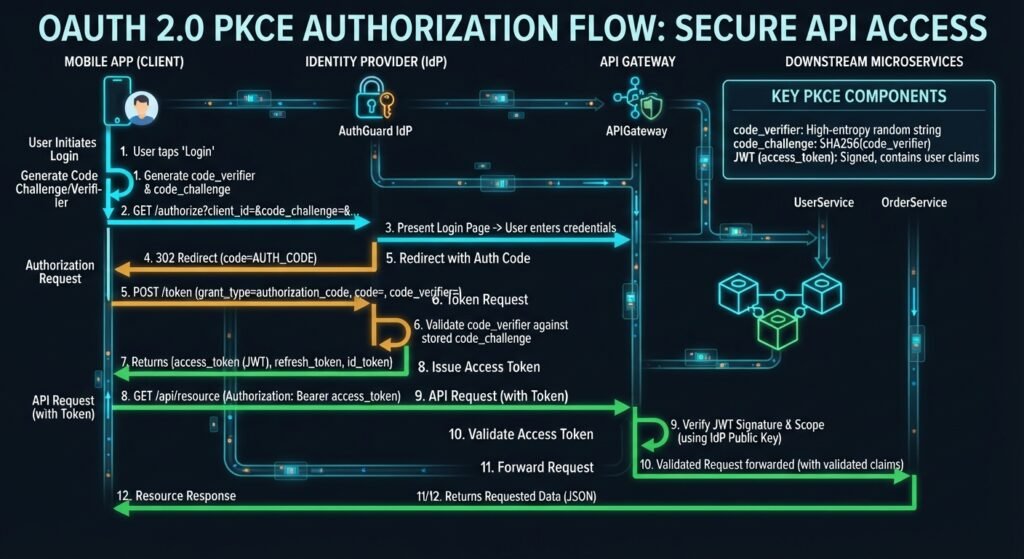
For web and mobile applications, use the OAuth 2.0 Authorization Code Grant with PKCE (Proof Key for Code Exchange) to prevent authorization code interception attacks.
2. Harden JSON Web Tokens (JWT)
JWTs are the de facto standard for stateless API token assertions, but misconfigured JWTs are a major security vulnerability.
- Use Asymmetric Cryptography: Sign tokens using asymmetric algorithms like RS256 or ES256 (private key signs at the identity provider; public key verifies at the API Gateway) rather than symmetric algorithms like HS256.
- Validate Claims Rigorously: Always check token expiration (
exp), issuer (iss), audience (aud), and signature. Reject requests immediately if any claim fails validation. - Block the
alg: noneVulnerability: Explicitly whitelist expected signature algorithms on the server side to block attackers from bypassing verification.
Advanced REST API Authorization Models
Once a client is authenticated, your API must enforce fine-grained access policies. The OWASP API Security Top 10 lists Broken Access Control and Broken Object-Level Authorization (BOLA) as the most critical threats facing modern endpoints.
Role-Based Access Control (RBAC) vs. Attribute-Based Access Control (ABAC)
- RBAC: Assigns permissions to coarse roles (e.g.,
Admin,Editor,Viewer). While easy to implement, pure RBAC fails when granular checks are required (e.g., “Can an Editor modify this specific document?”). - ABAC: Evaluates runtime attributes—including subject claims, target resource properties, action types, and request context (e.g., time of day, IP origin)—to render dynamic authorization decisions.
JSON
// Example: ABAC Policy Evaluation payload at API Handler
{
  "subject": { "id": "usr_9921", "role": "editor", "department": "finance" },
  "action": "HTTP_PUT",
  "resource": { "type": "invoice", "id": "inv_4021", "ownerId": "usr_9921" },
  "context": { "ip": "192.168.1.50", "mTLS_verified": true }
}
Mitigating Broken Object-Level Authorization (BOLA / IDOR)
BOLA occurs when an attacker replaces an object ID in a request URI (e.g., /api/v1/accounts/1002 to /api/v1/accounts/1003) and accesses unauthorized records because the server failed to verify resource ownership.
To eliminate BOLA vulnerabilities:
- Never trust client-supplied identifiers alone. Cross-reference the identifier in the URI against the subject ID extracted directly from the verified token.
- Use Indirect or Non-Enumerable Identifiers: Use UUID v4 string keys instead of auto-incrementing sequential integers to hinder resource guessing attacks.
- Centralize Policy Enforcement: Use policy engines like Open Policy Agent (OPA) to decouple authorization rules from core application code.
Defense-in-Depth: Perimeter and Gateway Controls
Securing endpoints requires defensive layers at the network edge before traffic reaches application handlers.
┌─────────────────────────────────────────────────────────────────────────────────┐
│                    MULTI-LAYER API GATEWAY DEFENSE TIER                         │
├──────────────┬──────────────────┬──────────────────┬────────────────────────────┤
│ TIER 1       │ TIER 2           │ TIER 3           │ TIER 4                     │
│ Mutual TLS   │ Web Application  │ Rate Limiting &  │ Schema Validation          │
│ (mTLS Enforce)│ Firewall (WAF)  │ Token Check      │ (OpenAPI Spec Strict Scan) │
└──────────────┴──────────────────┴──────────────────┴────────────────────────────┘
- Enforce Mutual TLS (mTLS): For zero-trust service-to-service communication, mandate mTLS. Both parties validate client and server x509 certificates to achieve point-to-point authentication and encryption.
- Implement Rate Limiting and Throttling: Guard endpoints against brute-force credential attacks, credential stuffing, and volumetric denial-of-service (DoS) using token bucket or leaky bucket algorithms.
- Enforce OpenAPI Schema Validation: Reject unexpected payloads at the API Gateway level to prevent SQL injection, cross-site scripting (XSS), and buffer overflow exploits.
For external standards and threat mappings, review the official OWASP API Security Top 10 Documentation.
Logging, Monitoring, and Threat Detection
Even robust authentication systems can be compromised if suspicious activity goes undetected.
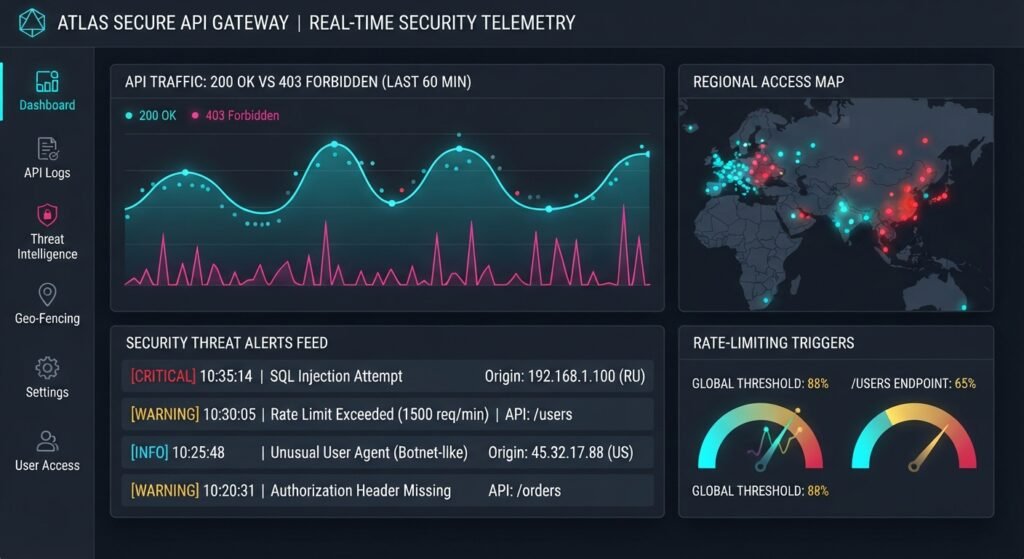
- Sanitize Security Logs: Log all failed authentication attempts, authorization denials, and token validation errors. Never store sensitive fields like raw passwords, API keys, or access tokens in plaintext logs.
- Correlate Traffic Patterns: Connect API Gateway logs with security information and event management (SIEM) solutions to detect anomalous access patterns (e.g., sudden spikes in HTTP 403 Forbidden errors across multiple endpoints).
Conclusion
Securing modern REST APIs requires combining token-based authentication with granular authorization and proactive gateway defenses. By adopting OAuth 2.0 with PKCE, validating signed JWT assertions, enforcing strict ABAC ownership checks to prevent BOLA vulnerabilities, and applying edge rate limiting, engineering teams can build resilient API architectures capable of withstanding sophisticated cyber threats.
Frequently Asked Questions (FAQs)
What is the best way to secure REST API keys?
API keys should be treated strictly as client identifiers rather than authentication secrets. Always pair API keys with HTTPS (TLS), restrict key scopes, enforce IP allowlists, and rotate keys regularly. For user-delegated authorization, use OAuth 2.0 access tokens instead of static API keys.
How do I prevent Broken Object-Level Authorization (BOLA) in REST APIs?
To prevent BOLA, enforce explicit server-side authorization checks on every data-fetching endpoint. Verify that the authenticated user ID (extracted directly from the verified access token) possesses explicit permission to access or modify the target resource ID requested in the URI.
Should I store JWT tokens in LocalStorage or HttpOnly Cookies?
Storing JWT tokens in browser LocalStorage exposes them to Cross-Site Scripting (XSS) attacks. For browser-based clients, store access and refresh tokens in HttpOnly, SameSite=Strict, and Secure cookies to protect them from client-side script theft.
1 thought on “How to Secure Modern REST APIs: Authentication and Authorization Best Practices”