Choosing Node.js vs Python for Backend APIs: Performance and Scalability Comparison the right server-side runtime for modern application programming interfaces (APIs) is a foundational decision for engineering teams and technical leaders. As web traffic grows, backend services must handle concurrent user connections, database queries, and external API calls efficiently without inflating cloud infrastructure costs or slowing response latency.
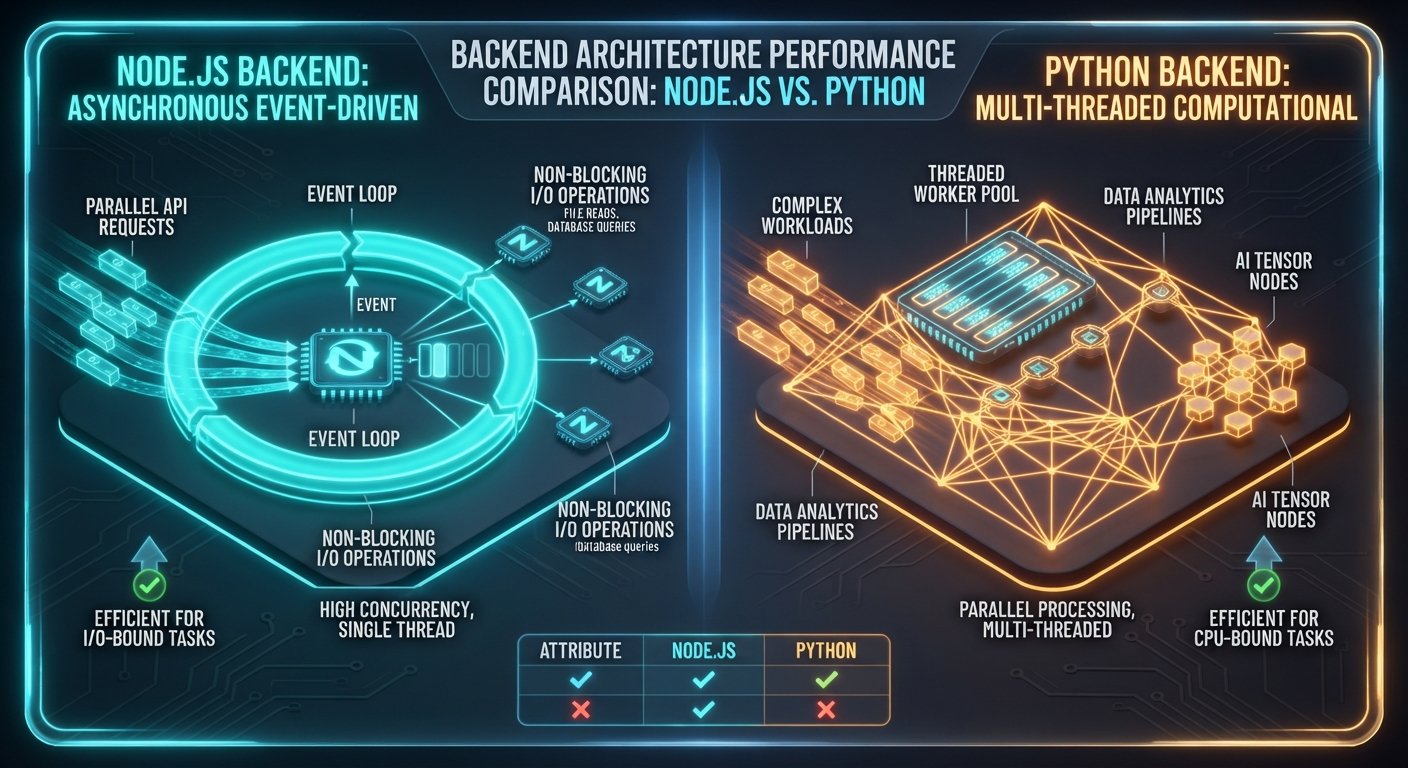
Evaluating Node.js vs Python for backend APIs performance and scalability involves looking past simple language popularity to examine architectural execution models. Node.js relies on an event-driven, single-threaded non-blocking I/O loop that handles high concurrency smoothly. Meanwhile, Python provides exceptional developer velocity, clean syntax, and a dominant data science ecosystem, using modern asynchronous frameworks like FastAPI to power high-throughput web applications. This comparative guide breaks down performance benchmarks, concurrency mechanisms, and architectural decision frameworks for modern software teams.
Key Takeaways Node.js vs Python for Backend APIs: Performance and Scalability Comparison
- Architectural Mechanics: Evaluating Node.js vs Python for backend APIs performance and scalability requires matching runtime concurrency models (Node.js event loop vs Python GIL/async loops) to your primary API workload.
- I/O vs CPU Workloads: Node.js excels at high-concurrency, I/O-intensive web APIs (chat apps, streaming services, real-time dashboards). Python dominates CPU-intensive tasks, data science pipelines, and machine learning integrations.
- Concurrency Efficiency: Node.js typically yields higher raw request throughput out of the box for lightweight JSON APIs, whereas Python’s FastAPI achieves competitive async performance when paired with ASGI servers like Uvicorn.
- Full-Stack Synergy vs. AI Dominance: Node.js enables shared TypeScript/JavaScript code across client and server layers, while Python provides native access to AI/ML libraries like PyTorch, TensorFlow, and Pandas.
Architectural Comparison: Event Loops and Threading Models
The core performance differences between Node.js and Python stem from how each runtime manages memory, execution threads, and concurrent input/output operations Node.js vs Python for Backend APIs: Performance and Scalability Comparison.
┌────────────────────────────────────────────────────────────────────────┐
│                   RUNTIME CONCURRENCY ARCHITECTURE                     │
├───────────────────────────────┬────────────────────────────────────────┤
│ NODE.JS (V8 ENGINE)           │ PYTHON (CPYTHON INTERPRETER)           │
├───────────────────────────────┼────────────────────────────────────────┤
│ Single-Threaded Event Loop    │ Multi-threaded / Process Worker Pools │
│ Non-Blocking Asynchronous I/O │ Global Interpreter Lock (GIL)   │
│ Handles 10k+ concurrent connections│ Uses AsyncIO / ASGI for Concurrency│
│ Ideal for I/O-heavy API routing│ Ideal for computational/ML pipelines  │
└───────────────────────────────┴────────────────────────────────────────┘
The Node.js Non-Blocking Event Loop
Learn Node.js vs Python for Backend APIs: Performance and Scalability Comparison built on Google’s Chrome V8 engine, Node.js operates on a single-threaded, event-driven architecture. When an API request initiates a database lookup or disk read, Node.js delegates the I/O task to the underlying operating system kernel via libuv. Rather than waiting idly for the database to return data, the single thread processes subsequent incoming requests. Once the database query resolves, a callback or Promise resolves on the event loop. This design allows a modest Node.js instance to handle thousands of concurrent API connections with minimal CPU and RAM overhead.
Python’s Global Interpreter Lock (GIL) and AsyncIO
Standard CPython uses a Global Interpreter Lock (GIL), a mutex that prevents multiple native threads from executing Python bytecodes simultaneously within a single process. While the GIL limits true multi-core CPU parallelism in a single Python thread, modern Python web applications overcome this constraint through two strategies:
- ASGI & AsyncIO: Asynchronous frameworks (such as FastAPI and Sanic) use event loops similar to Node.js, yielding control during I/O operations and delivering high concurrent request processing.
- Process Forking: WSGI/ASGI servers (like Gunicorn or Uvicorn) spawn multiple worker processes across available CPU cores, bypassing the GIL for web request handling.
Real-World Performance & Benchmark Metrics
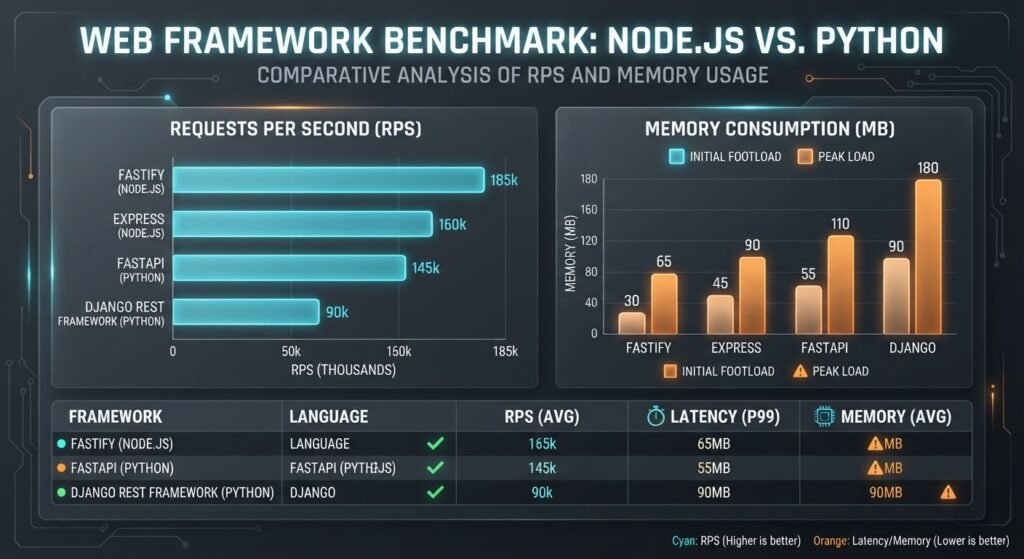
When testing raw HTTP request throughput and JSON serialization speeds, Node.js frameworks often demonstrate higher performance under heavy concurrent I/O loads. However, real-world API performance depends heavily on database query efficiency, external service latencies, and caching strategies Node.js vs Python for Backend APIs: Performance and Scalability Comparison.
┌─────────────────────────────────────────────────────────────────────────────────┐
│                 API REQUEST THROUGHPUT UNDER CONCURRENT LOAD                    │
├───────────────────────┬──────────────────────────┬──────────────────────────────┤
│ FRAMEWORK / RUNTIME   │ ARCHITECTURE             │ AVERAGE THROUGHPUT (REQ/SEC) │
├───────────────────────┼──────────────────────────┼──────────────────────────────┤
│ Node.js (Fastify)     │ Async Non-Blocking       │ ~80,000 – 120,000 req/s     │
│ Node.js (Express)     │ Async Classic            │ ~17,800 – 35,000 req/s     │
│ Python (FastAPI)      │ Async (ASGI / Uvicorn)   │ ~12,500 – 25,000 req/s     │
│ Python (Django WSGI)  │ Synchronous Multi-Process│ ~6,900 – 9,500 req/s        │
└───────────────────────┴──────────────────────────┴──────────────────────────────┘
Note: Benchmarks reflect standardized synthetic load testing (e.g., TechEmpower benchmarks). Actual production performance varies based on application business logic and infrastructure setup.
Scalability and Ecosystem Ecosystem Analysis
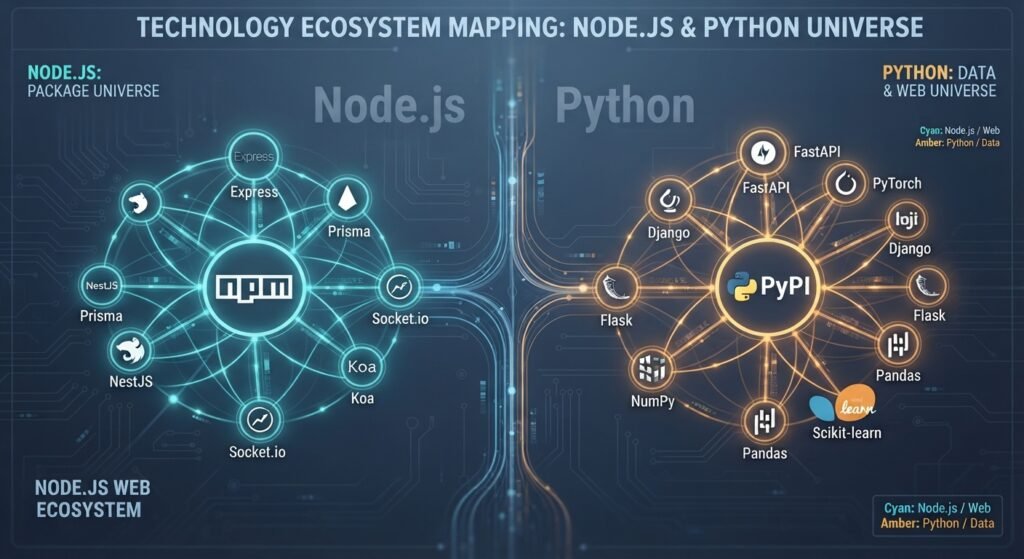
Scalability extends beyond raw execution speed; it includes how effectively a technology stack scales with growing developer teams, complex codebases, and expanding infrastructure.
Node.js: The Full-Stack JavaScript & TypeScript Ecosystem
- Type Safety & DX: Paired with TypeScript, Node.js provides shared type definitions, schema validation (e.g., Zod), and unified data models between React/Next.js frontends and Node.js backends.
- Package Marketplace: The
npmregistry offers the largest collection of third-party open-source libraries worldwide, simplifying integrations with databases, authentication providers, and cloud SDKs. - Real-Time Applications: Built-in support for WebSockets and event streams makes Node.js the go-to runtime for live chat systems, collaborative tools, and IoT data feeds.
Python: The AI, ML, and Data Engineering Powerhouse
- AI & Machine Learning Dominance: Python is the undisputed industry standard for artificial intelligence, machine learning, and advanced analytics. Frameworks like PyTorch, TensorFlow, Pandas, and NumPy run natively in Python environments.
- Clean Code and Maintainability: Python’s “Zen of Python” philosophy emphasizes readable syntax, reducing onboarding friction and long-term maintenance overhead for enterprise software teams.
- Enterprise Web Frameworks: Django offers a mature “batteries-included” ecosystem (built-in ORM, admin dashboard, authentication, security controls), allowing teams to build complex business platforms quickly.
Step-by-Step Decision Framework
Node.js vs Python for Backend APIs: Performance and Scalability Comparison
To determine whether Node.js or Python is the right fit when evaluating Node.js vs Python for backend APIs performance and scalability, follow this four-step selection process:
┌─────────────────────────────────────────────────────────────────────────────────┐
│                      BACKEND SELECTION DECISION FRAMEWORK                       │
├──────────────┬──────────────────┬──────────────────┬────────────────────────────┤
│ STEP 1       │ STEP 2           │ STEP 3           │ STEP 4                     │
│ Identify     │ Evaluate Data    │ Review Team      │ Plan Infrastructure &      │
│ Dominant     │ & AI Requirements│ Skill Set &      │ Deployment Costs           │
│ Workload     │                  │ Frontend Synergy │                            │
└──────────────┴──────────────────┴──────────────────┴────────────────────────────┘
- Classify Your Core Workload: If your API spends most of its lifecycle waiting on network requests, database reads, or third-party webhooks, Node.js provides superior I/O concurrency. If your API performs heavy mathematical computations, PDF generation, or image manipulation, Python handles CPU-bound operations more reliably.
- Determine AI and Data Dependencies: If your product roadmap includes custom machine learning inference, data processing pipelines, or deep AI integrations, choosing Python prevents complex cross-language inter-process communication.
- Assess Team Expertise: Team familiarity often outweighs minor benchmark differences. A well-optimized Python API built by an experienced team will consistently outperform a poorly written Node.js application.
- Evaluate Full-Stack Synergy: If your team already writes React, Vue, or Angular on the client side, adopting Node.js with TypeScript allows developers to work seamlessly across the full stack.
For official runtime documentation and security benchmarks, consult the Official Node.js Documentation and the Python Software Foundation API Reference.
Feature Comparison Matrix
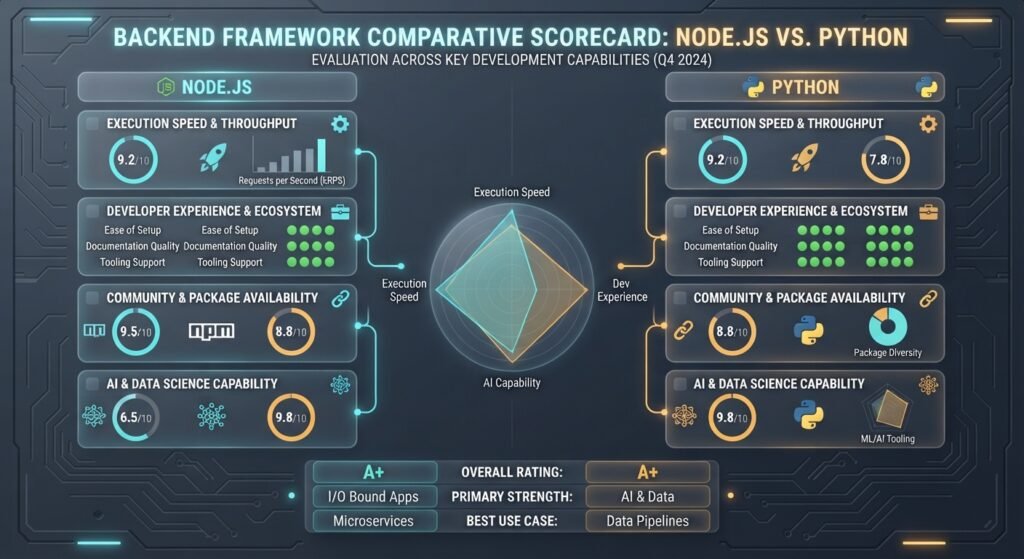
| Criteria | Node.js (V8 Engine) | Python (CPython) | Superior Choice For |
|---|---|---|---|
| I/O Concurrency | Non-blocking event loop | AsyncIO / ASGI loops | Node.js |
| CPU Computation | Thread-blocking on heavy tasks | Multiprocessing & C extensions | Python |
| AI & Machine Learning | Third-party REST wrappers | Native PyTorch, TensorFlow, Pandas | Python |
| Full-Stack Integration | Shared JS/TS code & schemas | Separate backend/frontend boundaries | Node.js |
| Developer Velocity | High (TypeScript + Fastify/NestJS) | Very High (Django / FastAPI) | Tie |
| Real-Time Communication | Native WebSockets & EventStreams | Third-party brokers (Redis/Celery) | Node.js |
Conclusion
Comparing Node.js vs Python for backend APIs performance and scalability reveals that neither runtime is universally superior. Node.js stands out for real-time applications, microservices gateways, and I/O-intensive web APIs where maximizing concurrent request throughput on minimal hardware is essential. Python leads in data-heavy platforms, enterprise automation, and AI-enabled software where development velocity and machine learning integration drive success. By aligning runtime architecture with your product’s core workload, your engineering team can build a fast, scalable backend foundation Node.js vs Python for Backend APIs: Performance and Scalability Comparison
Frequently Asked Questions (FAQs)
Is Node.js always faster than Python for backend APIs performance and scalability?
No. While Node.js generally achieves higher request-per-second throughput for lightweight I/O operations, modern Python async frameworks like FastAPI deliver comparable performance for typical web APIs. Application performance depends heavily on database design, caching layers, and code quality rather than the runtime alone Node.js vs Python for Backend APIs: Performance and Scalability Comparison
Can Node.js and Python be used together in a single application?
Yes. A common microservices strategy uses Node.js as an API gateway to manage incoming client traffic and real-time WebSockets, while offloading complex data analysis or machine learning tasks to dedicated Python microservices.
Which backend stack is easier to scale horizontally in the cloud?
Both runtimes scale horizontally with ease when designed statelessly using container technology (such as Docker and Kubernetes) behind a load balancer. Node js often requires fewer server instances to handle high concurrent connections due to its lower memory footprint per connection Node.js vs Python for Backend APIs: Performance and Scalability Comparison.
Node.js vs Python for Backend APIs: Performance and Scalability Comparison Node.js vs Python for Backend APIs: Performance and Scalability Comparison.
1 thought on “Node.js vs Python for Backend APIs: Performance and Scalability Comparison”