
Manual code reviews are one of the biggest friction points in modern software delivery. As development velocity accelerates, senior engineers spend hours hunting for subtle syntax errors, logic flaws, memory leaks, and security vulnerabilities inside pull requests (PRs).
Integrating the top 10 AI tools for automating code reviews and bug detection allows engineering teams to shift quality assurance and security left—detecting defects in real time before code reaches staging or production environments. Modern AI code review agents go far beyond traditional linters; they analyze full codebase context, enforce security compliance, and generate context-aware automated bug fixes directly within your workflow.
Key Takeaways
- Accelerated Delivery: Implementing the top 10 AI tools for automating code reviews and bug detection reduces PR cycle time by up to 40% while preventing review backlog accumulation.
- Hybrid Defense: Combining LLM-driven contextual reasoning with deterministic SAST (Static Application Security Testing) yields the highest accuracy with minimal false positives.
- Full Context Analysis: Advanced AI code reviewers index entire repositories rather than scanning pull request diffs in isolation, surfacing cross-file architectural bugs.
- Shift-Left Security: Automated scanning flags OWASP Top 10 vulnerabilities, exposed secrets, and unpatched package dependencies before pull requests are merged.
Why Automated AI Code Review is Essential in 2026
Traditional static analysis tools rely on rigid, pre-defined rule sets that miss complex, multi-file business logic defects and generate frustrating volumes of false positives.
Modern generative AI code review platforms solve these limitations by understanding code semantics and intent:
┌────────────────────────────────────────────────────────────────────────┐
│               TRADITIONAL LINTERS VS. AI CODE REVIEW AGENTS            │
├───────────────────────────────┬────────────────────────────────────────┤
│ TRADITIONAL LINITY / SAST     │ AI CODE REVIEW AGENTS                  │
├───────────────────────────────┼────────────────────────────────────────┤
│ Checks syntax & formatting    │ Analyzes business logic & context      │
│ Rigid, rule-based matching    │ Multi-file & repository-wide awareness │
│ High false-positive rate      │ Inline automated one-click bug fixes   │
│ Ignorant of pull request diffs│ Explores PR impact on runtime behavior │
└───────────────────────────────┴────────────────────────────────────────┘
learn Top 10 AI Tools for Automating Code Reviews and Bug Detection
Best For: Automated Pull Request Summaries and Contextual Inline Reviews
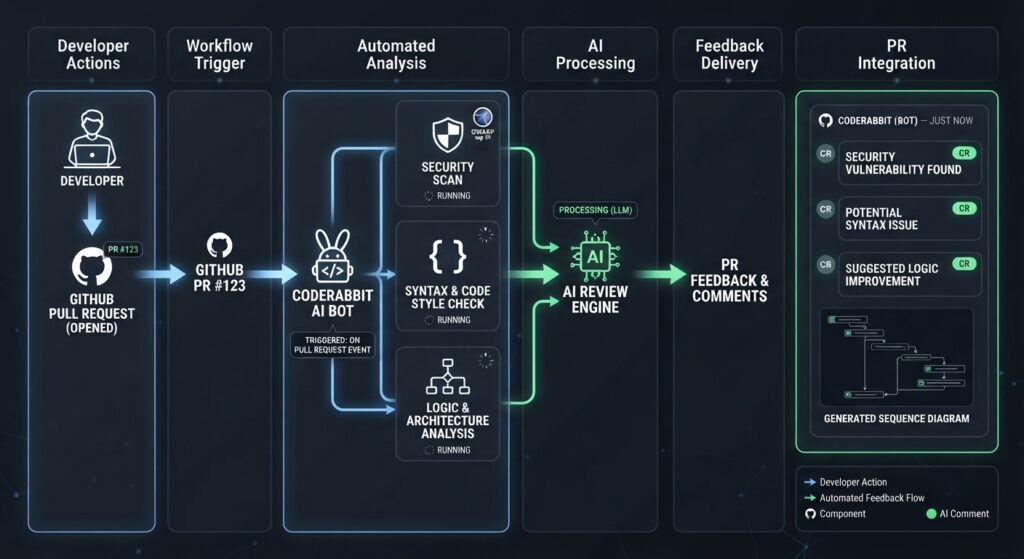
CodeRabbit has established itself as one of the most widely deployed GitHub and GitLab review agents. It operates automatically whenever a developer opens or updates a pull request, providing line-by-line feedback, security auditing, and automated release notes.
- Key Features:
- Context-aware inline PR comments generated via large language models.
- Plain-English configuration files (
.coderabbit.yaml) to enforce team standards. - Automatic generation of pull request summaries, sequence diagrams, and walkthroughs.
- Integrations: GitHub, GitLab, Azure DevOps, Bitbucket.
- Pricing: Free tier for public open-source repos; Pro plans start at $15–$24/user/month.
2. SonarQube (SonarCloud)
Best For: Enterprise Static Analysis, Security Gates, and Technical Debt Management
SonarQube combines traditional static application security testing (SAST) with deep learning engine capabilities to detect vulnerabilities, code smells, and technical debt across 30+ programming languages.
- Key Features:
- Strict quality gate enforcement that automatically blocks non-compliant PRs.
- Deep scanning for OWASP Top 10, CWE, and CVE vulnerabilities.
- AI CodeFix feature providing instant automated remediation suggestions for detected defects.
- Integrations: GitHub, GitLab, Bitbucket, Azure DevOps, Jenkins, CircleCI.
- Pricing: Free Community Edition (self-hosted); Cloud plans billed on Lines of Code (LOC) starting around $150/year.
3. Qodo (formerly CodiumAI)
Best For: Test-Driven Integrity and Automated Test Case Generation
Qodo focuses heavily on code behavior verification and test generation alongside review. It ensures that refactored or newly submitted code maintains full functional integrity without breaking existing application workflows.
- Key Features:
- Qodo Gen & Merge: Dual suites for in-IDE code completion and pull request governance.
- Automated generation of unit tests, integration tests, and edge-case mocks.
- Custom rules engine to enforce organization-wide architectural principles across all repositories.
- Integrations: VS Code, JetBrains, GitHub, GitLab, Bitbucket, Azure DevOps.
- Pricing: Free tier available; Developer and Team plans start at $19–$30/user/month.
4. Greptile
Best For: Full-Repository Contextual Awareness and Cross-File Bug Detection
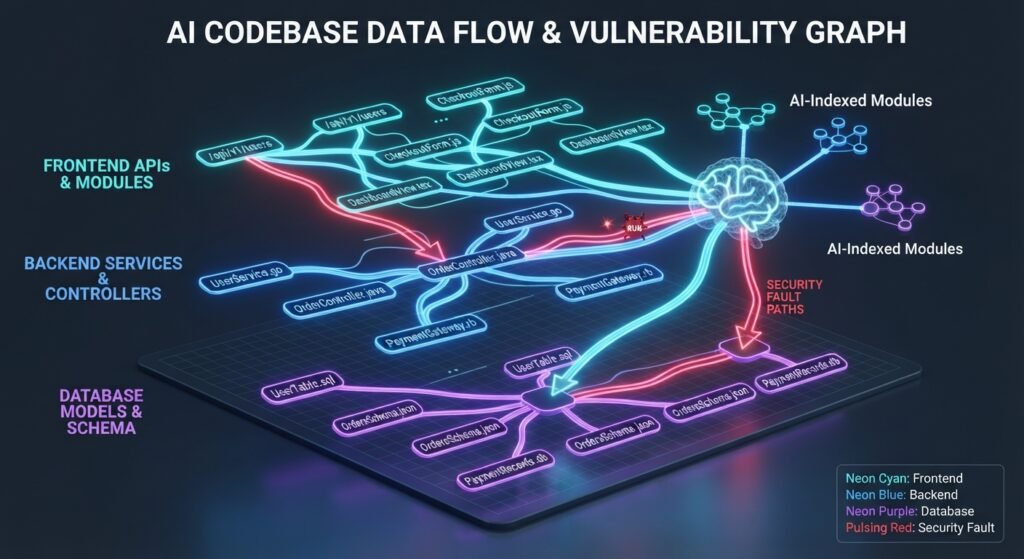
Unlike tools that evaluate code diffs in isolation, Greptile indexes your entire codebase. This deep repository graph enables Greptile to flag hidden breaking changes that occur across distant modules or API interfaces.
- Key Features:
- Full codebase graph index rather than diff-only scanning.
- Natural language querying of full repository architectures.
- Detection of complex architectural regression bugs and broken internal dependencies.
- Integrations: GitHub App, GitLab Cloud, Slack, Discord.
- Pricing: Starts at $30/user/month.
5. Snyk Code
Best For: Real-Time Security Vulnerability and SAST Scanning
Snyk Code uses a developer-first semantic AI engine trained on millions of open-source security patches to flag software vulnerabilities in real time.
- Key Features:
- Instant SAST scanning directly inside the developer’s local IDE environment.
- Real-time matching against OWASP, SANS Top 25, and CVE databases.
- Inline, developer-friendly remediation explanations and one-click code patches.
- Integrations: VS Code, JetBrains, GitHub, GitLab, Bitbucket, CircleCI, AWS CodePipeline.
- Pricing: Free tier (100 tests/month); Team plans start at $25/user/month.
6. GitHub Copilot Code Review
Best For: Native GitHub Workspace Integration and Low-Friction PR Feedback
GitHub Copilot Code Review expands GitHub’s native ecosystem by bringing AI review capabilities directly into the pull request tab.
- Key Features:
- Native integration requiring zero external app or token setups.
- Automated suggestions for code optimizations, refactoring, and readability improvements.
- Integrated security vulnerability scanning via GitHub Advanced Security.
- Integrations: GitHub Enterprise, GitHub.com, VS Code, Visual Studio.
- Pricing: Included with GitHub Copilot Business ($19/user/month) and Enterprise ($39/user/month) tiers.
7. DeepSource
Best For: Low False-Positive Static Analysis and Automated Code Refactoring
DeepSource combines static analysis engines with transformer-based AI models to analyze code for bug risks, performance bottlenecks, and style inconsistencies while maintaining an extremely low false-positive rate.
- Key Features:
- Autofix: Automatically generates and submits pull requests to patch discovered issues.
- Comprehensive coverage across Python, Go, JavaScript, TypeScript, Ruby, and Java.
- Continuous tracking of technical debt metrics and test coverage degradation.
- Integrations: GitHub, GitLab, Bitbucket.
- Pricing: Free tier for open-source and individual developers; Business tier starts at $12–$15/committer/month.
8. Cursor BugBot
Best For: AI-Native IDE Refactoring and Integrated Codebase Auditing
Built directly into the Cursor editor (a fork of VS Code), BugBot indexes local files and workspace history to catch defects while developers edit code.
- Key Features:
- Real-time background scanning as you type without waiting for CI builds.
- Deep multi-file refactoring engine that automatically updates dependent modules.
- Direct synchronization with GitHub Pull Requests.
- Integrations: Cursor IDE, GitHub.
- Pricing: Bundled within Cursor Pro ($20/month) or Business ($40/month) subscriptions.
9. Amazon Q Developer (formerly CodeWhisperer)
Best For: AWS Cloud Security, IAM Policy Verification, and Enterprise Architecture
Amazon Q Developer is specifically engineered for cloud development teams building microservices on AWS infrastructure. It checks code for application-level logic flaws and cloud security misconfigurations.
- Key Features:
- Specialized security scanning for IAM roles, S3 bucket permissions, and AWS CDK infrastructure code.
- Automated code transformation agents that upgrade legacy frameworks (e.g., Java version migrations).
- High-level architectural remediation guidance based on the AWS Well-Architected Framework.
- Integrations: JetBrains, VS Code, AWS Cloud9, AWS Management Console.
- Pricing: Free Individual tier; Pro tier starts at $19/user/month.
10. Codacy
Best For: Centralized Code Quality Metrics and Multi-Repository Governance
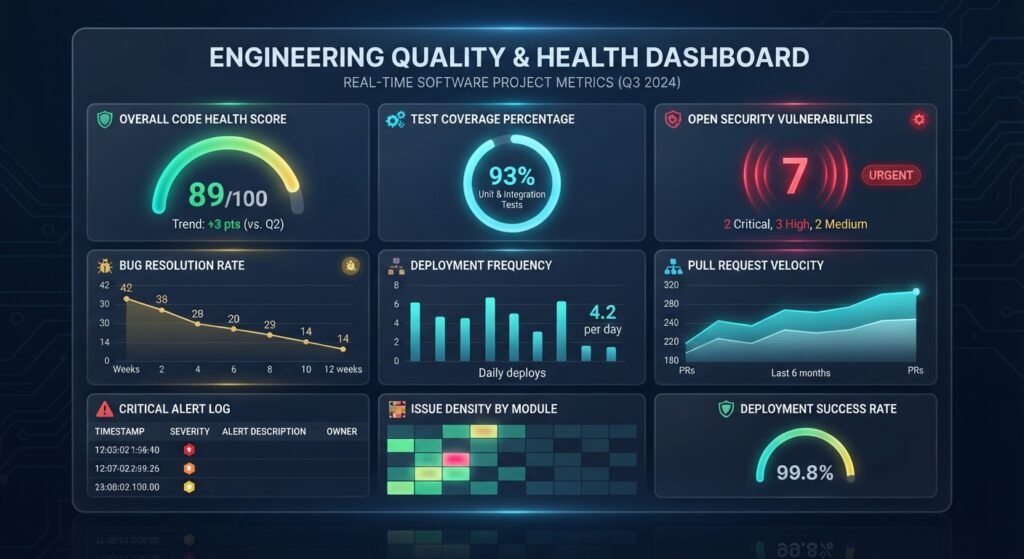
Codacy offers centralized monitoring for engineering leaders who need standardized code quality metrics, coverage reports, and security tracking across hundreds of repositories.
- Key Features:
- AI-powered PR analysis combined with coverage tracking across 40+ programming languages.
- Custom security rules and automated enforcement across all team repositories.
- Executive analytics dashboards tracking engineering throughput and code churn metrics.
- Integrations: GitHub, GitLab, Bitbucket.
- Pricing: Free tier for open source; Pro plans start at $15/user/month.
Side-by-Side Comparison Matrix
| Tool | Core Specialization | Context Depth | Free Tier | Starting Price |
| CodeRabbit | PR Commentary & Summaries | Diff + Linked Repos | Yes (Public repos) | $15–$24/user/mo |
| SonarQube | SAST & Quality Gates | Full Codebase | Yes (Community) | ~$150/yr (LOC based) |
| Qodo | Test Generation & Integrity | Full Codebase | Yes | $19–$30/user/mo |
| Greptile | Multi-file Architectural Bugs | Full Codebase Index | No | $30/user/mo |
| Snyk Code | Vulnerability & SAST Auditing | Semantic Context | Yes (100 scans/mo) | $25/user/mo |
| GitHub Copilot | Native GitHub PR Reviews | Diff Context | No | $19–$39/user/mo |
| DeepSource | Automated PR Fixes (Autofix) | Full Repository | Yes | $12/committer/mo |
| Cursor BugBot | IDE-Native Refactoring | Full Workspace Index | No | $20–$40/user/mo |
| Amazon Q | AWS Security & Upgrades | Cloud & App Scope | Yes | $19/user/mo |
| Codacy | Quality Metrics & Compliance | Multi-Repo Scope | Yes | $15/user/mo |
How to Choose the Right AI Code Review Tool for Your Team
Selecting among the top 10 AI tools for automating code reviews and bug detection depends on your primary engineering goals:
- For Fast-Moving Startups Needing Instant PR Reviews: Choose CodeRabbit or Qodo for frictionless GitHub/GitLab integration and plain-English PR feedback.
- For Security and Compliance-Heavy Enterprises: Deploy SonarQube alongside Snyk Code to enforce strict CI/CD quality gates and OWASP vulnerability policies.
- For Large Monorepos and Complex Architectures: Opt for Greptile to leverage full codebase contextual indexing and catch cross-service logic regressions.
- For AWS Cloud-Native Teams: Leverage Amazon Q Developer to identify infrastructure-as-code misconfigurations and IAM risks.
Conclusion
Integrating the top 10 AI tools for automating code reviews and bug detection into your development workflow transforms how engineering teams build software. By combining automated real-time vulnerability detection with generative AI contextual reviews, your team can maintain high code quality standards while significantly reducing time-to-market. Evaluate these platforms against your team’s size, security requirements, and primary tech stack to select the ideal AI code review solution today.
Frequently Asked Questions (FAQs)
Can the top 10 AI tools for automating code reviews and bug detection replace human software reviewers?how to learn Top 10 AI Tools for Automating Code Reviews and Bug Detection
No. While AI tools excel at flagging syntax errors, security vulnerabilities, and logic flaws at scale, they cannot replace human judgment regarding high-level business goals, product requirements, and system design choices.
How do AI code review tools handle private repository privacy and security?
Leading enterprise AI code review platforms comply with strict security standards like SOC 2 Type II and GDPR. They operate using zero-data-retention policies, ensuring your proprietary source code is never used to train public machine learning models.
What is the difference between an AI code review agent and a traditional linter?
Traditional linters use static, pre-defined formatting rules (e.g., checking tabs vs. spaces or missing semicolons). AI code review agents analyze semantic intent, business logic flows, and cross-file relationships to identify complex architectural defects and generate automated patch suggestions.
Top 10 AI Tools for Automating Code Reviews and Bug DetectionTop 10 AI Tools for Automating Code Reviews and Bug Detection Top 10 AI Tools for Automating Code Reviews and Bug Detection
1 thought on “Top 10 AI Tools for Automating Code Reviews and Bug Detection”